

India’s automotive market is seeing strong demand alongside changing buyer preferences. Passenger vehicle sales reached 4.58 lakh units in July 2026, growing 34.3% year-on-year, while utility vehicles now account for around 68% of passenger vehicle sales.
However, overall sales growth does not fully explain what customers are choosing and why. A Vehicle consumer demand analysis can help automotive businesses understand how price, powertrain, body style, features, brand perception, and ownership costs influence vehicle purchase decisions.
Understanding the Evolving Buyer Preferences
The vehicle buyers are looking for more than just an affordable and reliable mode of transportation. Their decisions are increasingly shaped by lifestyle needs, technology expectations, safety considerations, and overall ownership experience. Some key shifts in buyer behavior include:
- Growing preference for SUVs and utility vehicles, driven by higher seating position, spacious interiors, and suitability for diverse driving conditions. Utility vehicles now account for nearly 68% of passenger vehicle sales in India.
- Higher demand for feature-rich vehicles, with buyers increasingly valuing features such as sunroofs, connected-car technologies, and advanced driver assistance systems (ADAS). Hyundai reported that over half of its domestic sales came from sunroof-equipped vehicles, while demand for ADAS-enabled variants continued to rise.
- Greater emphasis on safety and technology, as consumers actively consider features such as multiple airbags, parking assistance, 360-degree cameras, and connected mobility solutions when making purchase decisions.
These trends highlight why understanding buyer preferences has become increasingly important for automotive businesses.
What Buyers Are Actually Looking for?
Vehicle demand is becoming increasingly segmented, requiring manufacturers to understand not only how many vehicles consumers may buy but also what configurations they prefer:
- Price sensitivity: Understand customer budgets, affordability thresholds, financing preferences, and willingness to pay.
- Powertrain demand: Assess preferences across petrol, diesel, CNG, hybrid, and electric vehicles based on customer requirements and usage.
- Body-style preference: Evaluate demand across hatchbacks, sedans, SUVs, MPVs, and other vehicle formats.
- Feature preference: Identify the safety, connectivity, comfort, infotainment, and convenience features that influence purchase decisions.
- Customer segmentation: Understand how preferences vary across age groups, income levels, geographies, household profiles, and vehicle usage.
Nexdigm connects these dimensions through a Vehicle consumer demand analysis, providing a structured view of customer needs, purchase drivers, emerging preferences, and market opportunities.
Nexdigm’s Approach to Vehicle Consumer Demand Analysis
Nexdigm takes a structured approach to understanding vehicle demand by combining market data, consumer research, competitive benchmarking, product analysis, and demand assessment.
- Market & Consumer Segmentation: Segment the market by geography, income, age, ownership profile, vehicle usage, price band, and other relevant consumer characteristics.
- Purchase Driver Assessment: Evaluate the importance of price, brand, design, mileage, safety, technology, financing, service availability, and ownership costs in purchase decisions.
- Product Preference Analysis: Assess consumer preferences across powertrains, body styles, vehicle sizes, features, technologies, and configurations.
- Competitive Benchmarking: Compare competing vehicles across pricing, specifications, features, positioning, ownership costs, and customer perceptions to identify market gaps.
- Demand & Product Roadmap: Prioritize customer segments, vehicle configurations, features, powertrains, and price points based on demand potential, competitive intensity, and commercial attractiveness.
Through a Vehicle consumer demand analysis, Nexdigm helps automotive businesses understand what buyers value, identify changing preferences, refine product positioning, prioritize vehicle features, and develop offerings aligned with evolving market demand.
Benefits of Nexdigm’s Vehicle Consumer Demand Analysis
By providing deeper visibility into customer preferences and purchase drivers, Nexdigm helps automotive businesses:
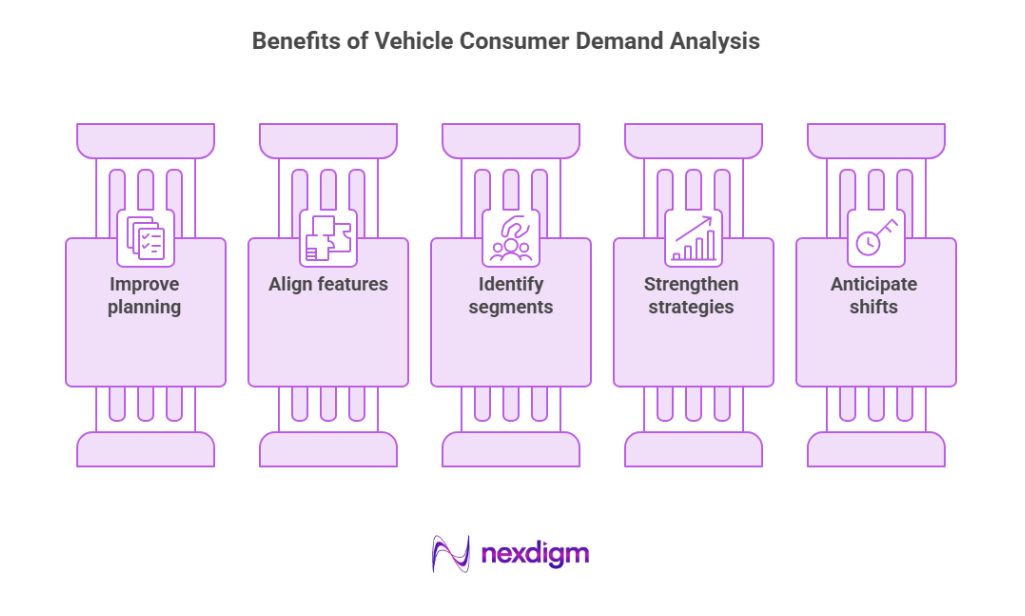
- Improve product and portfolio planning
- Align vehicle features with customer expectations
- Identify high-potential customer segments
- Strengthen pricing and positioning strategies
- Anticipate shifts in powertrain and technology demand
With a structured understanding of evolving buyer preferences, businesses can make more informed product, marketing, and investment decisions while staying aligned with changing market demand.
Business Impact by Nexdigm’s Expertise
By turning consumer insights into actionable recommendations, Nexdigm helps automotive businesses make more confident product, pricing, and market decisions. This enables manufacturers to better align vehicle offerings with customer expectations, capture emerging demand opportunities, strengthen competitive positioning, and improve the effectiveness of future investments and go-to-market strategies.
Nexdigm’s Case
Nexdigm assisted an automotive player in assessing consumer demand as passenger vehicle sales reached 4.64 million units in FY2025–26. The study evaluated price, powertrain, body-style, and feature preferences, helping identify priority customer segments, attractive vehicle configurations, and opportunities for stronger market positioning.
To take the next step, simply visit our Request a Consultation page and share your requirements with us.
Harsh Mittal
+91-8422857704