

The global vehicle demand exceeding 100 million units annually has significant implications for competitive intelligence services. It emphasizes the need for businesses to monitor market trends, consumer preferences, and economic conditions across different regions to ensure they can meet growing demand. Competitive intelligence services enable companies to track these shifts and adjust strategies accordingly.
As demand rises, companies must optimize production, inventory, and pricing strategies. Competitive intelligence helps businesses stay ahead by analyzing competitor performance, forecasting demand, and identifying new market opportunities to ensure sustainable growth.
Vehicle demand forecasting, as per competitive intelligence services, involves analyzing market trends, consumer preferences, economic factors, and competitor strategies to predict future vehicle demand. It helps automotive companies make informed decisions on production, inventory management, pricing, and marketing strategies, ensuring they meet customer needs while optimizing resources and profitability.
Effectiveness of Competitive Intelligence Services on Global Vehicle Demand
With global vehicle demand expected to exceed 100 million units annually, competitive intelligence services play a critical role in helping businesses make data-driven decisions, optimize strategies, and maintain competitive advantage in the automotive market.
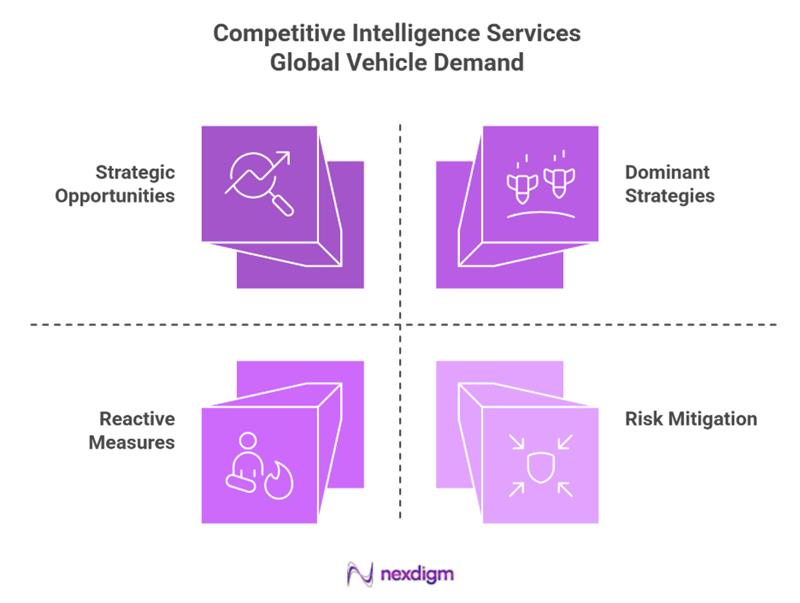
1. Enhanced Market Understanding
Competitive intelligence helps businesses analyze global demand trends, providing insights into regional variations, consumer preferences, and market dynamics, enabling informed decisions to align strategies with demand shifts.
2. Improved Decision-Making
By leveraging market intelligence, companies can make strategic decisions on production, pricing, and inventory management, ensuring that they can scale operations effectively in line with the increasing global demand.
3. Competitive Advantage
Competitive intelligence services help businesses understand competitors’ strengths, weaknesses, and market positioning. This knowledge enables them to identify opportunities, adapt quickly, and outperform rivals as demand surges globally.
4. Effective Risk Management
These services allow businesses to forecast potential risks associated with global demand growth, such as supply chain disruptions or regulatory changes, helping them proactively mitigate risks and maintain stability.
5. Optimized Resource Allocation
By analyzing data on demand patterns, competitive intelligence helps companies allocate resources efficiently, ensuring that production, distribution, and marketing efforts are focused on the most profitable markets and segments.
Objectives of Nexdigm’s Competitive Intelligence Services on Global Vehicle Demand
Nexdigm provides competitive intelligence services to help businesses capitalize on the expected rise in global vehicle demand. These objectives support strategic decision-making to ensure growth, competitiveness, and operational efficiency.
1. Demand-Supply Alignment
Nexdigm assists businesses in aligning production capacity with global demand forecasts, helping to ensure that supply levels match market needs, preventing both shortages and overproduction.
2. Competitive Market Insights
Nexdigm provides insights into competitor strategies, enabling companies to benchmark their own performance and adjust offerings to gain a competitive edge in an expanding global market.
3. Consumer Behavior Analysis
By analyzing consumer preferences and purchasing trends, Nexdigm helps businesses tailor their product development and marketing strategies to better align with shifting demand patterns across regions.
4. Regional Market Optimization
Nexdigm identifies regions with the highest demand growth, helping companies optimize regional strategies, adjust product offerings, and fine-tune marketing tactics to capture new market opportunities effectively.
5. Profitability Enhancement
By analyzing pricing and sales data, Nexdigm helps businesses optimize their pricing strategies to balance competitive positioning and profitability, ensuring businesses remain cost-effective while addressing rising demand.
6. Forecasting Supply Chain Challenges
Nexdigm predicts potential supply chain disruptions based on demand growth, allowing businesses to proactively manage risks, optimize logistics, and ensure timely delivery to meet global vehicle demand.
Nexdigm’s Case:
Nexdigm’s competitive intelligence enabled an OEM to align production with rising global demand, improving forecast accuracy by 18%, reducing inventory costs by 12%, and supporting plans for over 100-million-unit market growth.
To take the next step, simply visit our Request a Consultation page and share your requirements with us.
Harsh Mittal
+91-8422857704