

Distributor partnerships play a crucial role in automotive markets with complex supply chains, fragmented retail networks, regional demand differences, and varied regulatory requirements. For automotive brands entering such markets, distributors help manage inventory movement, dealer coordination, logistics, local compliance, pricing execution, and after-sales support.
A strong market entry strategy helps companies evaluate distributor’s capabilities, territory coverage, financial strength, service infrastructure, and alignment with brand standards before forming partnerships. An effective Vehicle distributor partnership strategy enables brands to reduce entry risks, improve regional reach, strengthen supply reliability, and build scalable retail operations in competitive automotive markets.
Worldwide, the car registrations rose 3.5% in 2025 to 77.6 million units, reflecting large-scale demand across regions. At the same time, the global automotive logistics market was valued at around USD 249.2 billion in 2025 and is projected to reach USD 460.2 billion by 2033, showing the scale of supply chain coordination needed for vehicle distribution.
Assessing Distributor Capability Across Complex Automotive Supply Chains
Assessing distributor capability involves reviewing logistics strength, warehousing capacity, dealer reach, inventory management, financial stability, compliance readiness, after-sales support, and ability to manage complex automotive supply chains:
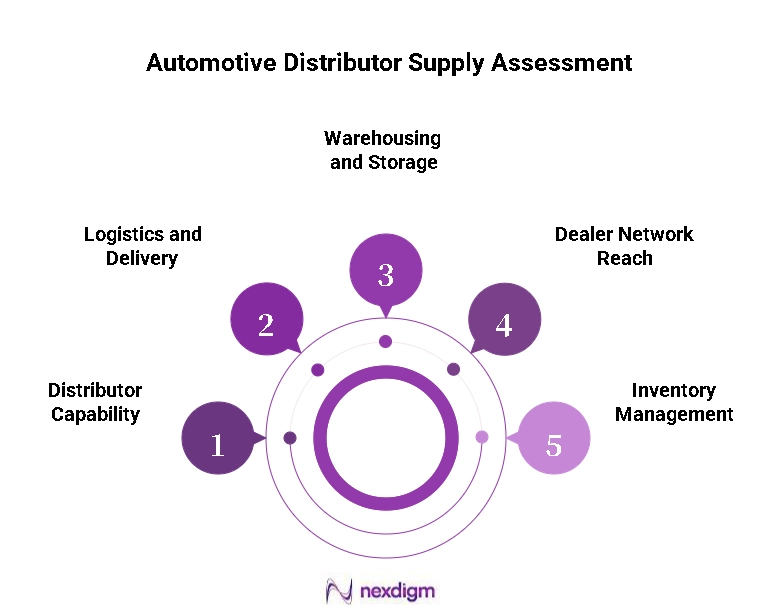
- Logistics and Delivery Strength: Assess distributor ability to manage vehicle movement, delivery timelines, route planning, and regional supply chain coordination.
- Warehousing and Storage Capacity: Review storage facilities, stock handling systems, safety standards, vehicle protection, and readiness for inventory scale-up.
- Dealer Network Reach: Evaluate distributor access to dealers, regional retailers, service points, and customer-facing automotive sales channels.
- Inventory Management Capability: Assess stock planning, demand forecasting, vehicle allocation, replenishment cycles, and real-time inventory visibility.
Nexdigm’s Advisory Support for Distributor-Led Automotive Operations
Nexdigm’s advisory support for distributor-led automotive operations helps companies manage market entry through reliable distributor partnerships. This includes assessing distributor capability, dealer reach, logistics readiness, inventory systems, pricing execution, compliance processes, and after-sales coordination. Nexdigm supports companies in reducing channel risks, improving operational control, and building scalable distribution networks across complex automotive markets.
Nexdigm’s Distributor Identification and Capability Assessment for Automotive Market Entry
Nexdigm’s distributor identification and capability assessment helps automotive companies shortlist suitable distributors by evaluating market reach, logistics strength, dealer access, financial stability, compliance readiness, and after-sales support.
- Market Reach Assessment: Nexdigm evaluates distributor presence across priority regions, city clusters, sales territories, and high-potential automotive demand pockets.
- Logistics Capability Review: Nexdigm assesses transportation capacity, delivery reliability, warehousing support, inventory movement, and supply chain coordination capabilities.
- Dealer Access Evaluation: Nexdigm reviews distributor relationships with dealers, retailers, service centers, fleet operators, and regional automotive sales channels.
- Financial Stability Assessment: Nexdigm evaluates working capital strength, creditworthiness, investment capacity, margin expectations, and ability to support expansion.
- Compliance and Service Readiness: Nexdigm reviews licensing, documentation, regulatory knowledge, warranty support, spare parts handling, and after-sales service coordination.
Nexdigm’s case:
Nexdigm supported a commercial vehicle manufacturer facing uneven regional coverage and delayed stock movement in a new market. Instead of appointing a single national distributor, Nexdigm assessed a hub-and-spoke distribution model across priority zones. The review covered warehousing capacity, parts availability, dealer servicing gaps, and distributor working capital. This helped the company improve projected stock availability by 25%, reduce expected delivery delays by 18%, and shortlist partners covering nearly 70% of target regional demand.
To take the next step, simply visit our Request a Consultation page and share your requirements with us.
Harsh Mittal
+91-8422857704