

Vehicle exports provide an important view of how automotive production and demand are connected across countries. Global vehicle production reached 96.4 million units in 2025, while global sales reached nearly 99.8 million vehicles, according to OICA. China produced around 34.5 million vehicles, making it the world’s largest production base, while India produced approximately 6.5 million.
At the same time, electric vehicles are becoming an increasingly important part of international trade, with China exporting more than 2.5 million electric cars in 2025. These developments make vehicle export volume tracking useful for identifying leading export hubs, changing model demand, destination markets, and opportunities for automotive businesses.
Export Volumes Can Reveal More Than Production Scale
A country with rising vehicle exports may be strengthening its manufacturing position, gaining access to new markets, or responding to changing domestic demand. Comparing export volumes with production, model categories, destination markets, and supplier activity can reveal whether growth is broad-based or concentrated in specific vehicle segments. Tracking these movements also helps businesses understand which production hubs are becoming more relevant to global automotive supply chains.
Destination Markets Can Signal Expansion Opportunities
Export destinations provide another perspective on changing automotive demand. New markets can indicate successful market entry, changing consumer preferences, competitive pricing, or growing demand for specific vehicle types. Meanwhile, declining exports to established destinations may reflect stronger local production, regulatory changes, or shifts in consumer preferences. Monitoring destination-level movements therefore helps businesses identify both emerging opportunities and markets requiring closer attention.
Nexdigm’s Role in Reading Vehicle Export Markets
Changing export destinations can reveal where automotive demand is developing, but businesses need deeper context to understand what those movements mean commercially. Nexdigm connects export data with market and competitive signals to:
- Interpret Export Demand: Analyze destination growth, vehicle segments, and import activity to identify markets where demand is strengthening, and export opportunities are becoming more attractive.
- Connect Production and Markets: Link export hubs with manufacturing capacity, supplier ecosystems, and destination requirements to understand which production locations are gaining strategic importance.
- Prioritize Expansion Markets: Compare demand, competition, regulations, and trade conditions to identify destinations offering stronger potential for market entry and export growth.
This approach helps businesses move beyond tracking export volumes to understand which market movements warrant strategic attention and action.
How Nexdigm Transforms Export Signals into Market Insights
Export volumes show where vehicles are moving, but they do not necessarily explain the commercial reasons behind those movements. Nexdigm adds context by connecting export data with production, vehicle demand, market conditions, competitive activity, and trade dynamics to gather insights about:
- What Is Driving Export Growth: Nexdigm compares export movements with production capacity, manufacturer activity, model launches, and overseas demand to determine whether growth reflects sustainable market expansion or a temporary shift.
- Where Demand Is Strengthening: Destination-level analysis examines import growth, registrations, vehicle segments, and buyer activity to identify markets where demand can support continued export opportunities.
- Market Expansion Conditions: Nexdigm considers competition, pricing, tariffs, regulations, infrastructure, and market access to determine whether rising export volumes translate into commercially attractive opportunities.
- Export Signals with Competitive Positioning: Manufacturer participation, model performance, and destination coverage are assessed to understand how companies are gaining or losing ground across international markets.
By bringing these signals together, Nexdigm transforms vehicle export volume tracking from a measurement exercise into a strategic assessment, helping businesses determine where to focus market-entry, export, product, and expansion decisions.
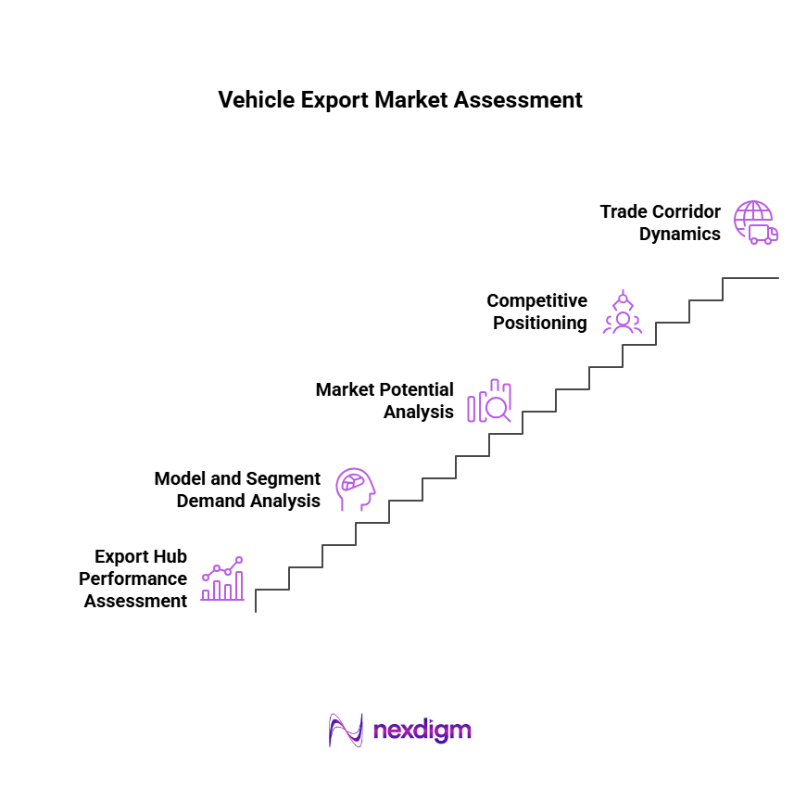
Key Areas Nexdigm Assesses Across Vehicle Export Markets
Nexdigm evaluates export movements across interconnected dimensions to determine where growth is occurring, what is driving it, and which markets or vehicle segments offer the strongest commercial potential. These dimensions are:
- Export Hub Performance: Assessment of export volumes, growth rates, production capacity, manufacturers, and origin markets to identify established and emerging vehicle-export hubs.
- Model and Segment Demand: Examination of vehicle categories, models, powertrains, and destination-level performance to identify products gaining stronger international demand.
- Destination-Market Potential: Analysis of import growth, registrations, competition, pricing, regulations, and market access to assess the attractiveness of individual export destinations.
- Competitive Positioning: Tracking of manufacturer participation, market shares, product activity, and changing supplier relationships to understand shifts in competitive strength.
- Trade Corridor Dynamics: Evaluation of origin-destination relationships, logistics, transportation routes, and changing trade volumes to identify emerging corridors and market dependencies.
These focused areas provide the foundation for a structured vehicle export volume tracking assessment, helping businesses connect export movements with actionable market and growth opportunities.
Nexdigm’s Case
Nexdigm supported an automotive-sector client in assessing export-market performance, where the analysis identified more than 35% growth in selected export corridors, while three destination markets recorded over 20% growth in vehicle imports. The assessment also found that two vehicle segments accounted for nearly 45% of the client’s export opportunity, helping the client prioritize markets and models for expansion.
To take the next step, simply visit our Request a Consultation page and share your requirements with us.
Harsh Mittal
+91-8422857704