

In price-sensitive and competitive automotive markets, a strong vehicle launch strategy for new markets is essential for improving customer adoption and building early brand acceptance. Successful launches depend on understanding buyer affordability, competitor pricing, product positioning, distribution reach, and local consumer preferences.
A well-planned market entry strategy helps automakers introduce vehicles at the right price, communicate clear value, and reduce barriers to purchase. By aligning features, financing options, promotions, and after-sales support with market expectations, vehicle launch strategies can increase trust, accelerate adoption, and improve long-term success in markets where customers compare value, reliability, and affordability carefully.
Global vehicle sales reached around 88.2 million units in 2025, reflecting a 1.7% increase from 2024. EV adoption also accelerated, with electric car sales crossing 17 million units globally in 2024, up more than 25%, while China alone exceeded 11 million EV sales.
Assessing Competitive Pricing Strategy for New Vehicle Launches
Assessing Competitive Pricing Strategy for New Vehicle Launches helps automakers set attractive prices by analyzing competitor models, customer affordability, production costs, perceived value, financing options, and expected market demand.
- Competitor Price Benchmarking: Compares rival vehicle prices, variants, features, and discounts to identify a suitable launch price range.
- Customer Affordability Analysis: Studies buyer income, financing needs, and price sensitivity to ensure the vehicle matches market purchasing capacity.
- Cost and Margin Evaluation: Reviews production, logistics, taxes, and dealer margins to set prices that remain profitable and competitive.
- Value-Based Pricing: Aligns price with perceived benefits such as safety, mileage, technology, comfort, warranty, and brand trust.
Nexdigm’s Vehicle Positioning Strategy for Competitive Market Adoption
Nexdigm Vehicle Positioning Strategy for Competitive Market Adoption helps automotive companies define how a new vehicle should stand out in price-sensitive and competitive markets. It focuses on customer needs, competitor offerings, pricing, features, ownership cost, and brand messaging. By aligning the vehicle’s value proposition with buyer expectations, Nexdigm supports stronger market acceptance, faster adoption, and improved launch success.
Nexdigm’s Customer Affordability and Demand Analysis for Automotive Markets
Nexdigm’s Customer Affordability and Demand Analysis for Automotive Markets evaluates buyer income, financing capacity, price sensitivity, regional demand, and ownership costs to help automotive brands launch vehicles aligned with customer expectations:
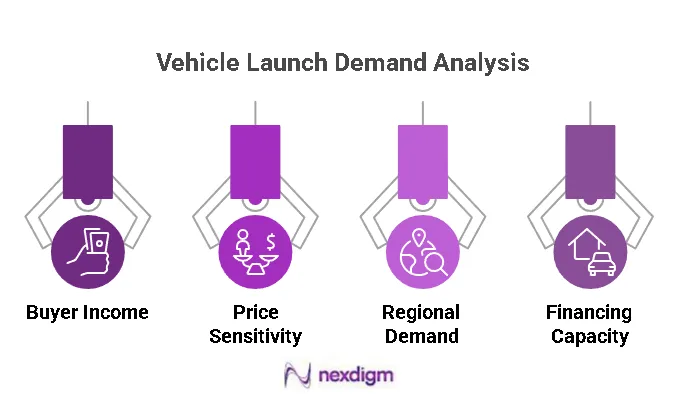
- Buyer Income Assessment: Nexdigm studies income levels and spending capacity to understand whether target customers can afford the launched vehicle.
- Price Sensitivity Analysis: Nexdigm evaluates how customers respond to price changes, discounts, financing options, and ownership cost differences.
- Regional Demand Mapping: Nexdigm identifies high-potential locations by studying vehicle demand, customer preferences, competition, and local purchasing behavior.
- Financing Capacity Review: Nexdigm assesses loan eligibility, EMI affordability, down-payment ability, and credit access for target customer groups.
Nexdigm’s case:
Nexdigm’s Vietnam Auto Finance Market Outlook to 2030 highlights how affordability support influences vehicle adoption. The market was valued at USD 6.45 billion in 2024 and is projected to grow at a 12.12% CAGR from 2024 to 2030, driven by rising disposable incomes, vehicle ownership, and wider loan availability. This supports the need for financing-led launch strategies in price-sensitive automotive markets.
To take the next step, simply visit our Request a Consultation page and share your requirements with us.
Harsh Mittal
+91-8422857704