

Benchmarking vehicle parts pricing across OEM and independent supplier networks helps companies understand price differences, cost structures, and market competitiveness across the automotive aftermarket. A vehicle parts pricing benchmark study compares OEM-listed prices with independent supplier rates for components such as sensors, brakes, electronic modules, and body parts. Through pricing analysis, businesses can identify pricing gaps, margin opportunities, supplier inefficiencies, and customer value expectations.
This approach supports better pricing decisions, stronger negotiation strategies, and improved profitability. As vehicle complexity increases, benchmarking becomes essential for maintaining competitive and transparent pricing across both branded and independent parts networks.
The global automotive aftermarket is estimated at USD 464.83 billion in 2025 and projected to reach USD 555.82 billion by 2030, growing at 3.64% CAGR. The independent aftermarket alone is expected to grow from USD 299.08 billion in 2025 to USD 418.29 billion by 2030. These figures highlight the need for pricing analysis in every vehicle parts pricing benchmark study.
Margin Analysis Across OEM and Aftermarket Channels
Margin analysis across OEM and aftermarket channels evaluates profitability differences by comparing production costs, selling prices, supplier margins, and customer demand. Pricing analysis helps optimize pricing strategies, improve competitiveness, and maximize returns across both distribution channels.
-
OEM Channel Margin Review
Assesses OEM part pricing, warranty costs, and brand premiums to understand profitability across authorized distribution channels.
-
Aftermarket Margin Comparison
Compares independent supplier prices, discounts, and cost structures to identify competitive margin opportunities.
-
Cost-to-Price Evaluation
Analyzes production, logistics, and selling costs against final prices to measure margin strength.
-
Price Gap Assessment
Identifies differences between OEM and aftermarket prices to support better pricing analysis.
Nexdigm’s Profitability Optimization for Vehicle Parts
Nexdigm’s profitability optimization for vehicle parts helps companies compare OEM and independent supplier pricing, analyze cost-to-price gaps, and identify margin improvement opportunities. Through pricing analysis, Nexdigm supports better supplier negotiations, channel-wise pricing decisions, discount controls, and profitability strategies across vehicle parts networks.
Nexdigm’s Data-Driven Margin Improvement Strategy Across Vehicle Parts Networks
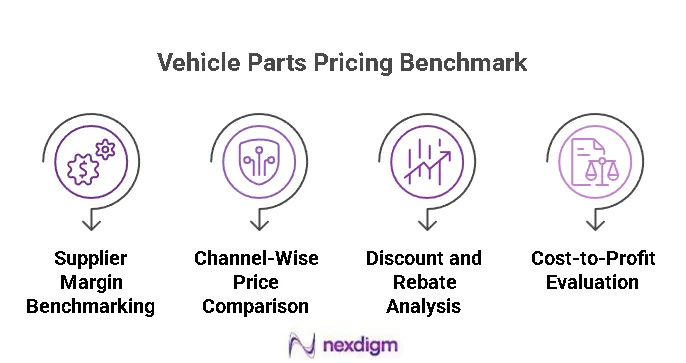
Nexdigm’s data-driven margin improvement strategy uses pricing analysis, supplier benchmarks, cost data, and channel comparisons to identify margin gaps, improve pricing decisions, optimize discounts, and strengthen vehicle parts profitability:
-
Supplier Margin Benchmarking
Compares supplier margins across OEM and aftermarket networks to identify pricing gaps and profit improvement opportunities.
-
Channel-Wise Price Comparison
Reviews prices across authorized dealers, distributors, and independent suppliers to support better pricing decisions.
-
Discount and Rebate Analysis
Assesses discount patterns, rebates, and incentives to reduce revenue leakage and improve margin control.
-
Cost-to-Profit Evaluation
Analyzes procurement, logistics, and selling costs against profits to strengthen vehicle parts profitability.
Nexdigm’s case:
Nexdigm helped a vehicle parts distributor benchmark pricing across 8 OEM and 15 independent supplier networks. Through pricing analysis, Nexdigm identified a 12% margin gap, reduced excessive discounts by 7%, and improved supplier negotiation terms. This helped the company increase channel profitability by 9%.
To take the next step, simply visit our Request a Consultation page and share your requirements with us.
Harsh Mittal
+91-8422857704