

Evaluating pricing competitiveness across automotive brands is essential in markets driven by value-conscious buyers who compare multiple options before purchasing. A vehicle pricing competitiveness study helps assess how different brands position their vehicles in terms of price, features, incentives, and perceived value. Through pricing analysis, automakers can understand competitor pricing strategies, identify gaps in affordability, and evaluate how pricing influences customer choice.
This process supports better segmentation, stronger positioning, and improved market responsiveness. By continuously analyzing pricing competitiveness, automotive brands can refine their strategies, enhance value perception, and remain relevant in highly competitive markets where price sensitivity strongly influences demand and sales outcomes.
Global automotive markets exceeding 90 million annual vehicle sales demonstrate strong price-based competition, especially among value-conscious buyers who compare multiple brands before purchasing. Studies show that even a 5–10% price difference can significantly shift demand across similar vehicle categories, particularly in entry-level and mid-segment segments.
Evaluating Competitor Pricing Strategies Through Pricing Analysis
Pricing analysis helps evaluate competitor pricing strategies by comparing vehicle prices, incentives, and positioning. It identifies gaps, improves competitiveness, and supports better pricing decisions in automotive markets:
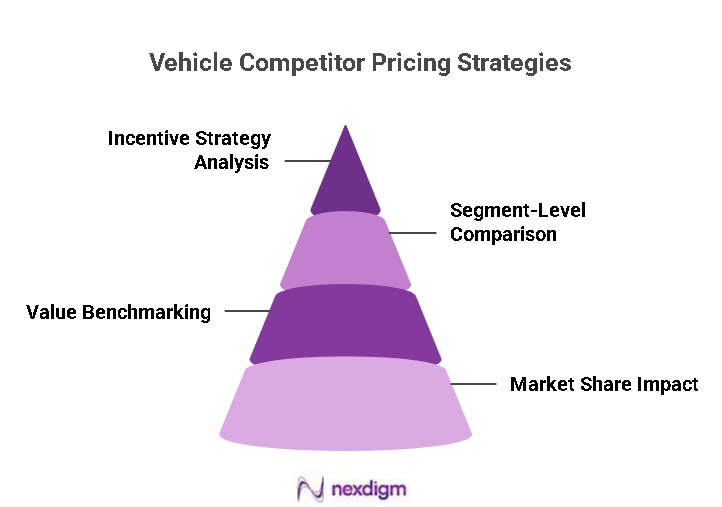
- Incentive Strategy Analysis: Evaluates discounts, rebates, and offers used by competitors to attract customers.
- Segment-Level Comparison: Assesses pricing differences across automotive segments to identify competitive advantages.
- Feature Value Benchmarking: Compares features against price points to evaluate competitor value propositions.
- Market Share Impact: Analyzes how pricing strategies influence competitor sales performance and market share.
Nexdigm Vehicle Price Sensitivity and Competitiveness Assessment
Nexdigm vehicle price sensitivity and competitiveness assessment helps automakers understand how customers respond to price changes across different vehicle segments. Using pricing analysis, Nexdigm evaluates competitor pricing, demand elasticity, and value perception to identify optimal price points. This enables brands to balance affordability and profitability, improve market positioning, and enhance competitiveness in value-conscious automotive markets.
How Does Nexdigm Evaluate Automotive Pricing Competitiveness for Value-Conscious Buyers?
Nexdigm evaluates automotive pricing competitiveness for value-conscious buyers using pricing analysis of competitor prices, features, incentives, and demand patterns to identify gaps, optimize positioning, and improve market competitiveness.
- Competitor Price Comparison: Analyzes rival vehicle prices to understand market positioning for value-conscious buyers.
- Customer Value Perception: Evaluates how buyers perceive price versus features and overall vehicle value.
- Segment Competitiveness Review: Compares pricing across automotive segments to identify competitive gaps.
- Incentive and Discount Analysis: Reviews competitor promotions and offers influencing buyer decisions.
Nexdigm’s case:
Nexdigm helped an automotive brand strengthen pricing competitiveness analysis across 15 value-focused markets and 60 vehicle models. Using pricing analysis, Nexdigm identified a 12% gap in entry-segment pricing and inconsistent competitor alignment in key regions. By optimizing pricing strategy and adjusting market positioning, the company improved sales conversion by 9%, increased competitiveness in high-demand segments, and achieved a 6% gain in market share within two quarters.
To take the next step, simply visit our Request a Consultation page and share your requirements with us.
Harsh Mittal
+91-8422857704