

India’s automotive industry is expanding, increasing the need to align production capacity with changing market demand. In FY2025–26, India produced 34.7 million vehicles, while passenger vehicle sales reached a record 4.64 million units, growing 7.9%.
With demand continuing to shift across segments, powertrains, and vehicle platforms, manufacturers need to assess plant utilization, platform mix, and production flexibility. Understanding available capacity and future demand can help identify capacity gap, improve asset utilization, and guide timely expansion decisions.
This alignment can also help manufacturers respond more effectively to demand changes while avoiding excess capacity or production constraints.
Understanding the Automotive Capacity Alignment
Automotive Capacity Alignment is the process of matching manufacturing and supplier capacity with current and future production demand, ensuring sufficient resources, scalability, cost efficiency, and supply continuity across vehicle programmes and component categories.
Is Automotive Capacity Aligned with Demand?
Automotive capacity is aligned when plants have sufficient volume, technology, platform flexibility, and geographic coverage to support demand without creating excessive idle capacity. Businesses can assess this through five areas:
- Demand-to-capacity fit: Compare expected vehicle demand with available production capacity to identify shortages, surplus capacity, and potential utilization gaps.
- Plant utilization: Evaluate utilization, production efficiency, bottlenecks, and available headroom across facilities and production lines.
- Platform mix: Assess whether existing capacity supports the models and platforms expected to drive future demand.
- Powertrain readiness: Determine whether plants can accommodate changing ICE, hybrid, and EV production requirements.
- Expansion potential: Identify whether future demand requires optimisation, retooling, additional shifts, or new manufacturing capacity.
Nexdigm connects these factors to determine where capacity is aligned, where gaps are emerging, and which manufacturing actions can best support future growth.
Nexdigm’s Approach to Capacity Assessment
Nexdigm uses a comprehensive Vehicle production capacity assessment to determine whether manufacturing capacity is aligned with current and future market requirements. The assessment connects market demand, plant utilization, platform mix, manufacturing capability, and expansion economics:
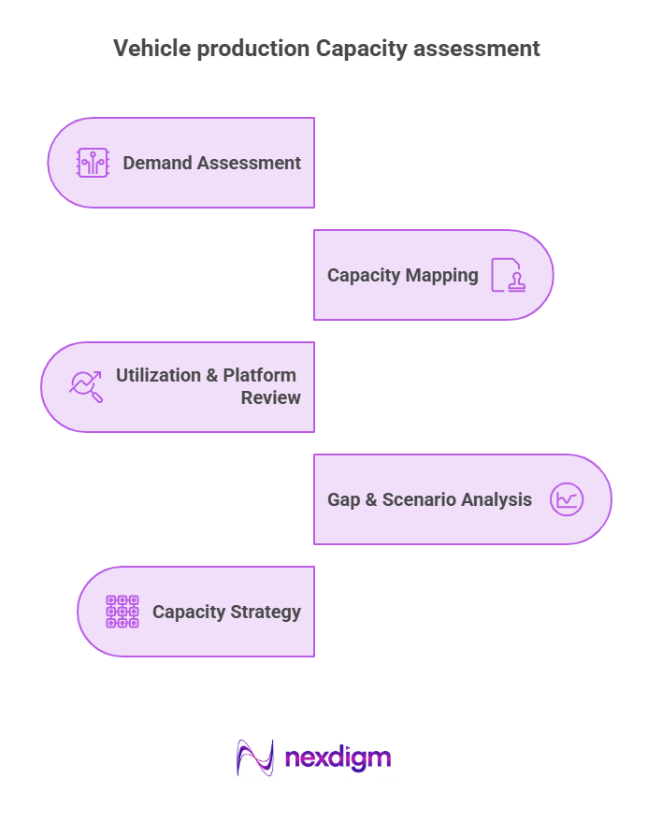
- Demand Assessment: Nexdigm evaluates current and expected demand by vehicle segment, geography, model, platform, and powertrain to establish future production requirements.
- Capacity Mapping: Existing plants, production lines, installed capacity, utilization, manufacturing footprint, and operational constraints are mapped to establish the current production base.
- Utilization & Platform Review: Nexdigm evaluates plant utilisation alongside platform and model mix to identify underutilized assets, bottlenecks, and capacity mismatches.
- Gap & Scenario Analysis: Potential over-capacity and under-capacity situations are modelled under different demand, product-mix, technology, and production scenarios.
- Capacity Strategy: Nexdigm translates findings into recommendations covering optimization, reconfiguration, additional shifts, flexible manufacturing, expansion, or new facilities.
Through this approach, Nexdigm helps automotive businesses align manufacturing investments with demand, improve asset utilization, and build flexible capacity strategies for evolving vehicle platforms.
Strategic Decisions that Nexdigm Can Support
Nexdigm helps automotive businesses analyze findings from capacity assessment into practical manufacturing and investment decisions. Some major key areas include:
- Capacity Optimization: Improve utilization of existing plants, lines, equipment, and production resources before considering additional investment.
- Production Reallocation: Assess opportunities to shift models or platforms across facilities to balance capacity and demand.
- Flexible Manufacturing: Evaluate multi-model and multi-platform production strategies that improve responsiveness to changing market requirements.
- Expansion Planning: Determine when additional lines, shifts, equipment, or plant capacity may be required to support future volumes.
- Technology Transition Planning: Assess capacity implications associated with EVs, alternative powertrains, new platforms, and changing manufacturing processes.
- Investment Prioritization: Compare capacity initiatives based on utilization improvement, capital requirements, scalability, implementation complexity, and expected business impact.
By connecting market demand with manufacturing economics and operational realities, Nexdigm helps businesses prioritize capacity decisions that improve asset productivity while reducing the risk of over-investment or future capacity constraints.
Nexdigm’s Case
Nexdigm assisted an automotive manufacturer in assessing plant utilisation, platform mix, and expansion potential. The review considered a market producing 3.1 crore vehicles annually, including 43 lakh passenger vehicles. As a result, the client improved capacity planning, prioritised expansion needs, and strengthened production alignment.
To take the next step, simply visit our Request a Consultation page and share your requirements with us.
Harsh Mittal
+91-8422857704