

Segment benchmarking, when provided through competitive intelligence services, analyzes the performance and market share of different vehicle types. In this case, it reveals that SUVs contribute over 45% of passenger vehicle sales, helping businesses understand consumer preferences and adjust their strategies to capitalize on the growing SUV market.
Vehicle Segment Benchmarking in Competitive Intelligence Services
Vehicle segment benchmarking in competitive intelligence services involves comparing various vehicle types and their performance within specific market segments. This helps businesses identify key differentiators and trends to enhance product development and positioning.
Performance Comparison
Evaluate performance metrics such as fuel efficiency, safety ratings, and technological features across different vehicle segments to identify leading products and areas for improvement.
Pricing Strategy Assessment
Analyze pricing strategies of vehicles in various segments to help companies adjust their offerings for competitive pricing.
Consumer Preferences Analysis
Track consumer preferences and demands across segments, ensuring products align with market expectations and drive sales growth.
Advantages of Competitive Intelligence Services on SUV Segment Benchmarking
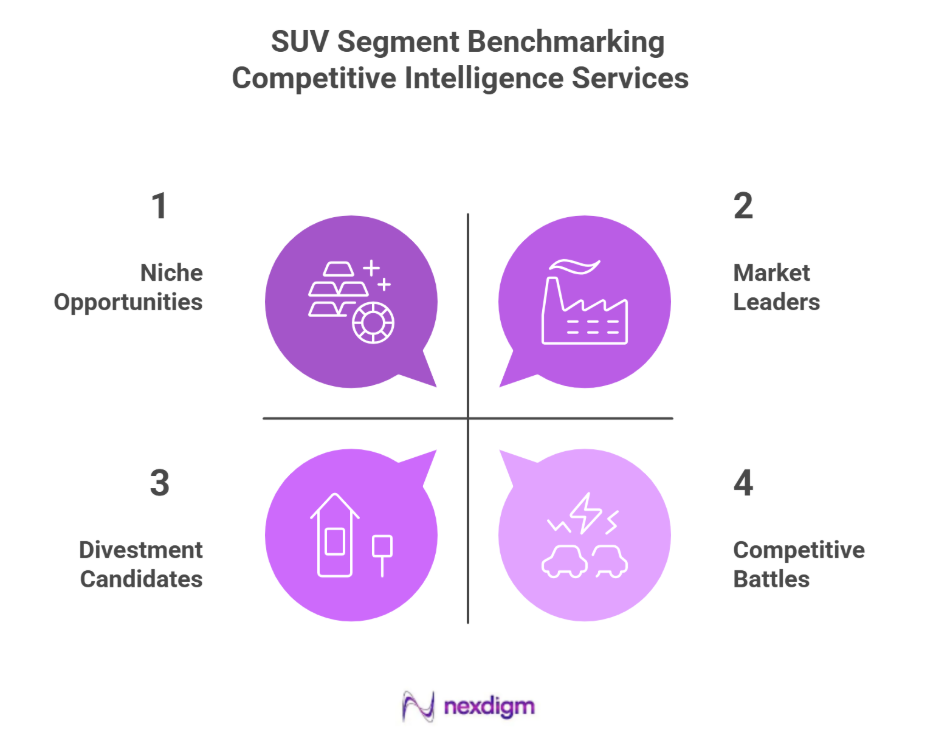
Competitive intelligence services on segment benchmarking help automotive companies understand market trends, like SUVs contributing over 45% of passenger vehicle sales. These insights guide strategic decisions for market expansion and product development.
Market Trend Identification
Competitive intelligence reveals shifting consumer preferences toward SUVs, allowing businesses to focus product development efforts on popular segments and meet growing demand.
Targeted Product Development
Benchmarking data helps companies design and enhance SUV models with features that cater to consumer preferences, improving competitiveness and market share.
Pricing Strategy Optimization
Insights into SUV segment performance allow businesses to adjust pricing strategies, ensuring competitiveness while maximizing profitability within the high-demand segment.
Informed Marketing Strategies
Segment benchmarking helps refine marketing campaigns targeted at SUV buyers, ensuring the messaging resonates with the preferences and expectations of the growing consumer base.
Steps Taken by Nexdigm’s Services on SUV Segment Benchmarking
Nexdigm takes several strategic steps to provide valuable competitive intelligence on the SUV segment, helping businesses capitalize on the growing market where SUVs contribute over 45% of passenger vehicle sales.
Market Trend Analysis
Nexdigm monitors consumer preferences and purchasing patterns, identifying the growing demand for SUVs and helping businesses align strategies accordingly.
Competitor Comparison
By benchmarking competitor SUV offerings, Nexdigm helps companies understand strengths and weaknesses, enabling them to enhance their own vehicle designs.
Pricing Strategy Evaluation
Nexdigm assesses competitor pricing for SUVs, offering insights to optimize pricing models and remain competitive while maximizing profitability.
Product Feature Benchmarking
Nexdigm evaluates the features and technologies of popular SUVs, helping companies integrate high-demand features into their models to attract more customers.
Customer Sentiment Tracking
Nexdigm tracks consumer reviews and feedback on SUVs, providing valuable insights into customer satisfaction and areas for improvement.
Supply Chain Assessment
Nexdigm analyzes the supply chain dynamics of the SUV segment, ensuring businesses can efficiently manage production, sourcing, and distribution processes.
Nexdigm’s Case:
Nexdigm’s competitive intelligence services revealed SUVs contribute over 45% of passenger vehicle sales, helping an OEM adjust product offerings. This led to a 20% increase in SUV market share and a 15% revenue growth.
To take the next step, simply visit our Request a Consultation page and share your requirements with us.
Harsh Mittal
+91-8422857704