

Sensors provide the information modern vehicles use to monitor their surroundings, manage vehicle functions and support driver assistance technologies. Applications range from engine temperature and wheel-speed measurement to radar-based object detection, camera systems, ultrasonic parking assistance and LiDAR-based environmental sensing.
The expansion of advanced driver assistance systems (ADAS), automated parking and connected vehicle technologies has widened the supplier landscape. OEMs now evaluate manufacturers across different sensor technologies, each with distinct performance characteristics, cost structures, and integration requirements.
A meaningful supplier comparison must begin with the intended application. Radar, cameras, ultrasonic sensors, and LiDAR do not perform identical functions, and their technical specifications cannot be assessed through a single accuracy or price measure.
Understanding the Main Automotive Sensor Categories
- Radar sensors use radio waves to detect objects and estimate distance and relative speed. They are used in adaptive cruise control, blind-spot detection, collision warning, and other ADAS applications. Their ability to operate in darkness and certain reduced-visibility conditions makes them relevant to several safety functions.
- Camera systems capture visual information for lane detection, traffic-sign recognition, object classification, and driver monitoring. Performance depends on resolution, field of view, image processing, calibration, and software algorithms. Camera systems are frequently integrated with radar and other sensor inputs.
- Ultrasonic sensors are commonly used for short-range applications, including parking assistance and proximity detection. Their range and performance depend on the intended application and surrounding conditions.
- LiDAR systems use laser-based sensing to generate detailed information about surrounding objects and their relative positions. They are relevant to selected advanced driving applications, although cost, packaging, durability and integration requirements influence adoption.
Which Suppliers Operate Across These Technologies?
The supplier landscape includes global automotive Tier 1 manufacturers and specialist sensor technology companies.
Bosch has a broad portfolio spanning radar, ultrasonic, and other automotive sensing technologies. Continental supplies radar sensors, camera systems, and integrated ADAS solutions. Denso participates in radar, camera and vehicle safety technologies, while Valeo has capabilities across ultrasonic sensors, cameras, LiDAR, and parking assistance systems.
Aptiv operates across advanced safety, perception and vehicle architecture technologies. ZF participates in radar, camera, and integrated driver assistance systems. Specialist companies such as Aeva and Innoviz focus on LiDAR technologies, while semiconductor and sensing businesses such as Infineon, NXP and ams OSRAM supply components used within automotive sensor systems.
These companies should be grouped according to their position in the value chain. A manufacturer supplying a complete sensor module has a different commercial and technical role from a semiconductor business providing sensing components.
Comparing Accuracy and Performance by Application
A sensor’s technical performance cannot be evaluated through a single headline specification. Radar systems may be compared through detection range, angular resolution, object separation, and performance across operating conditions. Cameras require assessment of image quality, field of view, low-light performance, and object-recognition capability. LiDAR systems may be compared through range, point-cloud density, resolution, and environmental performance.
Integration capability is equally important. Sensors must communicate with vehicle electronic architectures and work alongside other systems. Compatibility with domain controllers, software platforms, calibration procedures and functional safety requirements can influence supplier suitability.
For procurement teams, vehicle sensor supplier benchmarking should separate component-level specifications from system-level performance. A technically capable sensor may still be unsuitable if it requires expensive integration, additional computing resources or substantial vehicle redesign.
Cost and Commercial Readiness
Sensor cost depends on technology, production scale, component complexity, packaging, and the level of software or integration included in the offering. Radar modules, cameras, and ultrasonic sensors have different manufacturing economics, making direct price comparisons across categories inappropriate.
The assessment should consider unit-cost indicators, expected production volumes, development requirements, tooling, software licensing, and integration costs. It should also examine the supplier’s existing OEM relationships, manufacturing footprint, and ability to support the expected vehicle programme.
Suppliers with established production experience may offer advantages in programme readiness, while specialist technology companies may offer differentiated capabilities in emerging sensing applications. The appropriate choice depends on the OEM’s intended architecture, target vehicle segment, and cost constraints.
Vehicle Sensor Supplier Benchmarking Framework
Nexdigm can support procurement research by mapping sensor manufacturers, comparing technology portfolios, and evaluating the commercial and geographic characteristics of supplier markets.
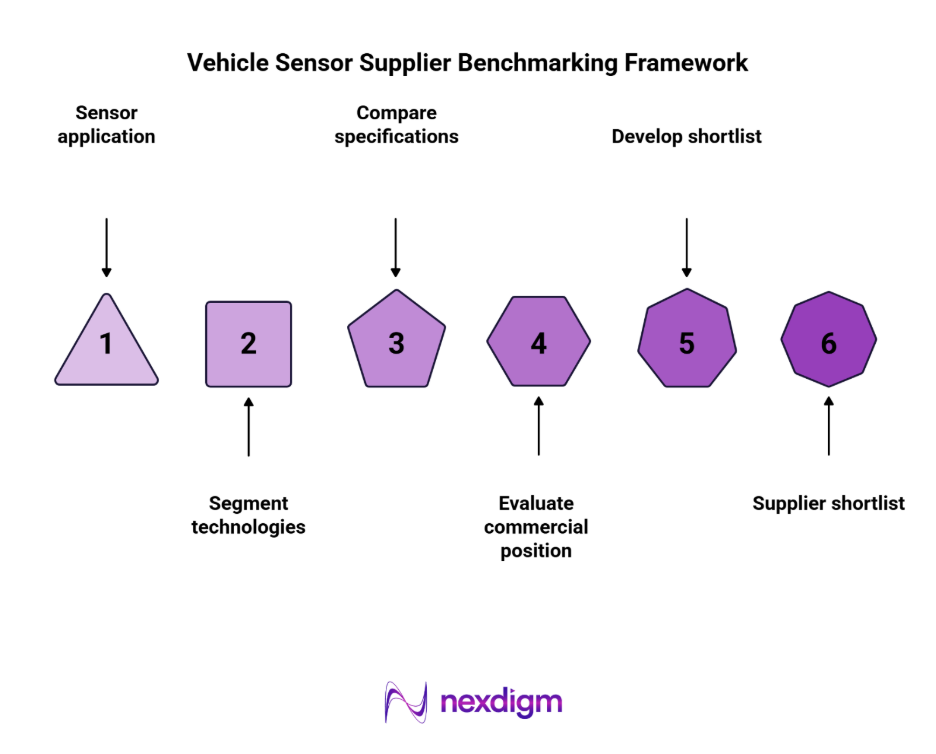
- Define the Sensor Application: Identify the intended vehicle function, sensing range, environmental requirements and system architecture.
- Segment Supplier Technologies: Separate radar, camera, ultrasonic, LiDAR and supporting semiconductor suppliers.
- Compare Technical Specifications: Assess application-specific performance indicators, software capabilities and integration requirements.
- Evaluate Commercial Position: Examine cost drivers, production scale, OEM relationships, manufacturing locations and technology partnerships.
- Develop a Supplier Shortlist: Identify manufacturers whose product capabilities and commercial positioning align with the intended vehicle platform.
Case Study: Comparing ADAS Sensor Suppliers
An automotive company evaluating ADAS sourcing options required a comparison of radar, camera, and ultrasonic suppliers. The assessment mapped 22 manufacturers across four technology categories, identified eight relevant candidates, and highlighted integration and cost considerations for further evaluation.
To take the next step, simply visit our Request a Consultation page and share your requirements with us.
Harsh Mittal
+91-8422857704