

Vehicle supply analysis refers to evaluating the availability, demand, production, and distribution of vehicles within a market. It helps identify supply chain efficiencies, forecast future demand, and optimize inventory management, ensuring timely delivery of vehicles while addressing market trends and consumer preferences. Inventory turnover improvements of 15–20% have been observed in companies using advanced analytics for supply planning.
When competitive intelligence services are provided on vehicle supply trends, the most significant factors affected are market demand forecasting and production planning. Organizations that integrate competitive intelligence into supply chain strategies report up to 20–30% improvement in demand forecast accuracy and 10–15% reduction in excess inventory costs. Additionally, real-time market intelligence can shorten production planning cycles by nearly 25%, allowing companies to respond faster to fluctuations in consumer demand.
Strategies for Competitive Intelligence in Stabilizing Vehicle Supply Trends
As global vehicle production recovers, competitive intelligence services help businesses adapt to changing supply trends. These strategies ensure companies can optimize production, anticipate market changes, and stay competitive in a recovering industry.
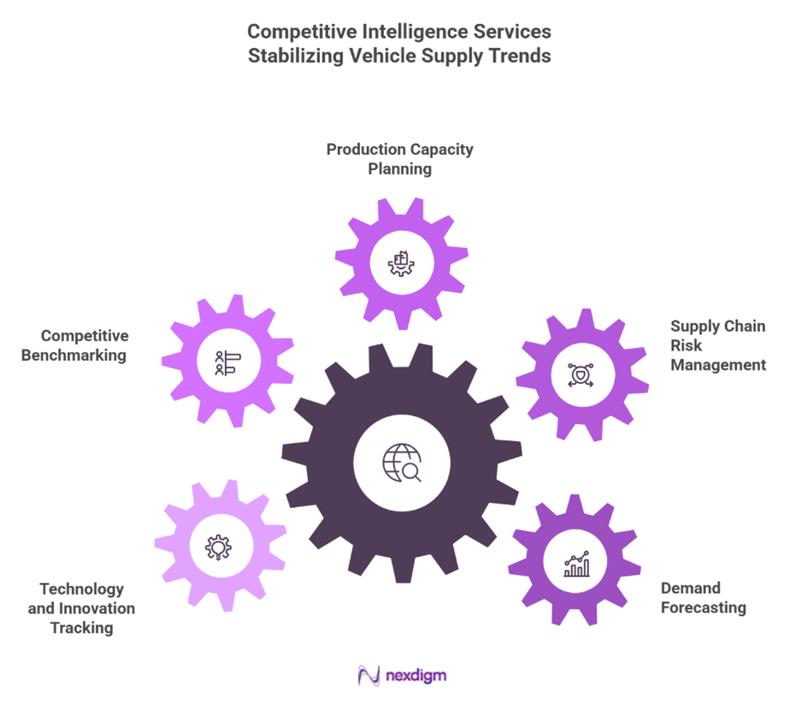
Demand Forecasting Optimization
Competitive intelligence helps analyze consumer trends, enabling businesses to forecast vehicle demand accurately. This helps manufacturers adjust production schedules and allocate resources effectively to meet market needs.
Supply Chain Risk Management
By identifying potential disruptions in the supply chain, competitive intelligence allows businesses to proactively manage risks. Companies can strengthen supplier relationships and diversify sourcing to ensure a consistent vehicle supply.
Production Capacity Planning
Competitive intelligence services provide insights into global production capacities, helping companies align their manufacturing processes with current trends. This enables manufacturers to optimize output and avoid production of bottlenecks as global supply recovers.
Competitive Benchmarking
By analyzing competitors’ strategies and performance, businesses can gauge their positioning in the market. Competitive intelligence allows companies to identify areas of improvement and refine their strategies for better market capture.
Technology and Innovation Tracking
Monitoring new technological advancements in manufacturing processes helps companies stay ahead of trends. Competitive intelligence enables businesses to incorporate innovations, improving production efficiency and the quality of vehicles offered to customers.
Nexdigm’s Steps in Competitive Intelligence on Stabilizing Vehicle Supply Trends
As global vehicle production stabilizes beyond 90 million units, Nexdigm offers competitor vehicle supply trends services that help companies navigate supply trends, optimize strategies, and ensure effective production management.
Demand-Supply Gap Analysis
Nexdigm analyzes market demand and production data to identify gaps, helping automotive companies adjust their strategies and forecast future demand more accurately for efficient supply management.
Supply Chain Optimization
By evaluating supply chain networks, Nexdigm identifies inefficiencies and recommends strategies to streamline operations, reduce lead times, and ensure timely vehicle delivery during production recovery.
Competitive Market Monitoring
Nexdigm tracks competitor activities, strategies, and market share to help businesses understand their competitive positioning, identify growth opportunities, and respond to market shifts more effectively.
Production Forecasting
Using advanced analytics, Nexdigm provides insights into global production trends, helping companies align their manufacturing schedules with expected demand, reducing production delays and optimizing inventory management.
Supplier Performance Evaluation
Nexdigm assesses supplier performance, identifying potential risks or opportunities to improve relationships, negotiate better terms, and ensure a steady supply of parts to maintain production stability.
Nexdigm’s Case:
Nexdigm helped an OEM reduce supply disruptions by 22% and improve production forecasting accuracy by 27%, using competitive intelligence to align supply trends with demand as global vehicle production stabilized beyond 90 million units.
To take the next step, simply visit our Request a Consultation page and share your requirements with us.
Harsh Mittal
+91-8422857704