
Vehicle telematics is evolving from basic vehicle tracking toward a broader intelligence platform. GPS location, vehicle diagnostics, driver behaviour, fuel consumption, and real-time operating data can now support decisions across fleet management, insurance, safety, maintenance, and mobility services.
As businesses collect more vehicle data, the opportunity is shifting from simply knowing where a vehicle is to understanding how it is being used, what may happen next, and how operations can improve.
For automotive businesses, a structured Vehicle telematics market study can help assess demand, technology adoption, customer requirements, competitive positioning, and emerging commercial opportunities.
Understanding the Telematics Shift
Traditional telematics focused primarily on location tracking and basic fleet monitoring. Modern systems increasingly combine vehicle, driver, environmental, and operational data to generate actionable insights. Organizations can assess this transition across four areas: Tracking, Monitoring, Analytics, and Intelligence.
The progression creates opportunities to move from simple visibility toward predictive and data-driven decision-making. For these following areas are the key contributors:
- Fleet Intelligence: Fleet management remains one of the most important applications for telematics. Operators can use vehicle data to improve utilization, routing, maintenance, fuel efficiency, and driver performance. Organizations can evaluate telematics demand to identify fleet segments where telematics can deliver the strongest operational value.
- Safety and Driver Behaviour: Telematics is increasingly being used to understand driving behaviour rather than simply monitor vehicle location. Data can help organizations assess how these capabilities are being adopted by fleet operators, insurers, and mobility businesses.
- Insurance Models: Telematics is creating new possibilities for insurance models based on actual vehicle usage and driving behaviour. Instead of relying only on traditional factors, insurers can potentially use telematics data to identify where telematics-enabled insurance models have realistic commercial potential.
How Is Telematics Moving from Tracking to Intelligence?
The transition can be understood through the increasing sophistication of data use.
- Tracking: Establish vehicle location, movement, and basic operating information.
- Monitoring: Combine location with vehicle condition, driver behaviour, and operational data.
- Analytics: Identify patterns, inefficiencies, risks, and recurring operating issues.
- Prediction: Use historical and real-time data to anticipate maintenance, safety, or operational events.
- Intelligence: Convert multiple data sources into recommendations that support business decisions.
Organizations can assess where different markets and customer segments currently sit within this transition and identify opportunities to move toward more advanced telematics applications.
Data as a Commercial Opportunity
As telematics becomes more sophisticated, the value of the system increasingly depends on what businesses can do with the data. Potential applications include:
- Fleet optimization
- Insurance risk assessment
- Predictive maintenance
- Customer engagement
Nexdigm can evaluate the commercial potential of these applications based on data availability, customer need, technology capability, regulatory requirements, and willingness to pay.
Nexdigm’s Vehicle Telematics Market Assessment
Nexdigm conducts a Vehicle telematics market study through a step-by-step process that helps businesses identify relevant opportunities and develop commercially viable telematics opportunities.
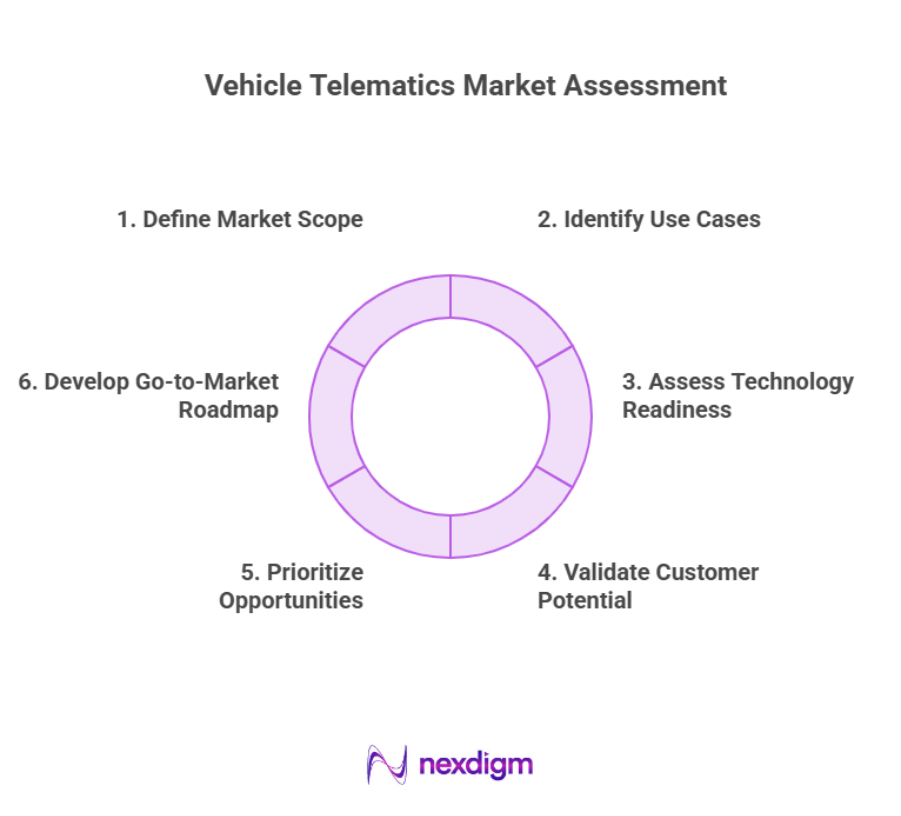
- Step 1 Define Market Scope: Identify priority vehicle segments, customer groups, geographies, fleet categories, and telematics applications to establish the addressable opportunity and key areas for assessment.
- Step 2 Identify High-Value Use Cases: Evaluate applications such as tracking, driver monitoring, diagnostics, predictive maintenance, safety, insurance, route optimization, and fleet management to determine where telematics can deliver the greatest customer and operational value.
- Step 3 Assess Technology & Ecosystem Readiness: Examine hardware, connectivity, software, analytics, data platforms, and integration requirements. Nexdigm also evaluates potential technology and ecosystem partners to identify capability gaps and partnership requirements.
- Step 4 Validate Customer & Commercial Potential: Assess customer needs, adoption barriers, willingness to pay, purchasing criteria, and potential revenue models. This helps determine which solutions can generate sustainable demand and commercial value.
- Step 5 Prioritize Opportunities: Compare potential opportunities based on market demand, customer value, competitive intensity, technology readiness, investment requirements, scalability, and expected commercial potential.
- Step 6 Develop Go-to-Market Roadmap: Define priority customer segments, solution positioning, technology requirements, partnerships, pricing models, investment priorities, and deployment timelines to support market entry and future scale.
These steps help businesses move systematically from understanding the telematics opportunity to identify viable opportunities for commercialization and growth.
Strategic Priorities for Automotive Businesses
Nexdigm helps businesses strengthen their telematics strategies by:
- Moving from basic tracking toward analytics and predictive capabilities
- Identifying fleet segments with clear operational needs
- Developing partnerships with technology and connectivity providers
- Exploring usage-based insurance opportunities
These approaches help automotive businesses connect telematics technology with market demand, customer requirements, competitive dynamics, and commercial models supporting strategies that move beyond tracking toward actionable vehicle intelligence.
Nexdigm’s Case
Nexdigm assisted an automotive player in assessing telematics as India’s market was projected to reach $137.4 million in 2026, growing at 21% CAGR through 2033. The study mapped fleet, insurance, safety, and data opportunities, identifying scalable value pools.
To take the next step, simply visit our Request a Consultation page and share your requirements with us.
Harsh Mittal
+91-8422857704