

Supplier performance is increasingly being evaluated beyond price and delivery. A recent 2025 Global CPO Survey found that 84% of high-performing procurement organizations met or exceeded supplier-performance expectations, compared with 59% of other organizations. The same survey found that 74% of procurement leaders viewed alternative supply sources as an effective risk-mitigation strategy, while 64% prioritized greater supply-chain visibility.
CIPS’ 2026 Global State of Procurement & Supply also found that 47% of procurement professionals identified risk management and new technology skills as top development priorities. These trends show why supplier comparison is becoming more structured.
Vendor and supplier benchmarking consulting can help businesses compare vendors across cost, quality, capacity, delivery, financial strength, and other performance dimensions to determine where supplier relationships create value and where improvement may be required.
The Lowest Price Does Not Always Mean the Best Supplier
Supplier competitiveness depends on the total value delivered rather than the quoted price alone. A vendor offering lower unit costs may have longer lead times, weaker quality performance, limited capacity, or greater geographic exposure. Conversely, a higher-priced supplier may offer stronger reliability, shorter delivery cycles, better technical capabilities, or greater flexibility. Benchmarking multiple performance dimensions gives procurement teams a more balanced basis for evaluating supplier value.
What Supplier Performance Reveals Beyond Price
A structured comparison can reveal differences that may not be visible through procurement spend data alone:
- Commercial Performance: Compare pricing, cost competitiveness, payment terms, and cost movements to understand the financial value offered by each supplier.
- Operational Performance: Evaluate quality, delivery reliability, capacity, responsiveness, and service levels to identify differences in execution and supply dependability.
Together, these measures help businesses distinguish between suppliers that are simply cost-competitive and those that deliver stronger overall commercial and operational performance.
Nexdigm’s Supplier Performance Benchmarking Expertise
Supplier performance can look different depending on the benchmark applied. Nexdigm helps businesses establish a market-informed comparison of vendors, combining commercial, operational, capability, and risk indicators to understand relative performance.
This enables procurement teams to identify where suppliers outperform, where performance gaps exist, and which vendors have the capabilities to support future requirements, creating a stronger basis for supplier selection, development, negotiation, and allocation decisions.
Nexdigm’s Vendor and Supplier Benchmarking Framework
Nexdigm structures supplier comparisons around the metrics through vendor and supplier benchmarking consulting approach, enabling businesses to evaluate vendors consistently rather than relying on individual performance measures by assessing the following areas:
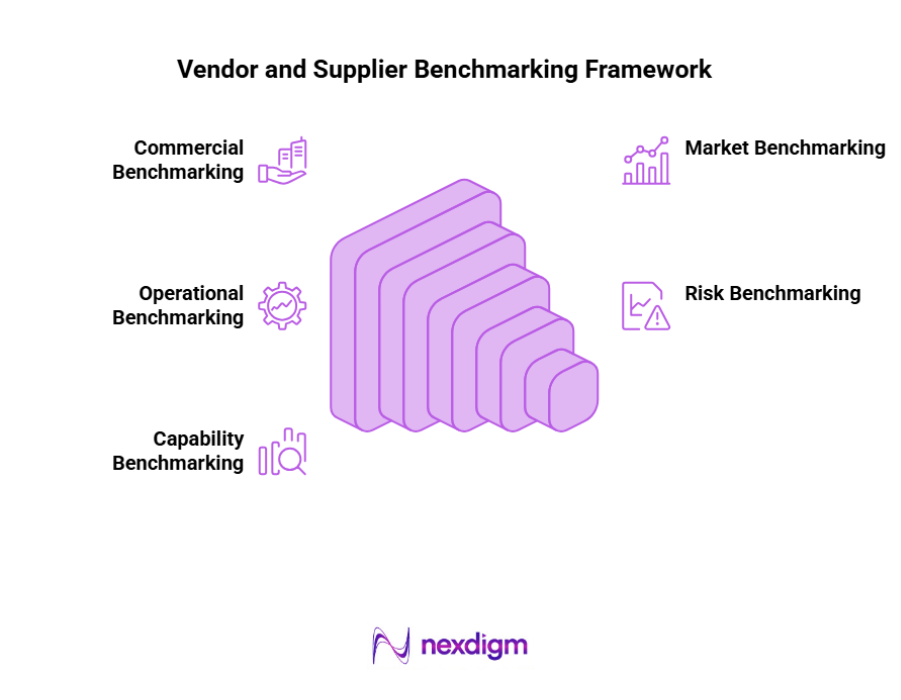
- Commercial Benchmark: Compare pricing, payment terms, cost movements, and contract conditions to assess relative financial competitiveness.
- Operational Benchmark: Evaluate delivery reliability, lead times, quality, capacity, responsiveness, and service levels to measure execution performance.
- Capability Benchmark: Assess technology, production capabilities, certifications, product range, and capacity expansion to determine future supplier suitability.
- Market Benchmark: Examine market position, export activity, customer presence, production footprint, and competitive strength to understand supplier standing.
- Risk Benchmark: Evaluate geographic exposure, supplier concentration, capacity constraints, trade dependencies, and other factors affecting supply continuity.
Together, these dimensions provide a balanced view of supplier performance, helping businesses distinguish between vendors that perform well today and those positioned to deliver sustainable value.
Applications of Nexdigm’s Supplier Benchmarking Framework
The framework can support procurement teams across supplier-related decisions, from initial vendor selection to ongoing performance management and strategic sourcing through:
- Supplier Selection: Compare prospective vendors against consistent commercial, operational, capability, and risk criteria before entering new supplier relationships.
- Supplier Development: Identify performance gaps and establish focused improvement priorities across quality, delivery, capacity, cost, or service.
- Negotiation Support: Use comparative supplier and market evidence to assess pricing positions and strengthen discussions around contracts and commercial terms.
- Supplier Allocation: Determine which vendors are best positioned for greater business share based on performance, capacity, competitiveness, and resilience.
- Risk Mitigation: Identify weaker or exposed suppliers and evaluate alternative vendors, markets, or sourcing arrangements to strengthen supply resilience.
- Performance Monitoring: Establish relevant benchmarks that allow procurement teams to track supplier performance against internal expectations and external market standards.
These applications help businesses turn supplier benchmarking into practical decisions around selection, development, negotiation, allocation, and risk management.
Nexdigm’s Case
Nexdigm benchmarked 20 suppliers across 15 commercial and operational parameters, identifying 6 high-performing vendors and 8 suppliers with notable performance gaps. The assessment also identified 5 alternative suppliers, helping the client strengthen supplier allocation, support negotiations, and reduce concentration-related sourcing risks.
To take the next step, simply visit our Request a Consultation page and share your requirements with us.
Harsh Mittal
+91-8422857704