

A vocational training centre can recruit learners and still struggle to build a sustainable business. The course may attract interest, but employers may not recognise the qualification, placement opportunities may be limited or the cost of equipment and instructors may exceed what learners can afford. A viable entry strategy must connect training demand to real job requirements and a delivery model that works financially.
For a new provider, the starting point is not choosing a popular course. It is identifying a skill shortage that can support repeatable enrollment and credible employment outcomes.
Where Is Demand for Vocational Training Coming From?
India’s skilling ecosystem spans short-term training, industrial training institutes, apprenticeships, employer-led programmes and continuing professional development. The Ministry of Skill Development and Entrepreneurship’s Annual Report 2024–25 describes government efforts to strengthen industry-linked training, certification, apprenticeship pathways and the quality of training infrastructure.
These programmes operate in a labour market where requirements vary by region and sector. A manufacturing cluster may need technicians, machine operators and maintenance workers. A growing healthcare market may require trained support staff, while logistics businesses may prioritise warehousing, equipment handling and supply-chain skills.
National skills priorities can identify areas to investigate, but they do not prove that a particular course will attract enough learners or employers. A provider entering a market should interview local employers, examine vacancies and hiring cycles, identify required certifications and determine whether businesses are willing to recruit graduates or support practical training.
The strongest opportunities usually connect a specific job role to a defined competency standard and a credible route into employment.
The Economics Behind a Training Programme
Programme economics vary considerably by occupation. A digital skills course may need computers, software and qualified instructors, while industrial training can require expensive machinery, safety systems, consumables and workshop space. Healthcare-related training may depend on specialist equipment and access to appropriate practical settings.
The provider must calculate the cost of delivering each cohort, not just the cost of developing the curriculum. Instructor utilisation, class size, equipment maintenance, assessment fees and learner support all affect margins. Small cohorts may improve individual attention but make it harder to recover fixed costs.
Pricing creates another trade-off. Learners may have limited ability to pay upfront, particularly when training requires time away from work. Employer-sponsored cohorts, apprenticeships, public programmes and financing partnerships can expand access, but each comes with its own eligibility rules, contract requirements and payment timelines.
Vocational Training Market Entry Strategy: Five Areas to Validate
A vocational training market entry strategy should test the relationship between learner demand, employer requirements and the provider’s ability to deliver training profitably.
- Local skill gaps: Identify occupations with recurring vacancies, expansion plans or persistent recruitment difficulties.
- Qualification relevance: Match course outcomes and practical assessment to recognised standards and employer expectations.
- Learner demand and pricing: Assess eligibility, willingness to pay, travel costs, schedule constraints and alternative training options.
- Programme economics: Model equipment, instructors, facilities, consumables, certification, cohort size and utilisation.
- Placement and employer access: Establish whether employers will interview graduates, provide workplace exposure or participate in apprenticeship pathways.
Placement claims require particular care. A course with strong enrollment but weak job outcomes may damage the provider’s reputation and reduce future demand. The assessment should establish how placements will be defined, tracked and verified, including whether jobs match the training and provide reasonable continuity.
Vocational Training Entry Feasibility Framework
The Vocational Training Market Entry Framework provides a practical sequence for deciding which programmes to launch.
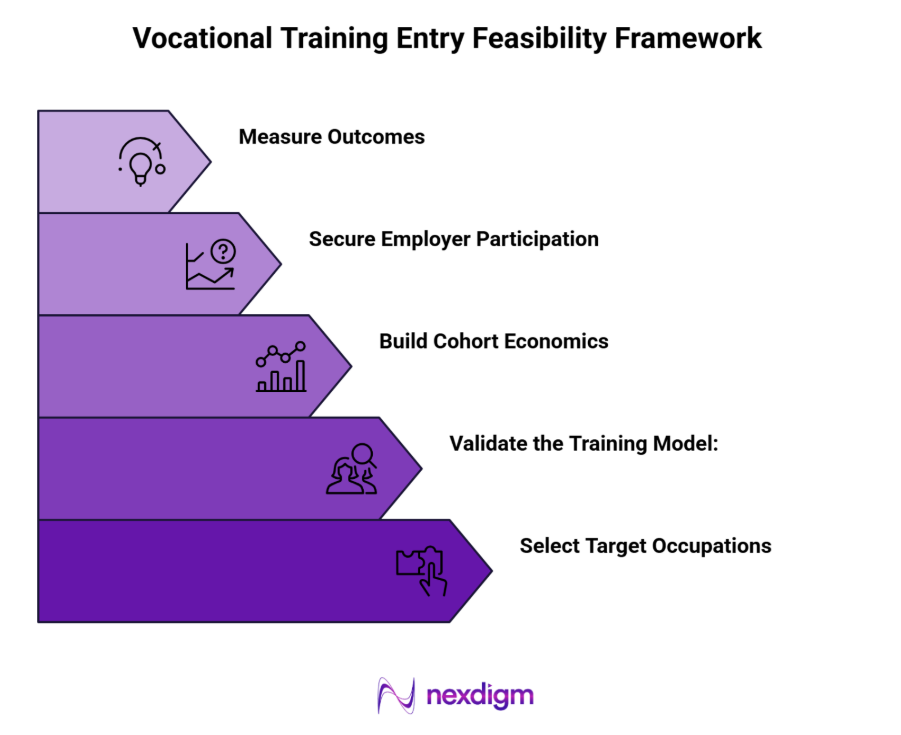
- Select Target Occupations: Identify specific roles, regional hiring demand and the competencies employers require.
- Validate the Training Model: Confirm curriculum, trainer availability, equipment, assessment and applicable recognition requirements.
- Build Cohort Economics: Estimate learner intake, delivery costs, fee income, funding sources and minimum viable batch size.
- Secure Employer Participation: Develop relationships for practical exposure, candidate assessment, apprenticeships and recruitment.
- Measure Outcomes: Track completion, certification, placement quality, retention and employer satisfaction.
A provider may find that one occupation supports a dedicated training centre while another is better served through shared facilities or employer partnerships. The entry model should follow the economics and local demand, not the other way around.
Nexdigm Case Study: Selecting Vocational Programmes
Nexdigm assessed six vocational programme options across two industrial clusters, combining employer interviews, vacancy analysis, equipment costs and learner affordability. Three programmes advanced to detailed evaluation. The provider prioritised two with clearer hiring pathways and lower initial infrastructure requirements, while deferring a capital-intensive programme pending employer commitments.
To take the next step, simply visit our Request a Consultation page and share your requirements with us.
Harsh Mittal
+91-8422857704