

A vocational training programme can fill every available seat and still fail to create lasting employment value. Learners may complete the course but struggle to find work. Employers may report shortages while remaining reluctant to recruit newly trained candidates. Training centres can end up repeating the same intake cycle without building durable relationships with local industry.
The commercial and social case for vocational training depends on whether the programme connects learners to jobs, employers to capable candidates and training providers to a financially sustainable operating model.
Vocational Training Market Demand: Are Employers Hiring?
India’s skilling system is substantial. The Ministry of Skill Development and Entrepreneurship reported that, by 31 December 2025, 1.64 crore candidates had been trained or oriented under the Pradhan Mantri Kaushal Vikas Yojana (PMKVY), with 1.29 crore certified. Scale alone, however, does not establish that training matches local hiring requirements.
The distinction becomes clearer when employment outcomes are examined. Across PMKVY’s first three versions, 24.3 lakh of the 56.89 lakh candidates certified under short-term training were reported placed, a placement rate of 42.8%. The programme has since evolved, so this historical figure should not be treated as a current placement rate for every training provider. It does, however, underline why certification and employment need to be measured separately.
Demand research should begin with employers. Which roles are difficult to fill? What technical skills are required on the first day of work? Do employers need permanent employees, apprentices, contract workers or self-employed service providers? Answers will differ by region and sector.
A programme designed around general employability may struggle to compete with one developed for a clearly identified occupational need, such as industrial maintenance, solar installation, healthcare support or equipment operation.
What Makes a Vocational Training Programme Financially Viable?
A training centre needs enough learner demand to operate consistently, but enrolment is only one side of the model. Employers must value the resulting skills, and the provider must be able to deliver training at a cost supported by fees, contracts or programme funding.
The business case should examine:
- Local job demand: Vacancies, employer expansion plans, replacement hiring and the stability of the occupation.
- Learner accessibility: Location, transport, course fees, schedule, entry requirements and the income learners forgo while training.
- Training delivery costs: Instructor salaries, equipment, workshop space, consumables, assessments and certification.
- Employer participation: Access to practical placements, apprenticeships, workplace assessments and interviews.
- Post-training outcomes: Placement, retention, wage progression, self-employment and employer satisfaction.
Some occupations require expensive equipment or small instructor-to-learner ratios. Others can be taught more economically but may face intense competition among providers. The programme should model these differences rather than assume that every course can be delivered at the same cost per learner.
Vocational Training Market Feasibility Study: Why Employer Links Matter
A Vocational training market feasibility study needs to test the relationship between course demand and actual employment opportunities. A survey showing that learners are interested in a course is not enough if employers have little intention of hiring graduates.
The National Council for Vocational Education and Training’s National Skills Qualification Framework provides a structure for linking qualifications to competency levels, progression pathways and industry requirements. Such alignment can help make training more legible to employers, but the qualification must still correspond to the tasks and standards required in the workplace.
Apprenticeships and on-the-job training can strengthen that connection. The Economic Survey 2025–26 reported more than 43.47 lakh apprentices engaged under the National Apprenticeship Promotion Scheme across 36 states and union territories, with participation from more than 51,000 establishments. This demonstrates the scale of the apprenticeship ecosystem, although it does not guarantee that every local training programme has access to suitable employer partners.
Vocational Training Programme Feasibility Framework
The Vocational Training Demand and Viability Framework helps determine whether a programme can attract learners, meet employer requirements and sustain delivery.
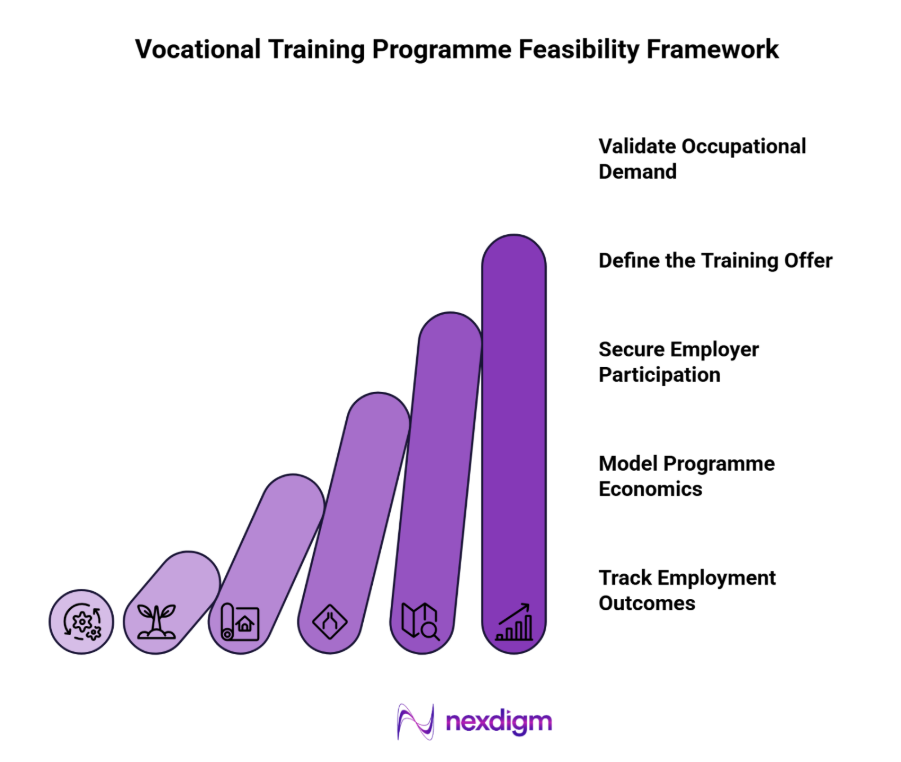
- Validate Occupational Demand: Confirm local hiring needs, expected vacancies, wage levels and the stability of target occupations.
- Define the Training Offer: Specify competencies, equipment, instructor requirements, qualification levels and practical assessment.
- Secure Employer Participation: Establish hiring commitments, workplace exposure, apprenticeships or structured employer feedback.
- Model Programme Economics: Estimate enrolment, completion, delivery cost, funding, fee affordability and capacity utilisation.
- Track Employment Outcomes: Measure placement, job retention, earnings progression and employer satisfaction over time.
The strongest programme is not necessarily the one that attracts the largest intake. It is the one that consistently produces skills employers need while remaining accessible to learners and financially viable for the provider.
Nexdigm Case Study: Assessing Vocational Programme Viability
Nexdigm assessed five vocational training opportunities across three industrial clusters, comparing employer demand, learner accessibility, equipment costs and placement pathways. Two programmes showed the strongest alignment between recurring vacancies and feasible delivery costs. The provider prioritised those programmes for employer validation and deferred investment in courses where hiring demand remained uncertain.
To take the next step, simply visit our Request a Consultation page and share your requirements with us.
Harsh Mittal
+91-8422857704