

In high-demand warehousing networks, capacity utilization is a strong indicator of operational efficiency, asset productivity, and network competitiveness. When warehouses operate at this level, fixed costs such as rent, labor supervision, equipment, and technology infrastructure are spread across higher volumes, reducing the cost per order and improving throughput. From a competitive intelligence perspective, tracking this metric helps companies assess how effectively competitors and market players are using their warehouse footprints, whether they are scaling efficiently, and where capacity constraints or expansion opportunities may exist.
Warehouse capacity benchmarking allows organizations to compare utilization rates, storage density, throughput performance, labor productivity, and facility efficiency against industry peers, helping identify best practices, cost advantages, and potential gaps in the logistics network.
Relevant benchmarks indicate that 70–85% warehouse utilization is generally considered an efficient operating range, while 75–90% utilization reflects healthy operations with some peak-capacity headroom. In India, demand pressure is visible: industrial and logistics leasing reached 27.1 million square feet up 63% year-on-year, led by 3PL, e-commerce, and manufacturing occupiers. These figures make warehouse capacity benchmarking critical for comparing space productivity, cost efficiency and expansion readiness.
Benchmarking How Efficiently Warehouses Use Storage Space in High-Demand Markets
This means comparing warehouses in busy markets to see how effectively they use available storage space, manage inventory, reduce wasted capacity, and maintain efficient operations under strong demand pressure.
- Storage Utilization Rate: Measures how much available warehouse space is occupied, helping identify underused capacity or overcrowding risks in high-demand locations.
- Inventory Turnover Performance: Assesses how quickly stock moves through warehouses, showing whether storage space supports fast-selling products efficiently.
- Space Cost per Unit Stored: Tracks storage cost per pallet, carton, or SKU to benchmark cost efficiency across competing warehouse networks.
- Warehouse Layout Optimization: Evaluates aisle design, racking systems, and product placement to improve movement, picking speed, and storage productivity.
- Demand Capacity Readiness: Measures whether warehouses can handle seasonal or sudden demand spikes without congestion, delays, or service failures.
Nexdigm’s Competitive Intelligence for Warehousing Network Efficiency
Nexdigm’s Competitive Intelligence for Warehousing Network Efficiency helps businesses assess competitor warehouse footprints, capacity utilization, expansion plans, storage efficiency, and market positioning. It provides insights into how efficiently industry players use warehousing assets, manage demand, and optimize networks. These insights support better benchmarking, location planning, capacity decisions, cost improvement, and strategic logistics expansion.
Nexdigm’s Strategic Support for Warehousing Expansion Planning
Nexdigm’s Strategic Support for Logistics Expansion Planning helps businesses identify high-potential warehousing locations, assess capacity needs, evaluate market demand, benchmark competitors, and plan scalable logistics network expansion:
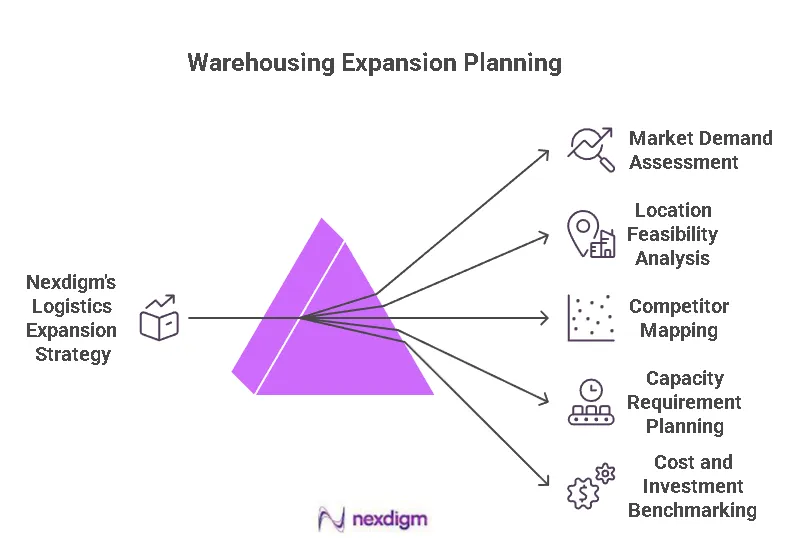
- Market Demand Assessment: Evaluates demand trends, customer density, and sector growth to identify where logistics expansion can create maximum business value.
- Location Feasibility Analysis: Assesses potential warehouse locations based on connectivity, labor availability, rental costs, infrastructure, and access to key consumption markets.
- Competitor Footprint Mapping: Tracks competitor warehouses, distribution hubs, and expansion activity to understand market saturation and whitespace opportunities.
- Capacity Requirement Planning: Estimates future storage, throughput, and handling needs to support scalable expansion without creating excess or underused capacity.
- Cost and Investment Benchmarking: Compares land, lease, labor, transportation, and operating costs to support financially sound logistics expansion decisions.
Nexdigm’s case:
Nexdigm supported a logistics client managing 90+ warehouses across 30+ locations and over 4.5 million sq. ft. of warehousing space. Through process review and performance assessment, Nexdigm helped identify operational gaps, improve control visibility, and support better capacity planning across a large distributed network. Such insights enable logistics players to benchmark warehouse utilization, reduce inefficiencies, and plan scalable expansion in high-demand markets.
To take the next step, simply visit our Request a Consultation page and share your requirements with us.
Harsh Mittal
+91-8422857704