

India’s warehousing market is expanding, but measuring future capacity through square footage alone can be misleading. Across the top eight cities, industrial and warehousing leasing reached 36.9 million sq. ft. in 2025, up 16% year-on-year. Grade A absorption reached about 37 million sq. ft., while more than 41 million sq. ft. of new supply was added. Vacancy remained around 16%.
The market is growing, but capacity requirements are becoming more specific. The next requirement depends on where demand develops, what products are being stored and how quickly those products move.
The Number of Square Feet Is the Wrong Starting Point
A warehouse handling industrial components has a different capacity profile from an e-commerce fulfilment centre. Cold-chain facilities require temperature-controlled infrastructure, while 3PL facilities need flexibility across multiple customers and inventory profiles.
Capacity planning therefore needs to account for:
- Storage density and inventory characteristics
- Throughput and order frequency
- Peak and seasonal demand
- Handling and automation requirements
- Required service levels
- Expected utilisation
A facility can have substantial vacant floor space and still lack the operational capacity required during peak periods.
Capacity Demand Follows What the Market Is Storing
The composition of occupier demand is changing the type of capacity being built.
3PL companies accounted for 30% of industrial and warehousing leasing in H1 2026, followed by engineering at 21% and e-commerce at 16%. Electronics leasing reached 1.4 million sq. ft., almost twice the level of the previous year.
These sectors create different capacity requirements. E-commerce needs high-throughput fulfilment and faster inventory movement. Engineering requires manufacturing-linked storage and larger handling areas. 3PL operators require facilities that can accommodate changing customer requirements.
Future capacity therefore needs to be forecast by segment rather than through a single market-wide growth rate.
Location Changes the Capacity Requirement
Delhi NCR and Chennai accounted for more than 45% of leasing across the top eight cities in H1 2026. Pune, Ahmedabad and Kolkata also recorded strong year-on-year growth, pointing towards a broader distribution of demand.
At the same time, 13 high-activity logistics clusters account for roughly three-quarters of industrial and warehousing demand and new supply accumulated since 2021.
A national capacity surplus can therefore coexist with a shortage in a specific market. A facility is only useful capacity if it can serve the relevant customers, suppliers and production centres within an economically viable network.
Grade A, Cold Chain, Fulfilment, and Industrial Space Have Different Demand Curves
Specification is becoming an important part of the capacity equation. India’s Grade A industrial and warehousing stock has reached approximately 300 million sq. ft., almost twice its 2021 level. Yet occupiers are increasingly looking for modern facilities suited to fulfilment, manufacturing, cold chain and technology-enabled operations.
The supply pipeline is also substantial. The top eight cities added around 25 million sq. ft. of Grade A supply in H1 2026, up 27% year-on-year. Nexdigm expects Grade A supply to reach 45–50 million sq. ft. across these markets by the end of 2026. The resulting capacity gap will depend on whether this new supply matches the location and specifications required by occupiers.
When Does Utilisation Become a Capacity Problem?
A facility operating at high utilisation may face constraints in dock availability, picking, staging, storage configuration or peak-period throughput before all available floor space is occupied. Conversely, a warehouse with low occupancy may still be poorly positioned or unsuitable for the products it is expected to handle. Capacity forecasting needs to distinguish between available space and usable operational capacity.
Forecasting the Next Capacity Requirement
Future requirements can be estimated by combining market growth with operational variables such as inventory turns, throughput, order volumes, seasonal peaks and facility utilisation.
Supply needs to be considered alongside demand. If new capacity enters a market faster than occupiers absorb it, vacancy can rise even while the broader logistics sector continues to grow. If demand concentrates in a particular cluster or specification, shortages can emerge despite sufficient national supply.
Nexdigm’s Framework: Convert Demand Growth into Warehouse Capacity Requirements
Nexdigm evaluates future warehouse requirements across five areas:
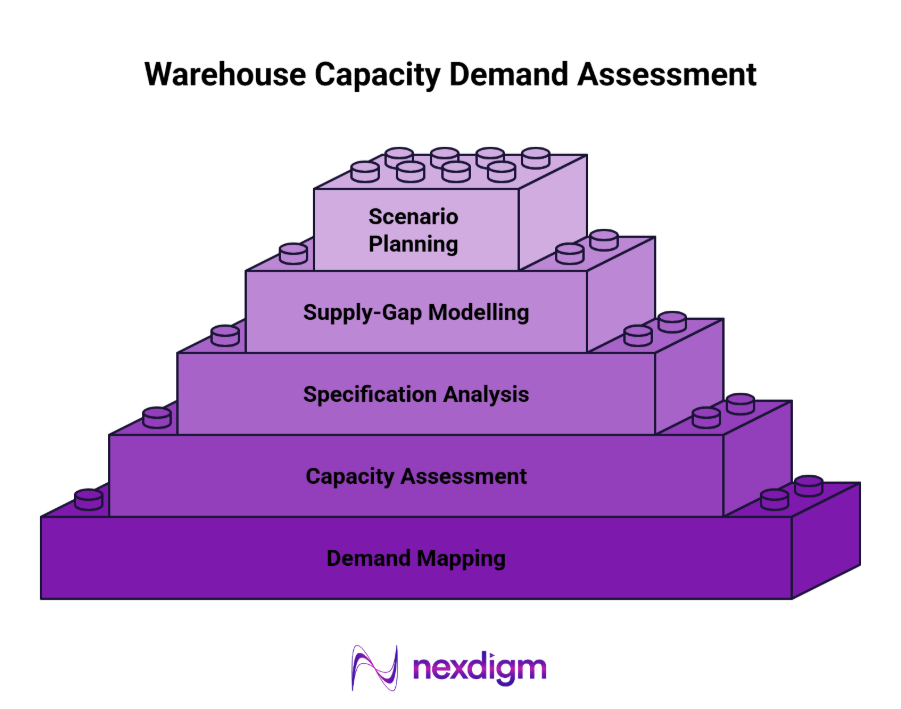
- Demand mapping: Projecting volume growth by geography, industry and customer segment.
- Capacity assessment: Measuring existing space, utilisation, throughput and operational constraints.
- Specification analysis: Identifying requirements for Grade A, fulfilment, cold-chain, manufacturing and specialised storage.
- Supply-gap modelling: Comparing existing and upcoming capacity against projected demand by market.
- Scenario planning: Testing expansion, relocation, leasing and new-build options under different demand assumptions.
A warehouse capacity demand assessment can support decisions on where capacity should be added, what specification it should have and when investment or leasing should take place.
How Nexdigm Identified the Right Capacity Expansion
For an Indian diagnostics manufacturer serving 200+ distributors through three distribution centres, Nexdigm assessed demand, warehouse utilisation and network performance. The analysis recommended a fourth warehouse and relocation of an existing facility, delivering 16% cost savings and a 7% improvement in service levels. It also identified an additional 27% potential supply-chain cost reduction.
To take the next step, simply visit our Request a Consultation page and share your requirements with us.
Harsh Mittal
+91-8422857704