

Warehouse infrastructure is becoming a key investment area as e-commerce expands, manufacturing networks change, and businesses demand faster distribution.
The opportunity is not simply about adding warehouse space but about increasingly need for strong transport links, efficient layouts, automation readiness, reliable utilities, and locations close to customers or production centers.
For developers, investors, logistics companies, retailers, manufacturers, and 3PL providers, the key is understanding where capacity is needed, what type of facility fits the market, and whether development can generate sustainable returns.
A Warehouse infrastructure development analysis helps answer these questions.
Nexdigm connects warehouse demand, supply gaps, location conditions, infrastructure requirements, development feasibility, and investment economics to identify practical opportunities.
Finding the Warehouse Gap
Warehouse demand often varies significantly across regions, making local market analysis essential for informed investment decisions. A national warehouse shortage may actually be driven by capacity constraints in a few high-growth locations.
Nexdigm evaluates:
- Existing Warehouse Stock: Nexdigm analyzes the current warehouse inventory within a market, including facility size, quality, location, and operational capabilities to determine whether existing infrastructure adequately supports industry requirements.
- Absorption and Market Demand Trends: Nexdigm examines the rate at which warehouse space is leased or occupied over time, providing insights into market demand strength and future capacity requirements.
This helps stakeholders identify markets where new warehouse capacity addresses genuine demand rather than creating oversupply, supporting more informed investment and expansion decisions.
Nexdigm in Tracking Warehouse Demand
Nexdigm evaluates the key drivers of warehouse demand to identify which customer groups can support sustainable occupancy and future market growth. These drivers are:
- Retail Distribution Requirements: Nexdigm analyzes retail supply chains and distribution networks to determine demand for warehouses that support inventory storage, replenishment activities, and efficient movement of goods to stores.
- Manufacturing and Production Clusters: The assessment evaluates industrial hubs and production centers where manufacturers require warehousing facilities for raw materials, finished goods, and supply chain coordination near operations.
- E-commerce Fulfillment Demand: Nexdigm studies online retail growth, delivery expectations, and order volumes to identify locations where fulfillment centers can support rapid order processing and last-mile distribution.
Nexdigm helps stakeholders understand these drivers, supporting more informed warehouse investment and expansion decisions.
The Nexdigm Development Framework
Nexdigm’s Warehouse Infrastructure Development Analysis evaluates opportunities across five key areas: Demand, Location, Facility, Development, and Investment.
This simple framework helps businesses and investors determine whether a warehouse shortage represents a genuine development opportunity and whether a new project can achieve long-term success.
- Demand: Evaluates occupier growth, space absorption, vacancy levels, industry activity, and future demand forecasts to determine whether a market can support sustained warehouse utilization and justify additional infrastructure investment.
- Location: Assesses connectivity to transport networks, proximity to customers and industrial clusters, land availability, and emerging logistics hubs to identify locations that maximize operational efficiency and accessibility.
- Facility: Reviews warehouse quality, automation readiness, energy infrastructure, specialized storage requirements, and sustainability features to ensure facilities align with current occupier needs and future market expectations.
- Development: Analyzes construction costs, regulatory approvals, project timelines, competing supply pipelines, and expansion possibilities to determine development feasibility and support effective long-term project planning.
- Investment: Examines rental potential, operating expenses, occupancy outlook, expected returns, and investment risks to evaluate whether warehouse developments can deliver sustainable profitability and attractive financial performance.
How Nexdigm Turns Gaps Into Strategies
Nexdigm’s framework identifies where demand is growing, where capacity is limited, and what type of facility can serve that demand.
For developers, this supports better site selection, facility size, and development planning. Investors can assess market demand, occupancy potential, costs, risks, and expected returns before committing capital.
Logistics operators can identify network gaps and locations for expansion, while retailers, manufacturers, and 3PL providers can evaluate whether new facilities will support future distribution needs.
In simple terms, Nexdigm helps answer three practical decisions: where to develop, what to build, and whether the opportunity makes commercial sense.
Business Impact of the Nexdigm’s Framework
Nexdigm’s framework turns warehouse-market intelligence into decisions that can directly influence investment and operating performance.
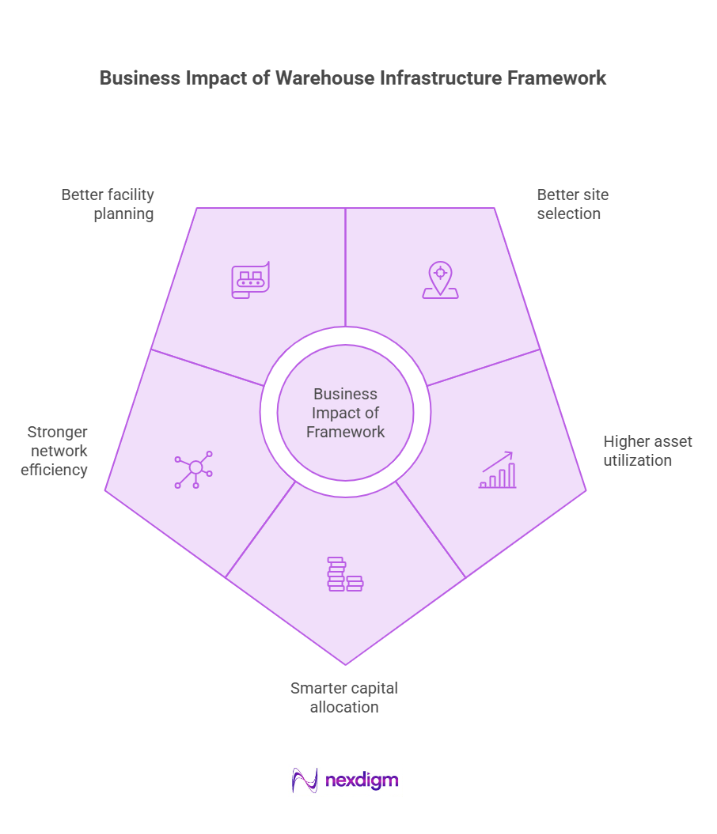
- Better site selection: Identifies locations with stronger demand, connectivity, and occupier potential, reducing the risk of investing in unsuitable markets.
- Higher asset utilization: Aligns facility capacity with projected demand, helping reduce vacancy and improve long-term warehouse occupancy.
- Smarter capital allocation: Compares development costs, demand, risks, and returns so investment can be directed toward stronger opportunities.
- Stronger network efficiency: Identifies locations that can improve distribution coverage, reduce transportation distances, and strengthen connections across logistics networks.
- Better facility planning: Matches warehouse size, specifications, automation readiness, and specialized requirements with the needs of target occupiers.
The framework helps organizations move from simply identifying warehouse demand to making more confident decisions about where to invest, what to develop, how much capacity to build, and when to expand.
Nexdigm’s Case
A logistics developer used Nexdigm’s Warehouse infrastructure development analysis to identify an underserved regional market. Within 12 months, facility utilization improved 29%, development planning time fell 22%, qualified occupier demand increased 31%, and projected investment efficiency improved, supporting stronger capacity and commercial performance.
To take the next step, simply visit our Request a Consultation page and share your requirements with us.
Harsh Mittal
+91-8422857704