

Warehouses support several critical supply chain activities, including receiving, storage, inventory management, picking, packing and dispatch. As businesses expand their distribution networks and manage larger product assortments, manual warehouse processes can become difficult to coordinate.
A Warehouse Management System (WMS) helps organisations manage these activities through structured workflows and real-time inventory information. However, software vendors differ in their functional capabilities, automation compatibility, integration architecture and ability to support complex warehouse operations.
For procurement teams, selecting a WMS requires an assessment of both present operational requirements and future scalability.
Why Warehouse Management System Selection Matters
A WMS coordinates the movement and storage of goods within a warehouse. It helps track inventory by location, manage stock movements, allocate picking tasks and monitor order fulfilment.
The Department for Promotion of Industry and Internal Trade (DPIIT) identifies functionalities such as goods receipt, putaway, picking, packing, dispatch, inventory reconciliation and integration with transportation and warehouse automation systems as important WMS capabilities.
These functions make system selection an important consideration for businesses seeking greater inventory control and operational consistency.
Key vendor evaluation parameters include:
- Inventory control: Stock tracking, inventory reconciliation, batch management and stock rotation.
- Warehouse execution: Receiving, putaway, picking, packing and dispatch workflows.
- Automation compatibility: Integration with conveyors, automated storage systems, sorters and robotics.
- System integration: Connectivity with ERP, TMS, procurement and order management platforms.
- Scalability: Ability to support additional warehouses, higher transaction volumes and changing product assortments.
- Reporting: Inventory accuracy, order fulfilment, warehouse productivity and operational dashboards.
Comparing Inventory Management and Warehouse Functionality
Inventory visibility is one of the primary requirements of a WMS. The system should provide accurate information about stock quantities, storage locations, movement history and order allocation.
Procurement teams should assess whether the platform supports:
- Real-time inventory tracking: Visibility into stock availability and warehouse locations.
- Batch and serial number management: Tracking products through unique identifiers, manufacturing dates and expiry dates.
- Stock rotation: Support for FIFO and FEFO processes where applicable.
- Cycle counting: Scheduled inventory verification and reconciliation.
- Order fulfilment: Automated picking, packing and dispatch workflows.
- Returns management: Processing returned goods and updating inventory records.
The platform should also support warehouse-specific requirements. A pharmaceutical warehouse, for example, may require batch traceability and expiry management, while an e-commerce distribution centre may prioritise high-volume order picking and rapid dispatch.
Evaluating Automation and System Integration
Warehouse automation increasingly involves the coordination of software, equipment and operational workflows.
A WMS may integrate with automated storage and retrieval systems, conveyor networks, barcode scanners, sortation equipment, pick-to-light systems and autonomous mobile robots.
However, automation compatibility should not be assumed simply because a vendor claims to offer integration capabilities.
Procurement teams should examine:
- Availability of standard integration interfaces.
- Compatibility with warehouse control systems.
- Support for equipment-level task allocation.
- Real-time inventory synchronisation.
- Exception handling and system recovery.
- Integration with existing ERP and TMS platforms.
The division of responsibilities between a WMS and external warehouse control systems is particularly important in automated facilities. SAP’s technical documentation highlights the need to coordinate warehouse management tasks with external automation systems.
Warehouse Management System Supplier Benchmarking Framework
A structured warehouse management system supplier benchmarking exercise should compare vendors across operational, technical and commercial requirements.
The evaluation can follow six stages:
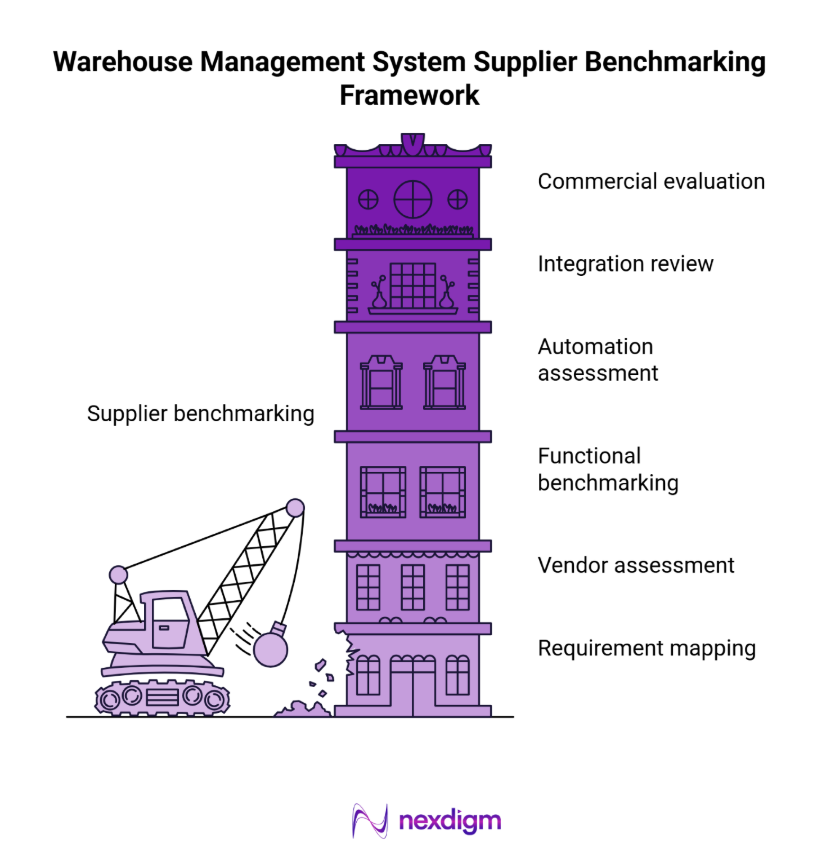
- Warehouse requirement mapping: Identify facility size, inventory categories, order volumes and operational workflows.
- Vendor landscape assessment: Identify WMS providers based on industry coverage, deployment models and functionality.
- Functional benchmarking: Compare inventory management, receiving, picking, packing and dispatch capabilities.
- Automation assessment: Evaluate compatibility with conveyors, robotics, automated storage and warehouse control systems.
- Integration and scalability review: Assess ERP connectivity, API availability, multi-site support and transaction capacity.
- Commercial evaluation: Compare licensing, implementation, maintenance, support and infrastructure costs.
Nexdigm can support organisations through WMS market research, supplier benchmarking, software capability comparisons and procurement due diligence. These assessments help businesses identify platforms that match their warehouse requirements and understand the long-term implications of technology selection.
Nexdigm’s Case Study
Nexdigm benchmarked 9 WMS vendors across 3 warehouse operating models, evaluating inventory control, automation compatibility, ERP integration and scalability. The assessment shortlisted 3 providers, identified a 19% variation in implementation costs and established 7 functional benchmarks for supplier selection.
To take the next step, simply visit our Request a Consultation page and share your requirements with us.
Harsh Mittal
+91-8422857704