

Warehousing has become a strategic part of supply-chain planning. Retail expansion, manufacturing growth, e-commerce, and logistics outsourcing are changing where facilities are needed and what capabilities they require.
India reflects this expansion. JLL reported that warehousing stock across India’s major and emerging markets reached 610 million sq. ft. in 2025, while net absorption reached a record 67 million sq. ft.
For developers, logistics companies, retailers, manufacturers, 3PL providers, investors, and technology companies, the opportunity depends on understanding who needs warehouse space, where demand is moving, and which facilities can serve it efficiently.
A Warehouse market assessment helps connect these factors.
Nexdigm combines occupier demand, industry activity, location economics, facility requirements, technology adoption, and supply conditions to identify attractive warehouse opportunities.
Understanding the Warehouse Market Demand
Warehouse demand varies considerably by user.
Retailers prioritize replenishment and omnichannel distribution. Manufacturers require facilities close to production and supplier networks. 3PL providers need flexible multi-client capacity, while e-commerce operators prioritize fulfillment speed and delivery coverage.
Nexdigm separates these requirements to understand both the volume and type of warehouse demand emerging across markets.
How Nexdigm Compares Key Users
The four major demand groups have different operating requirements.
- Retail: Demand is linked to store networks, inventory replenishment, omnichannel fulfillment, and consumer distribution patterns.
- Manufacturing: Demand follows factories, industrial clusters, supplier networks, production schedules, and inbound and outbound material flows.
- 3PL: Demand reflects logistics outsourcing, multi-client operations, contract logistics, and the need for flexible warehouse capacity.
- E-Commerce: Demand is driven by online orders, fulfillment speed, returns, inventory positioning, and increasingly compressed delivery windows.
Nexdigm compares these segments to determine which users are generating sustainable demand in each market.
Nexdigm’s Warehouse Opportunity Framework
The Warehouse market assessment centers on four dimensions: demand drivers, location potential, facility requirements, and market economics. Each dimension explains a different part of the investment and operating opportunity.
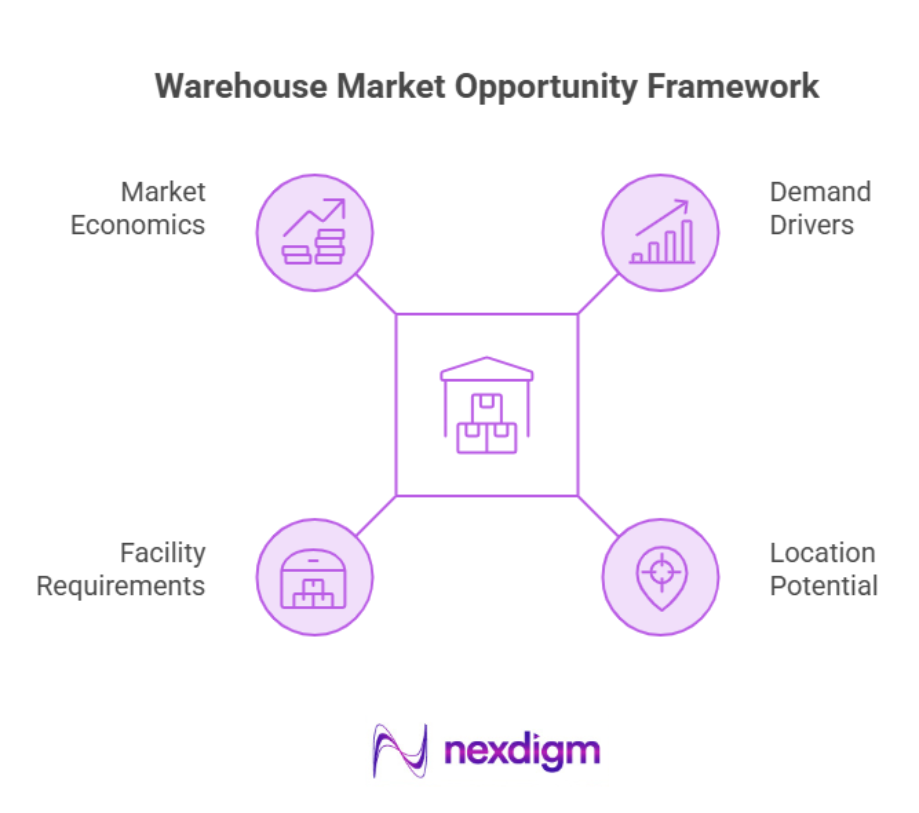
Demand Drivers
- Retail growth: Consumer spending, store expansion, inventory needs, and omnichannel sales indicate where retailers may require additional distribution capacity.
- Manufacturing activity: New factories, industrial investment, supplier clusters, and production expansion reveal where industrial warehouse requirements could increase.
- 3PL outsourcing: Greater reliance on external logistics providers can create sustained demand for flexible, multi-user facilities across established markets.
- E-commerce expansion: Online sales, fulfillment activity, returns, and delivery expectations indicate where specialized warehouse capacity may need to grow.
- User comparison: Nexdigm compares these demand sources to determine which occupier segments provide the strongest long-term foundation for warehouse growth.
Location Potential
- Logistics connectivity: Proximity to highways, ports, airports, railways, and major consumption centers influences warehouse accessibility and distribution efficiency.
- Emerging locations: Secondary cities can become attractive when infrastructure, industrial activity, and consumer demand support decentralized logistics networks.
- Delivery coverage: Nexdigm evaluates whether locations can efficiently serve customers within required delivery windows and service expectations.
- Land availability: Land costs, development availability, zoning, utilities, and infrastructure determine whether additional warehouse capacity can be delivered competitively.
- Regional migration: Nexdigm tracks whether occupier demand is shifting from established logistics hubs toward emerging locations with better economics.
Facility Requirements
- Modern facilities: Grade A warehouses can improve loading, storage density, operating efficiency, compliance, and overall occupier productivity.
- Automation readiness: Nexdigm assesses requirements for robotics, warehouse management systems, automated storage, sorting, and inventory technologies.
- Facility formats: Demand is compared across distribution centers, fulfillment centers, cold storage, multi-client facilities, and specialized warehouses.
- Sustainability: Energy efficiency, renewable power, environmental standards, and sustainable construction can increasingly influence occupier selection.
- User fit: Nexdigm matches facility specifications with the operating needs of retailers, manufacturers, 3PLs, and e-commerce businesses.
Market Economics
- Rental levels: Warehouse rents are assessed alongside location, facility quality, connectivity, vacancy, and occupier demand.
- Operating costs: Labor, utilities, transportation, maintenance, and technology expenses influence the financial performance of warehouse operations.
- Vacancy trends: Vacancy indicates whether new supply is being absorbed effectively or whether markets face potential oversupply.
- Supply pipeline: Nexdigm examines planned and under-construction facilities to determine how future capacity could affect market balance.
- Investment returns: Rental growth, absorption, tenant quality, supply, and long-term demand help determine the attractiveness of warehouse investments.
Nexdigm in Connecting Warehousing With Technology
Technology increasingly affects warehouse productivity and scalability.
Nexdigm evaluates demand for warehouse management systems, transportation management platforms, robotics, automated storage, inventory visibility, digital yard management, and predictive analytics.
This helps businesses to identify where technology can improve measurable outcomes such as storage density, order accuracy, labor productivity, throughput, and delivery performance.
Turning Market Signals Into Strategic Decisions
Warehouse demand becomes commercially useful when it informs specific decisions.
Nexdigm supports market entry, site selection, facility development, portfolio expansion, leasing strategy, automation investment, warehouse modernization, and 3PL network planning.
Developers can identify locations where new capacity is more likely to achieve strong absorption. Operators can evaluate markets that improve network coverage and investors can identify assets positioned around durable occupier demand.
Nexdigm’s Case
A logistics operator used Nexdigm’s Warehouse market assessment to identify high-demand locations and optimize facility capacity. Within 12 months, warehouse utilization increased 28%, qualified occupier leads grew 33%, operating costs declined 16%, and order fulfillment improved, strengthening network efficiency, customer service, and commercial performance.
To take the next step, simply visit our Request a Consultation page and share your requirements with us.
Harsh Mittal
+91-8422857704