

Warehouse service pricing analysis helps logistics providers, retailers, manufacturers, and third-party operators align storage charges with rising demand, facility location, space utilization, service complexity, and operating costs. Effective pricing analysis evaluates rental rates, handling fees, inventory velocity, labor, automation, energy, and value-added services to establish competitive and profitable structures.
By applying warehouse service pricing analysis, businesses can improve rate transparency, segment customers, optimize capacity, recover costs, strengthen contract negotiations, and adapt pricing models across urban, regional, cold-chain, and fulfillment markets while supporting scalable growth and dependable service delivery worldwide today.
The global warehousing market was estimated at USD 1.5 trillion in 2025 and is projected to reach about USD 3.3 trillion by 2035, representing 8.3% annual growth and creating strong opportunities for pricing optimization, capacity planning, and profitable service differentiation.
Pricing Analysis for Warehouse Space and Value-Added Services
Warehouse pricing analysis evaluates space utilization, service complexity, customer demand, operating costs, and market benchmarks to develop competitive rates and strengthen service profitability sustainably. Some important dimensions of the service are:
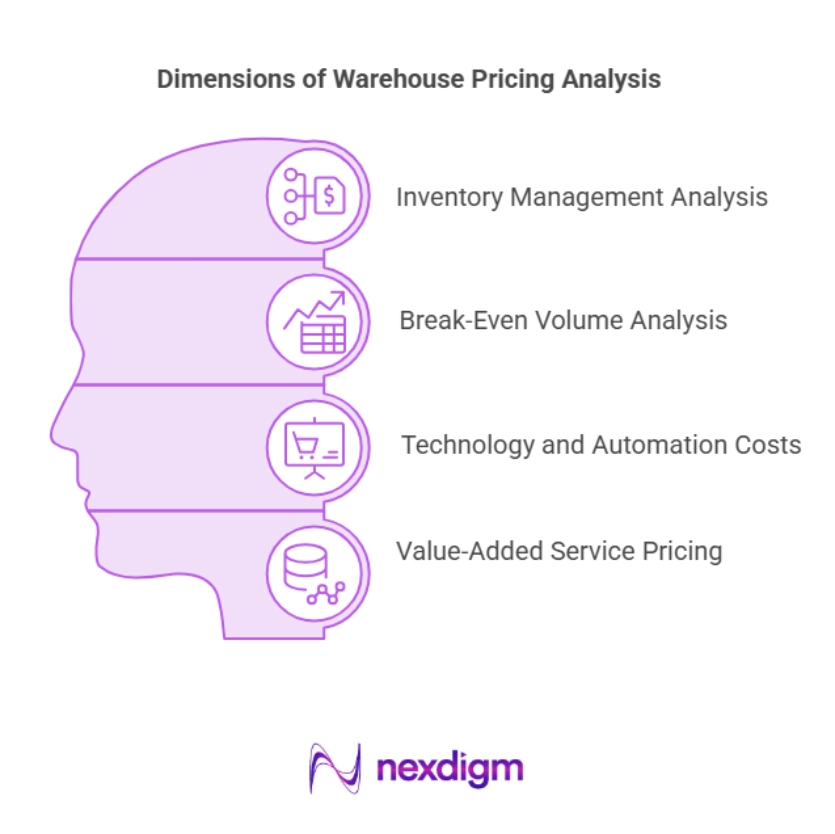
- Storage Space Utilization: Assess occupied areas, pallet density, dwell time, seasonality, and capacity availability to establish storage rates aligned with actual space consumption.
- Inventory Management Analysis: Analyze stock turnover, storage duration, order frequency, and movement patterns to differentiate rates for fast-moving, slow-moving, and seasonal inventory categories.
- Value-Added Service Pricing: Establish charges for labeling, kitting, repackaging, quality checks, returns processing, and customization based on labor, technology, and service complexity.
- Technology and Automation Costs: Incorporate warehouse management systems, robotics, tracking tools, data integration, and automation investments into pricing to support efficient cost recovery and scalability.
Nexdigm’s Advisory Role and Support in Warehouse Service Pricing Analysis
Nexdigm supports warehouse capacity and service pricing optimization through warehouse service pricing analysis, rate benchmarking, demand forecasting, and cost-to-serve analysis. Its expertise combines storage pricing intelligence, capacity planning, market analysis, and revenue optimization to help businesses improve warehouse utilization, strengthen pricing competitiveness, optimize value-added service charges, protect margins, and enhance long-term profitability across dynamic warehousing and fulfillment networks.
Nexdigm’s Dynamic Pricing Model for High-Demand Warehouse Markets
Nexdigm’s dynamic pricing model integrates demand, capacity, service complexity, customer value, and cost intelligence to create responsive warehouse rates that improve utilization, profitability, competitiveness, and commercial scalability. Some commonly used frameworks in this model are:
- Capacity Utilization Framework: Links pricing with available space, pallet density, inventory dwell time, and facility constraints to improve warehouse utilization and reduce idle capacity.
- Dynamic Rate Trigger Framework: Activates pricing adjustments when occupancy, labor costs, demand intensity, service requirements, or market conditions cross predefined commercial and operational thresholds.
- Multi-Tier Service Framework: Structures basic, standard, priority, and premium warehouse packages according to storage conditions, handling speed, reporting, customization, and service-level commitments.
- Location Premium Framework: Applies market-specific premiums based on proximity to customers, transport connectivity, labor access, urban demand, and regional warehouse availability.
Nexdigm’s Case
Nexdigm supported a warehousing company with dynamic pricing, customer segmentation, and cost-to-serve analysis. Over ten months, the engagement increased revenue per square foot by 12%, improved inventory turnover by 11%, reduced storage inefficiencies, and boosted customer retention by 10%.
To take the next step, simply visit our Request a Consultation page and share your requirements with us.
Harsh Mittal
+91-8422857704