

Warehouse provider selection has become an important consideration for businesses managing complex supply chains, expanding distribution networks, and rising customer service expectations. According to Savills India’s Year-End 2025 report, the industrial and logistics sector recorded 76.5 million sq. ft. of annual absorption, registering 18.6% year-on-year growth. Manufacturing accounted for 29% of total absorption, reflecting growing demand for industrial and storage infrastructure.
Another survey also reported that third-party logistics (3PL) providers accounted for approximately 44% of warehousing space absorption in H2 2025. These trends highlight the importance of selecting providers with suitable infrastructure, inventory management capabilities, geographic coverage, and service standards. A structured warehouse service provider analysis helps businesses compare potential partners against operational requirements and long-term distribution priorities.
Why Warehouse Provider Selection Requires Operational Alignment
Warehouse providers differ in their facility locations, storage capacity, technology infrastructure, workforce capabilities, and distribution networks. A provider offering competitive pricing may not necessarily meet requirements for specialized storage, inventory visibility, order fulfilment, or delivery timelines. Businesses must therefore assess service capabilities alongside costs to determine whether a provider can support current operations and future supply chain requirements.
Core Areas to Evaluate in Warehouse Partnerships
A warehouse partnership should be assessed across three dimensions that directly influence inventory control, distribution performance, and service delivery:
- Inventory Management: Evaluate storage capacity, stock accuracy, warehouse management systems, handling procedures, and inventory reporting capabilities.
- Distribution and Connectivity: Examine facility locations, transportation access, regional coverage, dispatch capabilities, and integration with distribution networks.
- Service Quality and Flexibility: Assess order fulfilment accuracy, turnaround times, workforce availability, scalability, and service-level commitments.
Considering these factors together helps businesses identify providers that balance operational efficiency, service reliability, and commercial value.
Nexdigm’s Role in Helping Businesses Evaluate Warehouse Partners
Nexdigm can support businesses through warehouse service provider analysis, combining market research and supplier benchmarking to evaluate potential partners. The assessment examines provider networks, facility infrastructure, technology capabilities, inventory management, distribution services, and commercial terms. By comparing these factors against operational requirements, businesses can identify suitable providers, assess capability gaps, and make informed warehouse sourcing decisions.
What Nexdigm’s Warehouse Service Provider Analysis Highlights
Nexdigm’s warehouse service provider analysis connects market intelligence with business requirements to reveal insights that go beyond basic supplier comparisons. It focuses on four areas:
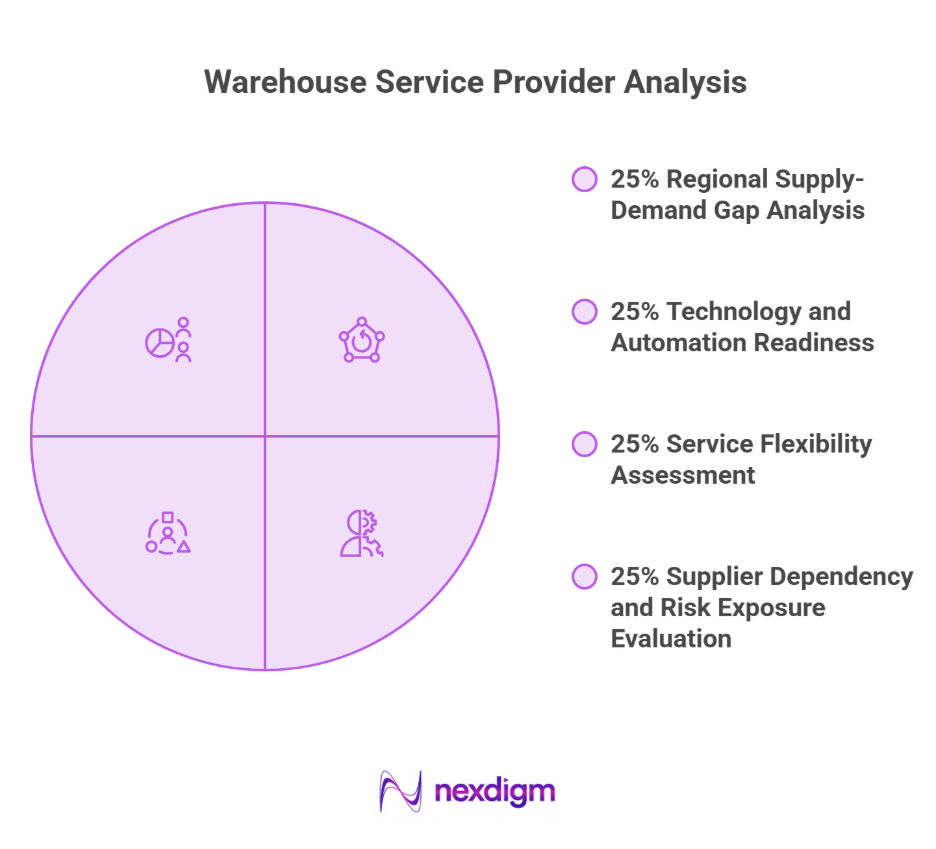
- Regional Supply-Demand Gaps: Identify locations where warehouse availability, infrastructure, or service coverage may not adequately meet business requirements.
- Technology and Automation Readiness: Assess providers’ use of warehouse management systems, automation, real-time tracking, and digital inventory solutions.
- Contract and Service Flexibility: Examine providers’ ability to accommodate seasonal demand, changing storage volumes, customised services, and evolving contractual requirements.
- Supplier Dependency and Risk Exposure: Evaluate concentration risks, geographic dependencies, operational vulnerabilities, and alternative sourcing options.
These insights can help businesses identify suitable warehouse partners, address supply chain vulnerabilities, and build more adaptable warehousing strategies.
How Nexdigm’s Analysis Supports Better Warehouse Sourcing Decisions
Nexdigm’s research-led analysis can help businesses translate warehouse provider comparisons into practical sourcing insights across four areas:
- Provider Performance Benchmarking: Compare warehouse operators on storage efficiency, inventory accuracy, order fulfilment, service reliability, and operational capabilities.
- Cost and Commercial Analysis: Examine storage charges, handling fees, transportation costs, and contractual terms to identify cost differences and potential savings.
- Operational Gap Identification: Assess limitations in facility capacity, technology, geographic coverage, and service delivery against business requirements.
- Supplier Selection Recommendations: Translate comparative findings into provider shortlists and sourcing recommendations aligned with operational priorities and future expansion plans.
These insights can help businesses improve supplier selection, strengthen commercial negotiations, and build more efficient warehouse networks.
Nexdigm’s Analysis Building Resilient Warehouse Networks
Nexdigm brings together market intelligence, supplier benchmarking, and operational insights to help businesses make strategic warehouse sourcing decisions. By identifying provider strengths, regional infrastructure gaps, cost differences, and capacity constraints, its analysis can support better supplier allocation, network planning, and resource utilisation. This enables businesses to develop warehouse networks that are more cost-efficient, flexible, and aligned with evolving distribution requirements.
Nexdigm’s Case
A distribution company sought to improve warehouse coverage and control storage costs. Nexdigm’s assessment compared provider capabilities, facility locations, and commercial terms, identifying 17% potential cost savings and 21% scope for improving regional coverage. These insights helped refine supplier selection and optimise warehouse allocation.
To take the next step, simply visit our Request a Consultation page and share your requirements with us.
Harsh Mittal
+91-8422857704