

Historical leasing tells an investor what tenants took last year, not how much space the market will need next. A physical forecast begins with goods moving through the region: retail sales, manufacturing output, imports, e-commerce orders and the inventory policies of the businesses that handle them. Those drivers are then translated into pallets, order lines and square feet. Vacancy, obsolete buildings and projects under construction determine how much additional supply the market can absorb.
India provides a useful example of why a leasing-only extrapolation can mislead. Commercial market trackers recorded strong industrial and warehouse absorption across major cities in 2025, with third-party logistics and e-commerce among the important occupiers. The mix matters more than the headline. A 3PL contract can represent a new tenant taking over stock already held by a manufacturer; e-commerce expansion may require more small urban facilities as well as regional fulfillment centers. Neither translates into an identical amount of net new national space.
Model the Stock, Flow, and Building Grade
For each market, forecast inventory throughput by sector and season. Convert throughput into average inventory using days of cover, then divide by practical storage density and utilization to estimate occupied area. Apply different space coefficients to bulk commodities, apparel, auto parts and fast-moving consumer goods. A move from just-in-time sourcing to more resilient stockholding raises days of cover; better inventory systems or faster turns can offset that increase. E-commerce adds picking, packing and returns space, so its floor-area intensity can differ from bulk storage.
Next separate Grade A demand from the older stock that tenants can still use. Clear height, floor loading, dock doors, fire protection, refrigeration, power and truck access affect substitutability. A vacancy rate of 8% is not an 8% supply cushion if most vacant space is in the wrong submarket or lacks the required specification. Announced construction should be weighted by land control, permits, financing and completion probability rather than counted at face value.
Identify the Markets Where a Shortage Is Plausible
A robust model forecasts demand under low, base and high cases, then tests supply delivery and absorption timing. Compare required occupied space with usable existing stock and committed completions. Include lease expiries and latent space that occupiers currently hold but could release. Regional logistics intensity should reflect proximity to ports, highways, industrial corridors and consumer demand, not state-level GDP alone.
For an investor or developer, the question becomes whether demand will support a specific building in a specific micro-market at a sustainable rent. Nexdigm can link sector growth and local operating requirements to a phased development plan, identifying where pre-leasing, built-to-suit design or a smaller initial phase limits downside.
A Four-Step Framework for Forecasting Warehouse Requirements
A practical warehouse demand assessment should answer four questions:
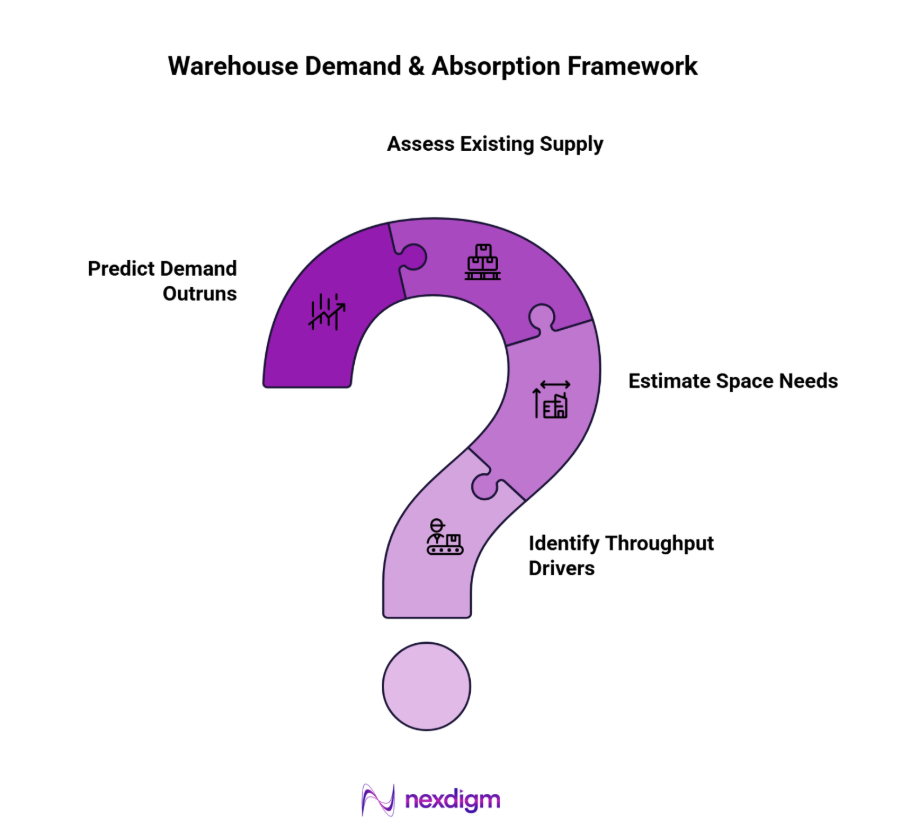
- What Is Driving Throughput?
Map sector growth, inventory movement, e-commerce activity and manufacturing output to establish the physical demand base. - How Much Space Does That Activity Require?
Translate throughput into inventory, pallet positions and usable floor area, while adjusting for storage density, utilisation and building specifications. - How Much Usable Supply Already Exists?
Separate occupied, vacant and obsolete stock from genuinely competitive Grade A capacity, then test which announced projects are likely to reach completion. - Where Will Demand Outrun Supply?
Model low, base and high scenarios by market and compare future requirements with deliverable capacity to identify where development or expansion is commercially justified.
How Nexdigm Supports Warehouse Investment Decisions
Nexdigm can combine sector demand, inventory requirements, local logistics conditions and future supply to determine how much warehouse capacity a market can realistically absorb. The assessment helps developers and investors decide where to build, how quickly to phase capacity and whether a site should be developed speculatively, pre-leased or held for later activation.
Nexdigm Case Study
Nexdigm assessed warehouse requirements across Delhi NCR, Mumbai, Pune, Bengaluru and Chennai for a logistics investment programme. The team modelled sector-level throughput, Grade A requirements and competing supply, identifying a 1.2 million-square-foot projected shortfall across 2 submarkets. The findings supported phased development in those locations while deferring a lower-priority site.
To take the next step, simply visit our Request a Consultation page and share your requirements with us.
Harsh Mittal
+91-8422857704