

Choosing a location for a greenfield warehouse is a long-term strategic decision. Demand, customer proximity, land availability, transportation connectivity, labor, utilities, construction costs, and future capacity requirements all influence whether a facility can deliver sustainable returns.
India’s industrial and logistics sector continues to attract strong occupier demand. CBRE reported that 27.1 million sq. ft. of industrial and logistics space was leased across India’s top eight cities in H1 2025, a record first-half level and 63% higher year-on-year.
The market is also moving toward higher-quality facilities. CBRE’s 2025 occupier survey found that 84% of occupiers were moving from older facilities to newer, investment-grade warehouses, while 57% were investing in automation. These trends make greenfield development attractive, but building a warehouse requires considerably more than identifying a large plot of land.
A warehousing greenfield entry strategy consulting approach helps organizations evaluate market demand, location attractiveness, land economics, customer proximity, operating costs, and long-term scalability to identify locations and development models that can support commercially viable warehouse investments.
Location Strategy Driving Warehouse Success
A greenfield warehouse can offer strong operational capabilities, but long-term performance depends heavily on location strategy. Proximity to customers, suppliers, ports, highways, manufacturing hubs, and distribution centers can significantly influence logistics costs, service levels, network efficiency, and overall supply-chain performance. Evaluating these factors early helps ensure that warehouse investments are aligned with both operational and commercial objectives.
Future-Ready Warehousing Starts with Demand and Scalability
Successful warehouse developments are built around realistic demand projections rather than current requirements alone. Assessing shipment volumes, customer needs, industry growth, distribution patterns, and capacity requirements helps determine the right facility scale and design. As occupiers increasingly seek automation-ready, sustainable, and investment-grade facilities, incorporating future expansion potential and evolving market requirements can support stronger asset utilization and long-term returns.
Role of Nexdigm in Supporting Warehousing Greenfield Investments
As demand for modern logistics infrastructure continues to grow, Nexdigm helps organizations evaluate greenfield warehouse opportunities through a structured assessment of market demand, location attractiveness, land economics, operating feasibility, and long-term scalability. Through its warehousing greenfield entry strategy consulting approach, Nexdigm enables businesses to identify locations and development strategies that support sustainable growth and investment returns.
Why Organizations Engage Nexdigm for Warehousing Greenfield Investments
Greenfield warehouse investments involve multiple strategic, operational, and financial decisions that can significantly impact long-term returns. Nexdigm helps organizations evaluate opportunities through a holistic assessment which involves:
- Data-Driven Location Selection: Identify locations that align with customer demand, supply-chain requirements, and long-term growth objectives.
- Comprehensive Investment Evaluation: Assess market potential, land economics, operating costs, and development feasibility before capital deployment.
- Risk-Informed Decision-Making: Evaluate location, infrastructure, demand, and operational risks to support stronger investment outcomes.
- Scalable Development Planning: Align warehouse design and capacity planning with future growth requirements and occupier expectations.
Through this approach, Nexdigm helps organizations identify attractive warehouse locations, evaluate investment feasibility, and develop scalable facilities aligned with long-term growth objectives.
Nexdigm’s Greenfield Warehouse Framework
Nexdigm’s warehousing greenfield entry strategy consulting framework evaluates the following areas to help businesses develop scalable facilities aligned with long-term growth objectives. These areas are:
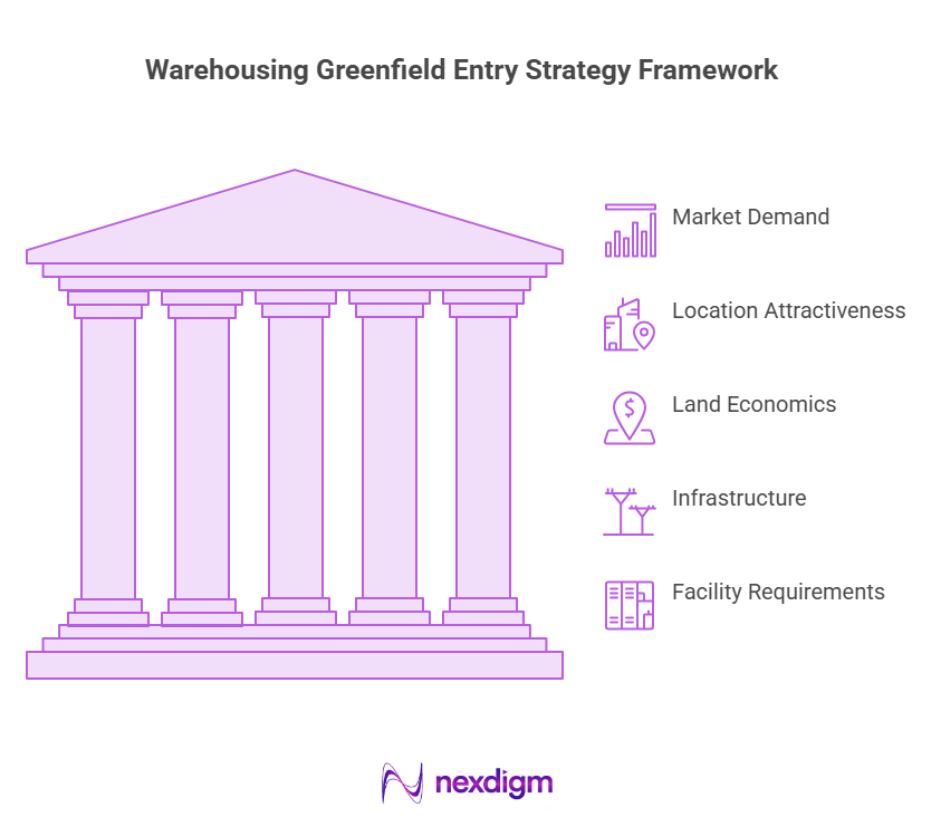
- Market Demand: Nexdigm assesses customer volumes, industry growth, distribution requirements, e-commerce activity, and future warehousing demand.
- Location Attractiveness: The assessment compares access to customers, suppliers, highways, ports, airports, railways, labor markets, and consumption centers.
- Land Economics: Nexdigm evaluates land availability, acquisition costs, lease alternatives, development costs, zoning, and future appreciation potential.
- Infrastructure: The framework assesses roads, utilities, power, water, connectivity, telecommunications, and surrounding logistics infrastructure.
- Facility Requirements: Nexdigm evaluates warehouse size, specifications, storage systems, automation readiness, loading infrastructure, parking, and expansion requirements.
The framework converts location and market analysis into a greenfield development roadmap, helping organizations select sites, determine capacity, evaluate investment requirements, and plan phased expansion.
Benefits of Nexdigm’s Greenfield Warehouse Framework
Nexdigm’s framework provides a structured approach to evaluating warehouse investment opportunities, helping organizations make more informed location and development decisions.
- Better Location Selection: Identifies locations that offer the right balance of demand, connectivity, customer access, and long-term growth potential.
- Improved Investment Outcomes: Aligns warehouse development decisions with market demand, operational requirements, and commercial viability to maximize returns.
- Reduced Development Risk: Evaluates location, infrastructure, demand, and cost considerations early to minimize investment and execution risks.
Through the following benefits, organizations can make informed location and development decisions by evaluating demand, location attractiveness, operational feasibility, and scalability. This enables the creation of future-ready warehouse assets that support sustainable growth and long-term value creation.
Nexdigm’s Case
A logistics client engaged with Nexdigm to assess locations for a new warehouse using demand, customer proximity, land costs, transportation, infrastructure, and future capacity. The assessment shortlisted three priority locations, improved projected utilization by 18%, and identified opportunities to reduce network costs by 14%, strengthening investment feasibility.
To take the next step, simply visit our Request a Consultation page and share your requirements with us.
Harsh Mittal
+91-8422857704