

Warehouse decisions are becoming more strategic as companies balance inventory growth, e-commerce demand, supply-chain resilience, rental costs, occupancy, and location requirements. For many businesses, the decision is whether to own it, lease it, or combine both models.
The global warehousing market was valued at approximately $1.16 trillion in 2025 and is projected to reach about $1.24 trillion in 2026, according to Grand View Research. The market is forecast to grow at a 9.2% CAGR from 2026 to 2033.
Demand is also increasingly concentrated around modern, well-connected facilities. The market is not uniform, however. Some locations face tight availability and rising rents, while others have excess supply and greater negotiating power for tenants.
For manufacturers, retailers, e-commerce companies, 3PLs, distributors, logistics providers, investors, developers, and supply-chain leaders, the central question is if their warehouse capacity should be built, leased, or secured through a hybrid model?
A warehousing market feasibility entry consulting approach helps evaluate demand, rental costs, occupancy, infrastructure, operating costs, and future capacity needs to help organizations choose the warehouse strategy that best supports operational and commercial objectives.
Demand, Cost & Location Considerations
Warehouse planning should be driven by current and future demand, including inventory levels, SKU complexity, order volumes, seasonality, and customer locations. Beyond rent, organizations must assess total occupancy costs such as transportation, labor, utilities, maintenance, technology, and insurance. Location also plays a critical role, influencing freight costs, delivery speed, labor availability, and customer service.
Build vs. Lease Decision
The choice between building and leasing is a strategic one. Building offers greater control over design, technology, and long-term operations, while leasing provides flexibility and reduces upfront capital investment. The right approach depends on demand certainty, investment capacity, occupancy requirements, lease economics, and long-term supply chain objectives.
Nexdigm’s Data-Driven Approach to Warehouse Planning
Nexdigm helps organizations make informed warehousing decisions by combining demand forecasting, market analysis, location assessment, and cost modeling. The approach evaluates current and future capacity requirements, infrastructure availability, and operational considerations to determine whether a build, lease, or hybrid strategy is the most effective option.
By aligning warehousing investments with business growth plans, supply chain objectives, and financial priorities, we help organizations optimize costs, improve network efficiency, and create long-term operational resilience.
Nexdigm’s Warehousing Feasibility Assessment
Choosing the right warehousing strategy requires more than comparing rental costs or available space. Through its warehousing market feasibility entry consulting approach, Nexdigm evaluates market demand and financial viability to help organizations identify the most effective warehousing solution for current needs and future growth through:
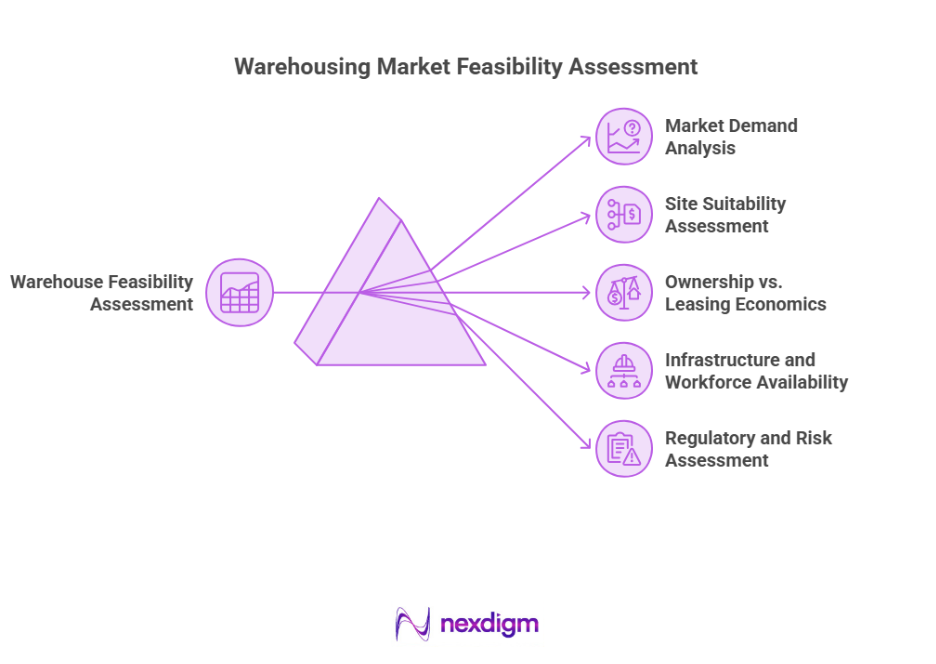
- Market Demand Analysis: Evaluates current and projected storage requirements based on inventory levels, business growth, demand patterns, customer locations, and supply chain dynamics to ensure appropriate capacity planning.
- Site Suitability Assessment: Analyzes location attractiveness by considering connectivity, proximity to suppliers and customers, infrastructure quality, accessibility, and expansion potential to support long-term operational efficiency.
- Ownership vs. Leasing Economics: Compares build, lease, and hybrid models by assessing capital investment, occupancy costs, financing requirements, flexibility, and long-term financial implications for informed decision-making.
- Infrastructure and Workforce Availability: Reviews transportation networks, utilities, technology readiness, labor availability, and workforce costs to determine the operational viability of potential warehouse locations.
- Regulatory and Risk Assessment: Examines zoning requirements, permits, compliance obligations, environmental considerations, and market risks to help minimize operational disruptions and investment uncertainties.
Nexdigm’s assessment helps organizations make data-driven warehouse investment decisions by balancing cost, operational efficiency, scalability, and long-term business objectives.
Nexdigm’s Warehouse Location and Site Selection Strategy
Selecting the right warehouse location can significantly influence operating costs, service levels, and future scalability. Nexdigm helps organizations identify and evaluate strategic warehouse locations through the following approach:
- Location Shortlisting: Identifies high-potential warehouse markets based on demand drivers, industrial activity, logistics infrastructure, and proximity to key customer and supplier clusters.
- Connectivity Evaluation: Assesses access to highways, ports, airports, rail networks, and major distribution corridors to optimize supply chain efficiency and transit times.
- Labor Market Analysis: Evaluates workforce availability, skill levels, wage trends, and labor market competitiveness to support efficient warehouse operations.
- Competitive Benchmarking: Compares rental rates, occupancy levels, supply availability, and market dynamics to identify attractive warehousing opportunities.
Nexdigm helps businesses identify warehouse locations that balance cost efficiency, operational performance, and future growth requirements.
Turning Warehousing Insights into Action with Nexdigm
Warehousing decisions require balancing demand forecasts, location viability, operating costs, and long-term growth objectives. Nexdigm’s data-driven approach helps organizations evaluate these factors, compare strategic alternatives, and select warehousing solutions that align with both operational requirements and business goals.
Nexdigm’s Case
A logistics company engaged with Nexdigm to assess warehouse demand, occupancy, rental costs, and location economics. The analysis supported a revised capacity strategy that improved warehouse utilization by 21%, reduced occupancy costs by 14%, and lowered transportation expenses by 11%, improving network flexibility and supporting scalable business growth.
To take the next step, simply visit our Request a Consultation page and share your requirements with us.
Harsh Mittal
+91-8422857704