
Warehouse demand is often measured in square feet, but space alone says little about whether a facility is commercially viable. A manufacturing warehouse, an e-commerce fulfilment centre and a 3PL multi-client facility can occupy similar areas while having completely different requirements for location, building specification, labour and throughput.
India’s current market illustrates this differentiation. Industrial and warehousing demand across the country’s top eight cities reached about 22 million sq. ft. in H1 2026, up 12% year on year, according to Colliers. Delhi-NCR and Chennai together accounted for more than 45% of demand. 3PL operators represented about 30% of leasing, followed by engineering and e-commerce occupiers.
CBRE similarly reported that Delhi-NCR, Chennai and Bengaluru represented approximately 60% of H1 2026 industrial and logistics leasing, while 3PL and engineering and manufacturing accounted for 31% and 26% of absorption. About 33% of new warehousing supply was institutionally backed, indicating continued investor preference for higher-quality assets.
The figures point to an important distinction: demand is growing, but it is concentrated by geography, occupier type and facility quality.
Space requirements are being created by different operating models
3PL companies generally require flexible facilities that can accommodate multiple customers, changing inventory profiles and varying contract durations. Their demand can therefore support large Grade-A facilities in established logistics clusters.
Manufacturing occupiers have different priorities. Warehouses need to support inbound raw materials, production schedules and finished-goods distribution. Proximity to plants, suppliers and transport corridors can matter more than access to consumer markets.
Retail networks require inventory to be positioned around store clusters and regional distribution points. E-commerce creates yet another configuration. Faster delivery models require inventory to move closer to consumers, creating demand for regional fulfilment centres as well as smaller urban facilities.
These differences make aggregate vacancy a weak measure of market feasibility. A city may have available warehouse space while still lacking buildings with the required clear height, floor loading, dock configuration, power capacity or access to major transport corridors.
Location can change the economics of otherwise similar buildings
Warehouse feasibility depends heavily on the relationship between facility location and the cost of moving inventory.
A lower-rent facility farther from customers may appear attractive until additional line-haul and delivery costs are incorporated. Conversely, a more expensive site near a major consumption cluster can be economically preferable if it reduces transport distances and improves delivery productivity.
Current leasing patterns demonstrate this concentration. Colliers reported that Bhiwandi in Mumbai and the Farukhnagar and NH-48 clusters in Delhi-NCR together accounted for more than one-third of demand in H1 2026. At the city level, Bhiwandi, Chakan-Talegaon and Oragadam were among the strongest Grade-A micro-markets during 2025.
This suggests that feasibility should be tested at micro-market level rather than treating an entire metropolitan area as a single warehouse market.
Supply growth does not automatically mean oversupply
The relationship between demand and new construction is also becoming more important. Colliers reported approximately 25 million sq. ft. of new supply across the top eight Indian markets during H1 2026, exceeding the 22 million sq. ft. of leasing recorded during the period. Vacancy consequently increased to 16.7% at the end of Q1 2026. Yet rents remained broadly stable across most major cities, with stronger increases in selected high-activity micro-markets.
This is a useful reminder that supply should be evaluated by quality and location, not simply quantity. A market can experience rising vacancy overall while well-located Grade-A assets continue to attract tenants.
The feasibility question is therefore whether new space will meet the requirements of future occupiers better than existing inventory.
Testing whether new warehouse capacity makes commercial sense
A warehouse feasibility assessment can be built around five practical tests:
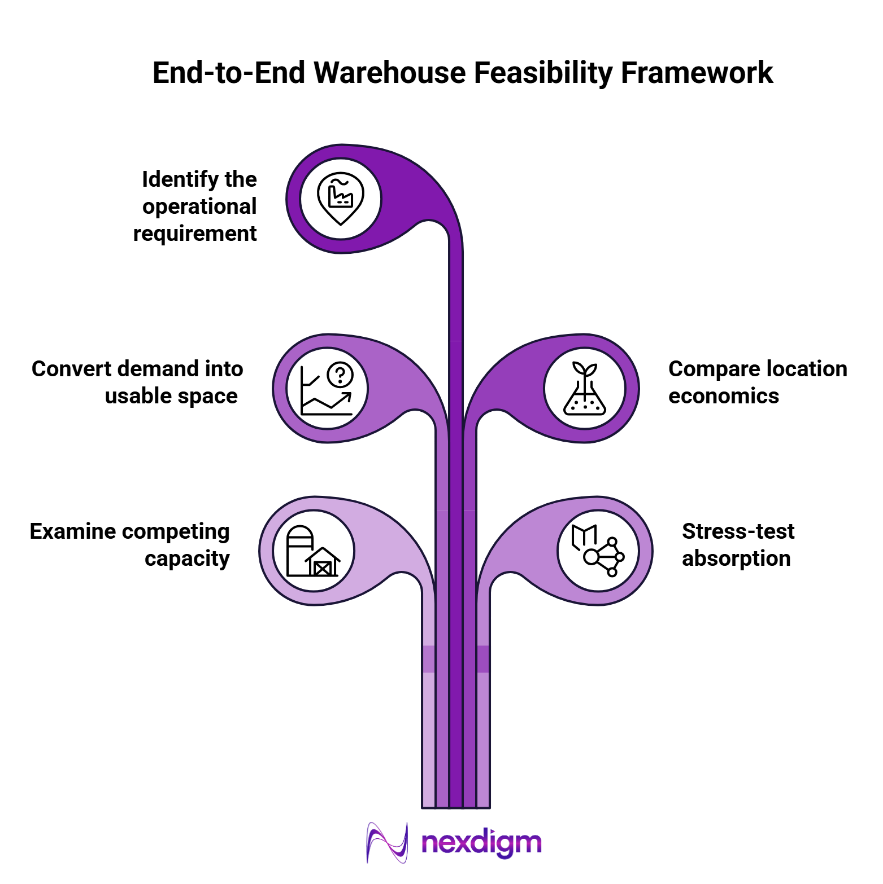
- Identify the operational requirement
Define whether the facility is intended for manufacturing, retail, 3PL, e-commerce or another use. Establish storage density, throughput, temperature requirements, automation needs and delivery frequency. - Convert demand into usable space
Estimate inventory volumes, pallet positions, throughput and utilisation. Gross floor area should then be translated into genuinely usable storage and operating capacity. - Compare location economics
Evaluate rent or land cost alongside transport to suppliers, ports, factories and customers. The lowest property cost does not necessarily produce the lowest supply-chain cost. - Examine competing capacity
Map existing Grade-A and Grade-B facilities, vacancy, upcoming supply, tenant quality and rental levels. Identify whether the proposed asset addresses a genuine specification or location gap. - Stress-test absorption
Model conservative, base and upside leasing scenarios. Test how quickly space can be absorbed, what rental level is sustainable and how the project performs if demand shifts toward alternative locations or facility formats.
This is the basis of warehousing market feasibility research that connects property economics with actual supply-chain requirements. For Nexdigm, the assessment can support decisions around new facility development, network consolidation, market entry or location selection.
Nexdigm Case: Screening a Regional Warehouse Network
A feasibility study assessed 14 warehouse markets and 29 occupier segments across manufacturing, retail, 3PL and e-commerce. Four locations met minimum demand and cost thresholds. A proposed 850,000-sq.-ft. Grade-A facility in the highest-ranked cluster achieved the strongest five-year occupancy scenario, supported by diversified anchor demand.
To take the next step, simply visit our Request a Consultation page and share your requirements with us.
Harsh Mittal
+91-8422857704