

Warehousing costs can represent a significant part of an organisation’s logistics expenditure, particularly for businesses managing large inventory volumes or operating across multiple distribution markets. However, comparing warehouse providers is rarely as simple as evaluating rental rates per square foot or pallet position.
Storage costs vary according to location, facility specifications, labour availability, infrastructure, technology and the range of services included in a contract. Two providers operating in the same market may offer substantially different commercial arrangements because their facilities and service models are not equivalent.
For procurement teams, warehousing procurement cost benchmarking reports provide a structured way to understand these differences, evaluate supplier competitiveness and identify opportunities to improve warehouse spending.
What Determines Warehousing Procurement Costs?
Warehouse pricing is influenced by several operational and geographical factors.
Location is one of the most visible cost drivers. Facilities located near major consumption centres, ports, industrial clusters and transportation corridors may command higher rental rates because of their accessibility and infrastructure.
Facility specifications also affect pricing. Temperature-controlled warehouses, specialised storage facilities and buildings with advanced fire protection or automated handling systems generally involve different cost structures from conventional storage facilities.
The pricing model used by the provider is equally important. Some operators charge by square footage, while others use pallet positions, cubic volume, handling activity or a combination of these measures.
A procurement comparison must account for these differences before identifying which provider offers better value.
Comparing Warehouse Pricing Models
Warehouse contracts may include fixed and variable charges.
Fixed charges can cover storage space, facility access and dedicated infrastructure. Variable charges may include receiving, put-away, picking, packing, dispatch, labour and inventory handling.
Additional costs can arise from packaging, labelling, stock counting, order processing, equipment usage and technology access.
A provider offering a lower storage rate may charge more for inbound and outbound handling. Another may offer a higher base rate but include value-added services that reduce the organisation’s overall operating expenditure.
Procurement teams should therefore compare the total cost of operating a warehouse rather than focusing on a single pricing component.
A standardised cost model should account for storage requirements, average inventory levels, inbound and outbound volumes, order profiles, operating hours and additional service needs.
Understanding Regional and Market-Level Cost Variations
Warehousing costs can differ considerably between markets, even when facilities offer similar specifications.
Factors such as industrial land availability, rental demand, labour costs, transportation connectivity, electricity expenditure and local infrastructure influence warehouse economics. Within a country, major logistics hubs may have higher occupancy costs but offer advantages through proximity to suppliers, ports and customer markets.
Smaller markets may offer lower rental rates but involve longer transportation distances or limited access to specialised logistics infrastructure.
International comparisons introduce additional considerations, including currency fluctuations, taxation, local labour regulations, utility costs and differences in facility standards.
For organisations operating across multiple locations, benchmarking should distinguish between market-driven cost differences and supplier-specific pricing variations.
Assessing Productivity and Total Cost of Ownership
Cost competitiveness should be evaluated alongside warehouse productivity.
A warehouse with lower rental expenditure may require more labour, generate higher handling costs or experience slower inventory movement. These factors can reduce the financial advantage of a lower quoted rate.
Procurement teams should examine inventory accuracy, storage utilisation, picking productivity, order fulfilment turnaround and equipment availability.
Total cost of ownership should also include implementation, technology integration, relocation, transition and contract termination costs where relevant.
A useful comparison measures the cost of handling a standardised volume of inventory or processing a defined number of orders. This allows providers with different facility sizes and pricing structures to be assessed on a more consistent basis.
Using Benchmarking to Improve Negotiating Position
Market-level benchmarking gives procurement teams a clearer understanding of whether supplier quotations reflect prevailing market conditions.
If a provider’s pricing is substantially higher than comparable facilities, the organisation can investigate whether the difference is justified by location, infrastructure or service quality. Where several suppliers offer similar capabilities, benchmark data can support competitive negotiations and supplier consolidation.
Businesses can also use benchmarking to review contract structures, identify unnecessary service charges and evaluate alternative warehouse locations.
Warehousing Procurement Cost Benchmarking Framework
A structured warehousing procurement cost benchmarking reports exercise should include:
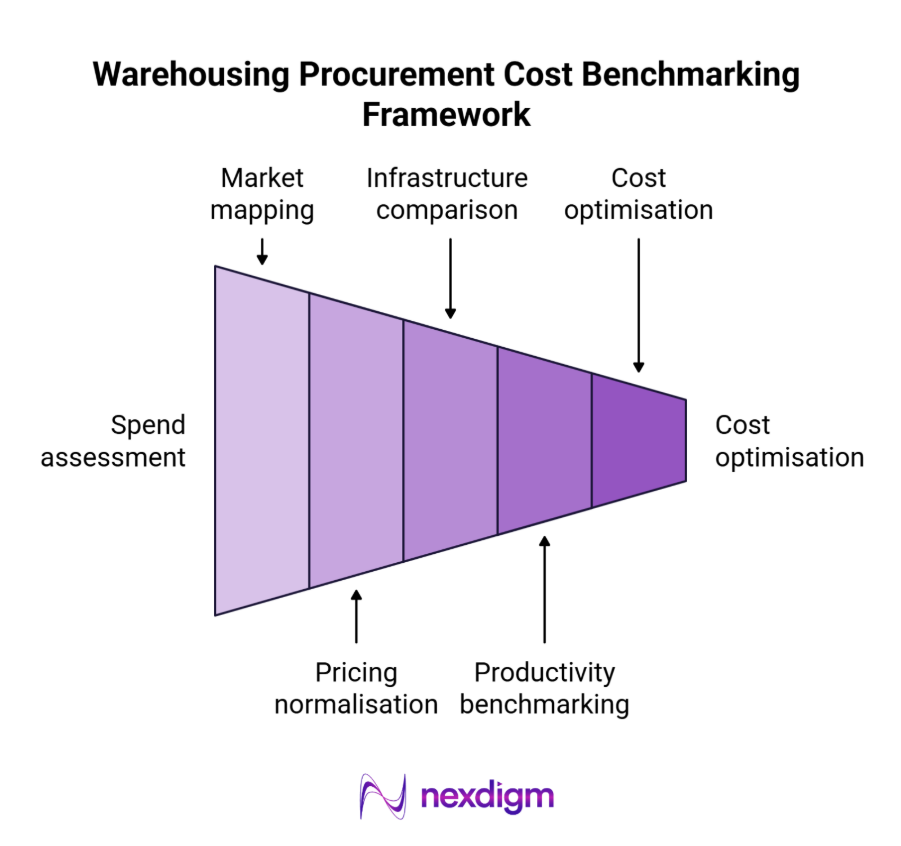
- Spend assessment: Consolidate warehouse expenditure by location, provider, facility type and service category.
- Market mapping: Identify warehouse operators and compare facilities across relevant logistics markets.
- Pricing normalisation: Standardise rental, storage, handling, labour and additional service charges.
- Infrastructure comparison: Evaluate facility specifications, storage capacity, technology and operational capability.
- Productivity benchmarking: Compare inventory accuracy, storage utilisation, handling productivity and fulfilment performance.
- Cost optimisation: Identify negotiation opportunities, alternative locations, contract improvements and supplier consolidation options.
Nexdigm can support organisations through warehouse market research, cost benchmarking, supplier intelligence and procurement analysis. These services help businesses understand regional pricing differences, evaluate warehouse provider competitiveness and develop more informed sourcing strategies.
Nexdigm’s Case Study: Comparing Warehouse Costs Across Markets
Nexdigm benchmarked 14 warehouse operators across 6 logistics markets, comparing rental structures, handling charges, infrastructure and productivity. The assessment identified a 19% variation in comparable operating costs, shortlisted 4 competitive providers and established 8 cost and service benchmarks.
To take the next step, simply visit our Request a Consultation page and share your requirements with us.
Harsh Mittal
+91-8422857704