

Warehousing is a critical component of supply chain operations, influencing inventory availability, order fulfilment, distribution efficiency and overall logistics expenditure. As businesses expand across regions and manage increasingly complex product portfolios, selecting the right warehouse service provider becomes an important procurement decision.
A warehouse offering competitive rental rates may not necessarily provide the operational capacity, technology or service quality required by a business. Organisations must evaluate providers across storage infrastructure, workforce productivity, inventory management, automation capabilities and commercial terms to establish which suppliers offer the strongest operational fit.
Why Warehouse Supplier Benchmarking Matters
Warehouse requirements vary considerably across industries. A pharmaceutical company may prioritise temperature-controlled storage, product traceability and regulatory compliance, while an e-commerce business may require high picking accuracy, rapid order processing and flexible storage capacity.
Manufacturers may place greater emphasis on bulk storage, material handling and proximity to production facilities.
Supplier benchmarking helps organisations compare providers against consistent requirements rather than relying on advertised storage capacity or rental rates.
Evaluating Capacity, Infrastructure and Productivity
Warehouse capacity should be assessed according to usable storage space rather than total facility area. Organisations should examine clear height, racking configurations, floor loading capacity, dock availability and storage density.
The distinction between installed capacity and available capacity is particularly important. A warehouse may have substantial physical space but limited operational availability because of existing inventory commitments or inefficient storage arrangements.
Productivity provides another indication of supplier capability. Procurement teams should examine inventory accuracy, receiving turnaround, order picking rates, dispatch performance and labour utilisation.
Useful performance indicators include storage utilisation, available pallet positions, inventory accuracy, order fulfilment turnaround, inbound and outbound handling capacity, and damage rates.
These indicators should be assessed against the organisation’s actual product mix and expected shipment volumes.
Technology, Automation and Operational Reliability
Technology increasingly influences warehouse performance. Warehouse Management Systems (WMS), barcode scanning, RFID, automated storage systems and inventory analytics can improve operational visibility and reduce manual errors.
However, the presence of technology does not automatically indicate better performance. Businesses should examine whether the systems are actively integrated into warehouse processes and whether they provide reliable operational data.
A supplier operating a WMS should demonstrate inventory tracking, batch management, location control, order processing and reporting capabilities. Businesses with complex distribution networks should also assess integration with ERP and Transportation Management Systems.
Operational reliability requires attention to security, fire protection, equipment maintenance, business continuity and workforce availability. The supplier should be able to demonstrate documented operating procedures and appropriate emergency arrangements.
Commercial Benchmarking and Supplier Selection
Warehouse pricing can involve several components beyond the basic rental charge. These may include storage fees, inbound and outbound handling, labour, packaging, inventory management, technology access and additional services.
A meaningful commercial comparison should standardise these components across suppliers.
Organisations should also consider the location of each facility. A warehouse with lower rental costs may generate higher transportation expenditure if it is located far from suppliers, manufacturing facilities or customer markets.
Contractual flexibility matters as well. Seasonal inventory fluctuations, minimum volume commitments, expansion options and termination provisions can influence the long-term commercial value of a warehouse arrangement.
Warehousing Supplier Evaluation and Benchmarking Framework
A structured warehousing supplier evaluation and benchmarking exercise should assess providers across six areas:
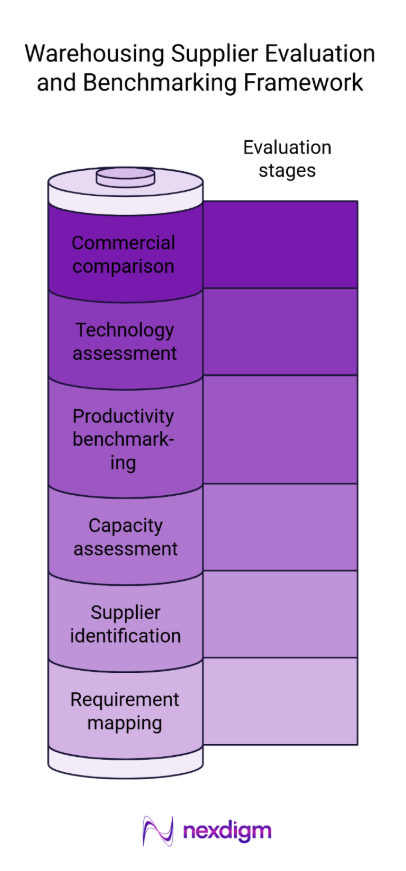
- Requirement mapping: Define storage volumes, product categories, geographical requirements and service expectations.
- Supplier identification: Map warehouse operators according to location, facility type and industry specialisation.
- Capacity assessment: Compare usable storage space, racking, dock availability and handling infrastructure.
- Productivity benchmarking: Evaluate inventory accuracy, order processing, handling capacity and fulfilment performance.
- Technology assessment: Review WMS capabilities, automation, integration and reporting.
- Commercial comparison: Assess storage, handling, labour, technology and additional service charges.
Nexdigm can support organisations through warehouse market research, supplier mapping, facility benchmarking and commercial assessments. These services help procurement teams compare warehouse operators, identify capacity and service gaps, and evaluate providers against operational and financial requirements.
Nexdigm’s Case Study: Optimising Warehouse Supplier Selection
Nexdigm assessed 12 warehouse operators across 5 distribution regions, comparing storage capacity, inventory accuracy, technology and commercial terms. The research shortlisted 4 providers, identified a 17% variation in comparable operating costs and established 7 performance benchmarks for supplier selection.
To take the next step, simply visit our Request a Consultation page and share your requirements with us.
Harsh Mittal
+91-8422857704