
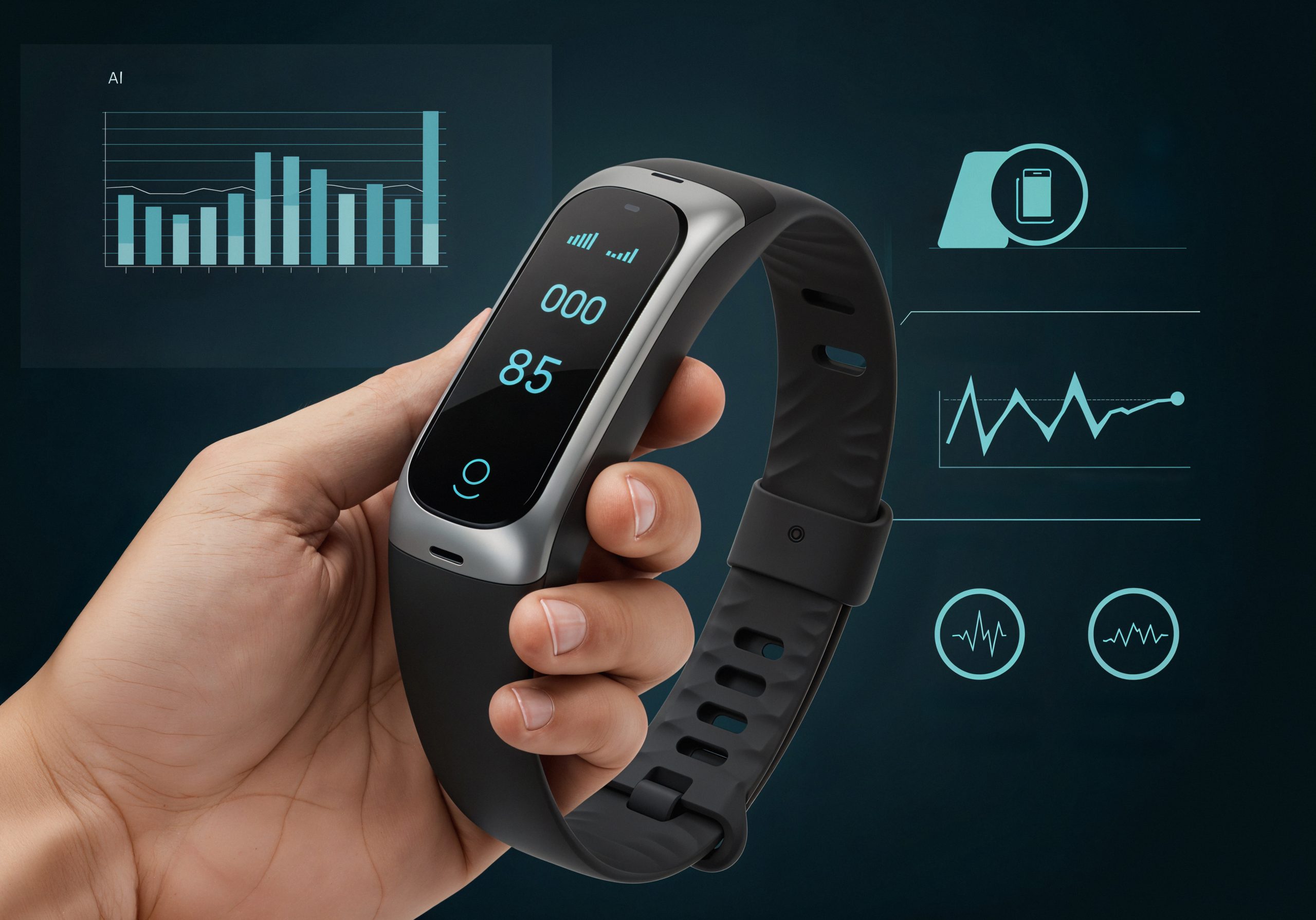
The global wearables market is expanding, but the more important shift is occurring within the category itself. IDC recorded 145.7 million wearable device shipments in Q1 2026, up 4.3% year over year. Hearables remained the largest category at roughly two-thirds of shipments, while smart glasses and smart rings emerged as faster-growing form factors. IDC forecasts 407.6 million hearables shipments in 2026, alongside 159.7 million smartwatches and 13.6 million smart glasses.
This diversification changes the commercial question for manufacturers. Basic step and activity tracking is increasingly difficult to differentiate, while devices that generate useful information continuously can serve broader consumer, enterprise, and healthcare workflows. The opportunity therefore depends on the use case attached to the hardware, the value of the resulting data, and the willingness of another party to pay for that value.
Smart Glasses and Rings Are Opening New Use-Case Pools
Smart glasses are among the clearest examples of this transition. Display-less smart glasses shipped approximately 2.25 million units in Q1 2026, representing 167% year-over-year growth. IDC forecasts 13.6 million units for 2026 and 27.3 million by 2030, equivalent to an 18.9% CAGR.
The appeal extends beyond visual computing. Smart glasses can combine microphones, cameras, audio, connectivity, and AI-assisted interfaces in a form factor that leaves the user’s hands free. Potential applications include field-service guidance, real-time translation, remote assistance, contextual information, and accessibility support.
Smart rings are developing along a different path. Their small form factor makes them particularly suited to passive monitoring of sleep, recovery, heart rate, skin temperature, and other physiological signals. Their commercial potential depends less on replacing the smartwatch and more on providing continuous measurements with lower friction.
Hearables also have room to expand beyond audio consumption. Voice interfaces, real-time translation, biometric sensing, and contextual AI can turn earbuds into persistent interfaces between users and digital services. With 407.6 million hearables shipments forecast for 2026, even modest adoption of higher-value capabilities can affect a very large installed base.
Health Monitoring Creates a Different Commercial Model
Healthcare shifts wearables from lifestyle gadgets to clinical tools. Using advanced biosensors (ECG, glucose, PPG), these devices support everything from preventive wellness to chronic care and remote monitoring.
Commercially, actionable clinical data moves revenue beyond one-off hardware sales into recurring streams from software, monitoring services, and analytics funded by providers, payers, and employers. However, scaling requires clearing strict regulatory hurdles: diagnostic claims demand medical-grade validation, robust privacy, interoperability, and reimbursement approval.
Enterprise Wearables Can Solve Problems Consumers Will Not Pay For
Industrial use cases provide another route beyond fitness tracking. Wearable devices can support worker safety, ergonomics, remote assistance, location awareness, environmental exposure monitoring, and hands-free access to operational information.
Industrial enterprises buy wearables for measurable operational gains like safety, faster inspections, and immediate data access, not consumer appeal.
Accessibility is another emerging opportunity. Wearables combining microphones, cameras, spatial audio, and language processing can support speech transcription, directional audio cues, navigation assistance, and scene interpretation. These applications create a different purchasing logic because utility can be tied directly to independence, workplace participation, or service accessibility.
The Business Model Matters as Much as the Hardware
A wearable manufacturer relying entirely on hardware sales remains exposed to component costs, short product cycles, and low-cost competitors. Higher-value applications create opportunities for recurring software and data revenues, but these models require sustained engagement and demonstrable value.
A wearable technology market opportunity analysis should therefore distinguish between consumer adoption and economic monetization. A product can achieve high shipment volumes while generating limited recurring revenue, whereas a smaller enterprise or clinical segment may support substantially higher revenue per active device.
Nexdigm’s own wearables market research illustrates this broader segmentation. Its US health-tracking wearables analysis separates smartwatches and multifunction devices, fitness bands, smart rings, medical-grade patches and biosensors, while also examining consumer wellness, sports and recovery, chronic-disease management, and clinical remote patient monitoring as distinct use-case clusters.
Nexdigm Framework for Identifying High-Value Wearable Opportunities
Nexdigm can assess wearable opportunities across six commercial dimensions:
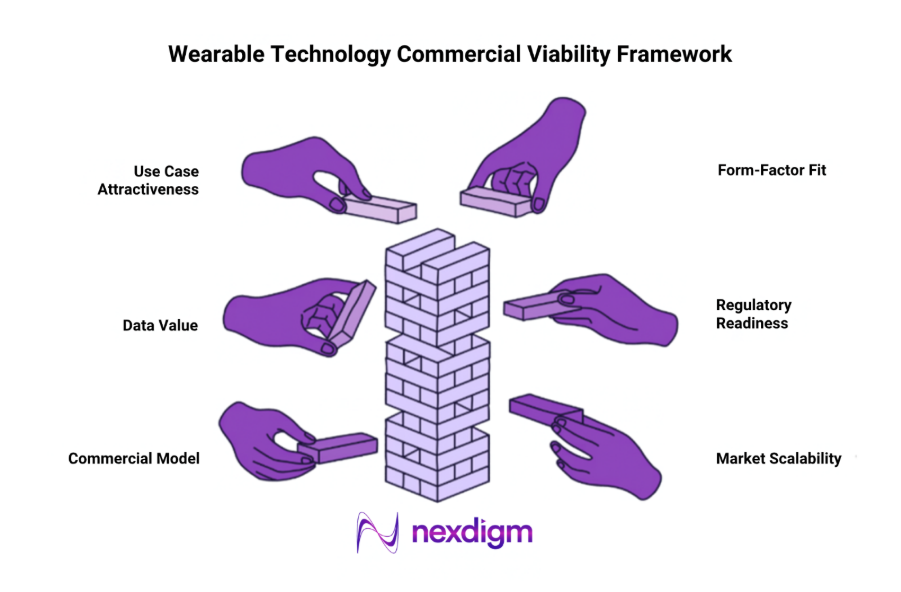
- Use-case attractiveness: Determine the problem being solved, frequency of use, user need, and measurable outcome.
- Form-factor fit: Match sensors, battery requirements, comfort, connectivity, and interaction method to the use case.
- Data value: Assess whether the device produces information that consumers, enterprises, providers, or payers can act upon.
- Regulatory and clinical readiness: Evaluate certification, validation requirements, claims, reimbursement pathways, privacy, and compliance.
- Commercial model: Compare hardware sales, subscriptions, enterprise licensing, clinical services, and device-plus-service models.
- Market scalability: Size target users, competitive intensity, channel access, adoption barriers, replacement cycles, and expansion opportunities.
This framework helps manufacturers identify where wearable technology can generate durable commercial value rather than simply adding another sensor to an increasingly crowded hardware category.
Nexdigm Case: Medical Device Pricing Intelligence With Quantified Outcomes
Nexdigm has published a medical-device pricing and competitive-intelligence engagement in which its analysis of global device pricing and reimbursement supported launch strategy. The published case reports a 20% increase in market-access success and 15% faster hospital procurement approvals, demonstrating the commercial value of pricing, reimbursement, and competitive benchmarking.
Device performance establishes the technical proposition, but pricing, reimbursement, regulatory positioning, and procurement determine whether that proposition can translate into sustained market adoption.
To take the next step, simply visit our Request a Consultation page and share your requirements with us.
Harsh Mittal
+91-8422857704