

Web3 is moving into a more commercially demanding phase. The strongest opportunities are increasingly tied to financial infrastructure, tokenized assets, payments, custody, and enterprise transaction rails rather than broad promises of decentralized consumer ownership. Chainalysis identifies stablecoins, tokenized real-world assets, agentic payments, and blockchain infrastructure selection as major areas shaping institutional digital-asset adoption in 2026.
For companies evaluating Web3, the central question has therefore changed. A large community or high transaction count can demonstrate activity, but it does not establish a viable business. The stronger test is whether adoption can translate into recurring revenue, defensible customer relationships, regulatory viability, and infrastructure economics.
Five Web3 Models Are Showing Different Commercial Signals
Stablecoin payment rails have one of the clearest routes to commercial adoption because they address an existing financial workflow. Banks, fintechs, payment providers, and businesses can use stablecoins for cross-border settlement and on-chain liquidity, with the commercial proposition built around transaction efficiency and infrastructure access rather than token appreciation. Chainalysis describes stablecoins as increasingly production-grade financial infrastructure, with institutions evaluating whether to issue, partner, or integrate with existing networks.
Tokenized real-world assets have a similarly institutional orientation. Tokenized private credit, treasuries, funds, and other assets can provide 24/7 settlement and programmable ownership structures. Chainalysis estimates the tokenized RWA market is approaching $30 billion, with institutional asset-backed credit among the fastest categories to reach scale.
Institutional custody and settlement represent another infrastructure-led model. Here, the customer is an asset manager, bank, fintech, or corporate treasury rather than a retail token holder. Revenue can come from custody, transaction processing, asset servicing, software, compliance, and assets under management. High security requirements and integration costs can also create meaningful switching barriers.
DePIN, covering decentralized compute, storage, wireless networks, and other physical infrastructure, has a different commercial profile. Token incentives can accelerate network formation, but long-term viability depends on whether customers are willing to purchase the underlying service at economically sustainable prices. The distance between subsidized supply and durable demand is therefore critical.
Consumer and community-owned platforms face the most difficult conversion problem. Gaming, social applications, creator platforms, and community ecosystems can attract users through token rewards, but retention can deteriorate when speculative incentives decline. A large wallet base therefore provides limited evidence of commercial viability unless users demonstrate willingness to pay for the underlying product.
The Real Test Is Conversion from Participation to Revenue
Community adoption is useful when it produces measurable economic behavior. Wallet creation, token ownership, transaction volumes, developer activity, and social engagement can indicate ecosystem momentum, but each metric needs to be connected to a revenue mechanism.
A Web3 technology market opportunity analysis should therefore distinguish between subsidized activity and economically productive usage. For a payments platform, the relevant metrics may include transaction frequency, settlement value, take rate, compliance costs, and customer concentration. For tokenized assets, they may include assets under management, issuance fees, secondary-market liquidity, custody revenue, and institutional retention.
This distinction becomes especially important where token emissions are used to bootstrap network participation. If users remain active only while rewards exceed the value of the service received, the apparent network effect can disappear once incentives are reduced.
Regulation Is Becoming Part of the Business Model
Regulatory readiness increasingly dictates institutional access in Web3, particularly as frameworks like the EU’s MiCA establish mandatory authorization regimes.
For stablecoin issuers and tokenization platforms, embedding governance, custody, AML controls, and verifiable reporting directly into product architecture raises initial operating costs. However, this upfront investment creates a decisive competitive moat by unlocking enterprise and institutional capital restricted from using unregulated alternatives.
Infrastructure Economics Can Separate Scalable Models from Expensive Ones
Underlying blockchain architecture directly impacts commercial viability: headline transaction fees matter less than throughput, finality, and predictable operating costs. For enterprise applications, scaling transaction volumes, compliance, integration, and custody can quickly outstrip fee revenue if unit economics are misaligned.
Defensible Web3 models tie infrastructure usage directly to measurable customer value, allowing leadership to validate economic durability before committing significant capital.
Nexdigm Web3 Opportunity Prioritization Framework
Nexdigm can evaluate Web3 opportunities through five decision gates:
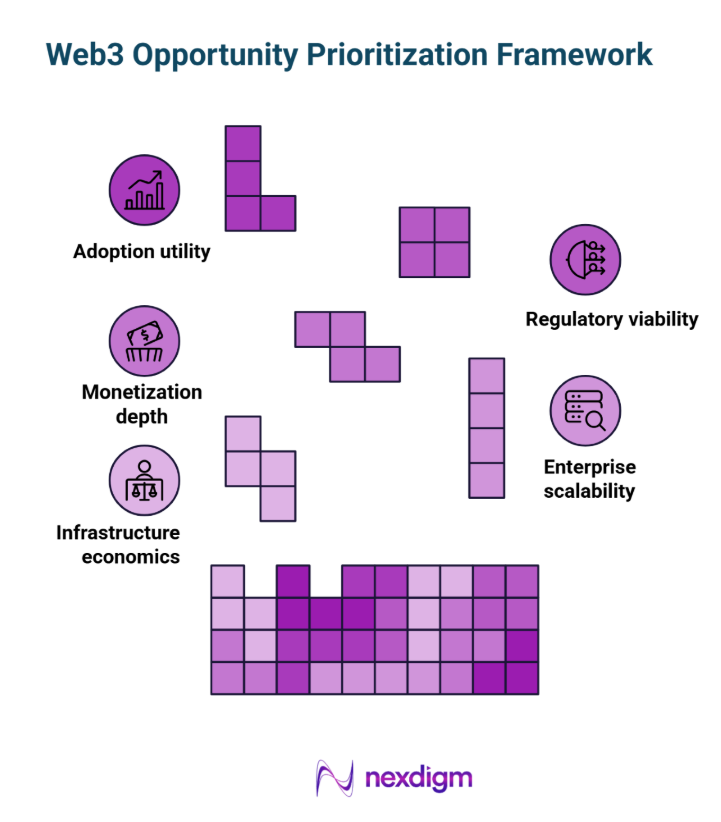
- Adoption utility: Determine whether the solution addresses a measurable workflow or customer need.
- Monetization depth: Test whether revenue can be generated through recurring, fiat-denominated fees rather than continuing token incentives.
- Regulatory viability: Assess licensing, securities treatment, AML/KYC requirements, taxation, custody, and jurisdictional constraints.
- Infrastructure economics: Model transaction costs, throughput, finality, storage, security, and integration requirements at scale.
- Enterprise scalability: Evaluate interoperability with treasury, ERP, payments, custody, accounting, and existing technology environments.
The framework helps distinguish ecosystem activity from commercially defensible demand. It also allows opportunities to be compared on a consistent basis across payments, tokenization, custody, infrastructure, and consumer applications.
Nexdigm Commercialization Lens: From Adoption to Scale
Web3 investment viability varies sharply by model. Tokenized real-world assets are approaching a $30B market, while stablecoins are emerging as high-volume settlement infrastructure. Institutional custody offers recurring fee and AUM-linked revenue, whereas DePIN remains dependent on converting token-incentivized supply into paid enterprise demand. Consumer platforms face the highest churn risk once token rewards decline. The strongest models therefore combine recurring fees, measurable transaction volume, sustainable infrastructure costs, and regulatory access.
To take the next step, simply visit our Request a Consultation page and share your requirements with us.
Harsh Mittal
+91-8422857704