

Wheat market expansion strategies are becoming important as rising demand across food, feed, and processing applications reshapes global agricultural trade. Wheat remains a key staple crop used in flour, bakery products, animal feed, and industrial processing, creating opportunities for exporters, traders, and processors. Companies planning expansion must assess consumption trends, production capacity, pricing volatility, logistics infrastructure, buyer requirements, and regulatory conditions.
Market entry strategy helps identify attractive regions, manage supply risks, and build competitive distribution models. A focused Wheat market expansion strategy supports informed decisions by aligning market demand, trade dynamics, and customer needs with scalable growth opportunities.
Global wheat utilization is projected to reach 805.4 million tonnes in 2025/26, rising 1.3%, with growth supported by food, feed, and other applications. Data also indicates global wheat production for 2026/27 may reach 810.9 million tonnes, though lower wheat trade is expected to affect overall cereal trade. These figures support Wheat market expansion strategy planning by highlighting demand growth, supply availability, trade exposure, and commodity volatility considerations.
Identifying High-Potential Regions for Wheat Market Expansion
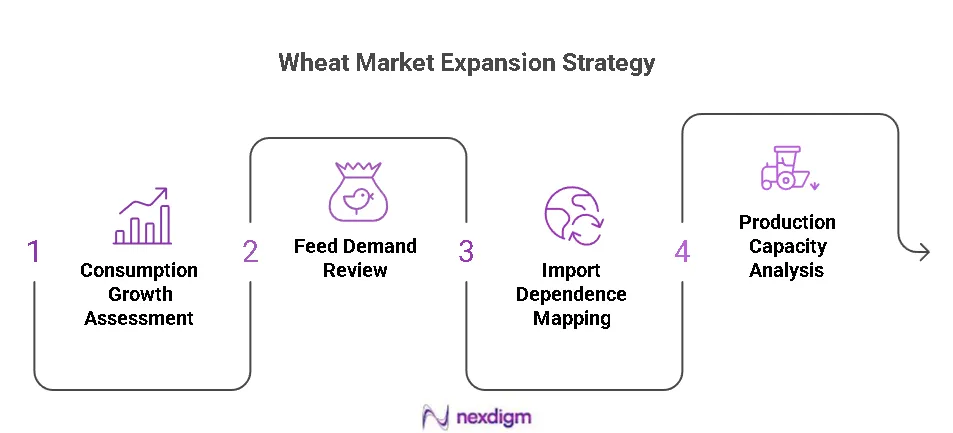
This involves assessing consumption growth, feed demand, import dependence, production capacity, trade access, pricing trends, and logistics readiness to prioritize attractive regions for wheat market expansion:
-
Consumption Growth Assessment
Analyze population trends, wheat-based food demand, bakery consumption, and processing needs to identify high-growth regions.
-
Feed Demand Review
Evaluate livestock production, feed mill demand, and grain substitution trends influencing wheat consumption in animal feed applications.
-
Import Dependence Mapping
Assess domestic supply gaps, import reliance, procurement cycles, and trade exposure across target wheat markets.
-
Production Capacity Analysis
Review acreage, yield levels, harvest volumes, and seasonal supply reliability to assess sourcing strength.
Nexdigm Import, Export, and Regulatory Compliance Review
Nexdigm can help wheat market entrants assess import-export regulations, tariff structures, food safety standards, quality specifications, documentation needs, and trade compliance requirements. This review supports market expansion by identifying approval gaps, cost implications, regulatory risks, and cross-border opportunities across wheat food and feed markets.
Nexdigm Demand Assessment Across Wheat Food and Feed Applications
Nexdigm can assess food consumption, feed demand, processing needs, import dependence, buyer segments, pricing trends, and supply gaps to support wheat market expansion decisions.
-
Buyer Segment Profiling
Map millers, feed producers, traders, distributors, and institutional buyers based on volume and quality requirements.
-
Pricing Trend Evaluation
Assess wheat price volatility, landed costs, buyer affordability, and margin impact across food and feed markets.
-
Supply Gap Assessment
Identify regions facing production deficits, seasonal shortages, logistics constraints, and rising dependence on wheat imports.
-
Demand Prioritization
Rank target markets by food demand, feed usage, import reliance, buyer access, and commercial expansion potential.
Nexdigm’s case:
Nexdigm helped a wheat market entrant assess demand across food and feed applications. The analysis identified food processors contributing nearly 45% of projected demand, feed users showing 18–22% growth potential, and import-dependent regions with 15% supply gaps. These insights helped the company prioritize target markets, evaluate buyer segments, refine pricing, and build a focused wheat market expansion strategy.
To take the next step, simply visit our Request a Consultation page and share your requirements with us.
Harsh Mittal
+91-8422857704