

Wheat procurement requires buyers to interpret global supply trends alongside origin-specific quality and commercial conditions. In its November 19, 2026 Grain Market Report, the International Grains Council forecast total global grains production, including wheat and coarse grains, at 2,428 million tonnes for 2026/27.
In India, government data reported wheat procurement of 357.57 lakh metric tonnes during the 2026–27 Rabi Marketing Season, compared with 299.75 lakh metric tonnes in the previous season. These figures illustrate how supply conditions and procurement activity vary across markets. Wheat procurement supplier analysis helps businesses translate such market signals into origin selection, supplier comparisons, and more informed purchasing decisions.
Reading Origin-Level Signals in the Wheat Market
Wheat sourcing markets differ in production scale, grain characteristics, export availability, and logistics. Countries such as Australia, Canada, Russia, Argentina, and Kazakhstan serve different buyer requirements. Harvest outcomes, domestic consumption, export policies, and transportation access can influence the volume and type of wheat available for trade. Understanding these origin-level differences helps buyers identify markets worth exploring before engaging individual suppliers.
Establishing the Procurement Criteria That Matter
Once potential origins are identified, buyers need clear criteria to compare suppliers. Three considerations provide a practical starting point:
- Quality and End-Use Requirements: Define protein content, moisture, test weight, gluten strength, falling number, and other specifications according to milling, baking, or feed applications.
- Volume and Delivery Requirements: Establish required quantities, shipment schedules, seasonal availability, minimum order volumes, and acceptable delivery locations.
- Commercial and Contract Conditions: Set expectations for price basis, payment terms, currency, inspection, packaging, shipment responsibilities, and contractual flexibility.
These requirements create a common reference point for assessing suppliers across different origins and business models.
Nexdigm’s Role in Identifying Relevant Wheat Supply Markets
Our experts help businesses move from broad market interest to a more focused view of potential wheat sourcing locations. Our research examines production trends, export activity, trade flows, supplier concentration, and market access across selected countries. We identify relevant market participants, including grain producers, aggregators, traders, exporters, and bulk commodity suppliers.
Rather than treating every exporting country as equally suitable, our experts examine how each origin aligns with the buyer’s quality, volume, and delivery requirements. This provides a basis for prioritizing markets and directing supplier research towards relevant sourcing opportunities.
Assessing the Journey from Grain Specifications to Supplier-Level Evidence with Nexdigm
Wheat grades and quality indicators can vary across origins and suppliers. Our expertise helps organizations assess how supplier offerings correspond with their procurement specifications with the help of wheat procurement supplier analysis. Our research can cover:
- Grain Profile Comparison: Review wheat classes, protein ranges, moisture levels, test weight, gluten characteristics, and other stated quality indicators.
- Application-Based Suitability: Assess product positioning for flour milling, bakery production, food processing, and feed applications.
- Quality Assurance Evidence: Examine available laboratory testing, inspection arrangements, certifications, and documentation practices.
This analysis helps buyers identify where supplier offerings appear aligned with their requirements and where further sample testing or technical verification may be needed.
Insights from Nexdigm’s Wheat Procurement Supplier Analysis
Our wheat procurement supplier analysis brings together origin intelligence, supplier capabilities, quality specifications, and commercial information to help businesses make informed sourcing decisions. Our research focuses on four key areas:
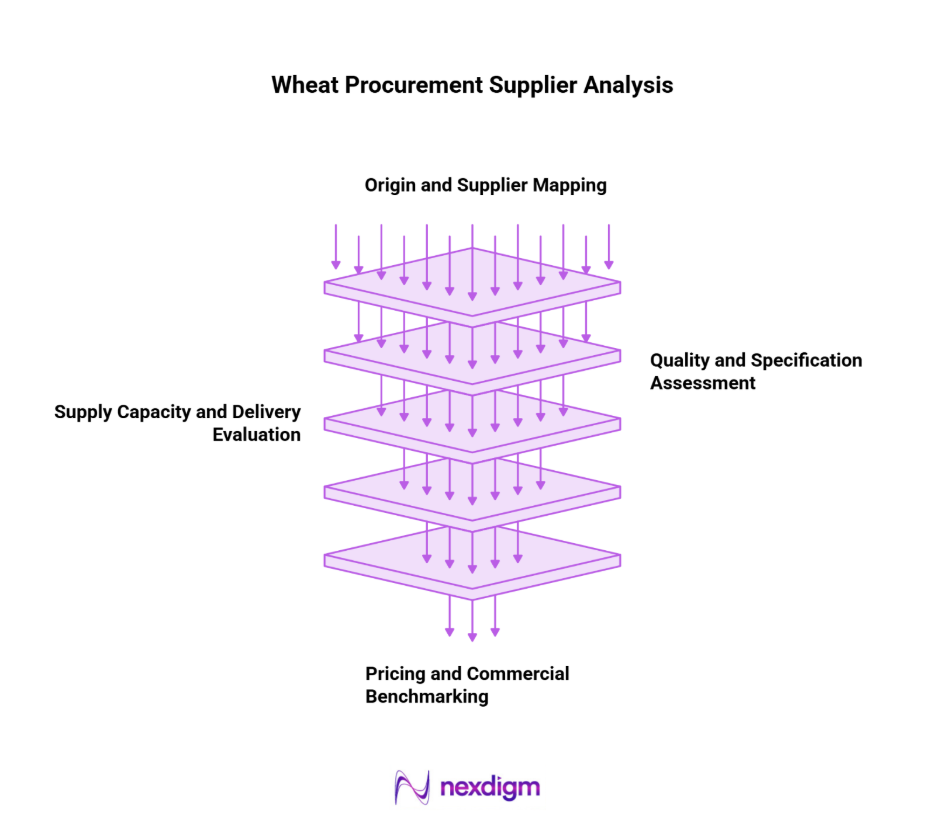
- Origin and Supplier Mapping: Identify wheat suppliers across major producing and exporting markets, examining their geographical presence, product focus, sourcing networks, and market positioning.
- Quality and Specification Assessment: Compare wheat varieties, protein content, moisture levels, test weight, gluten characteristics, and quality documentation against buyer-specific requirements.
- Supply Capacity and Delivery Evaluation: Examine available volumes, seasonal supply patterns, storage infrastructure, export readiness, shipment flexibility, and logistics capabilities to understand supplier reliability.
- Pricing and Commercial Benchmarking: Assess supplier quotations, minimum order quantities, payment terms, delivery conditions, and other cost components to understand commercial competitiveness.
Business Benefits of Nexdigm’s Wheat Supplier Intelligence
By connecting market research with supplier-level assessments, our experts help businesses:
- Identify suitable wheat sourcing markets and potential suppliers.
- Compare suppliers against consistent quality and operational criteria.
- Understand pricing differences and commercial trade-offs across origins.
- Recognize supply constraints and opportunities for sourcing diversification.
- Develop a prioritized supplier shortlist for further technical and commercial evaluation.
These insights support more structured procurement planning, supplier engagement, and sourcing decisions.
Nexdigm’s Case
A flour milling company wanted to expand its high-protein wheat supplier network while maintaining consistent grain specifications. Nexdigm assessed 32 suppliers across four sourcing markets, examining quality parameters, supply capacity, and commercial terms. The study found that 28% had gaps in quality documentation, while 22% offered limited flexibility in shipment volumes. The company developed a prioritized shortlist for technical validation and procurement discussions.
To take the next step, simply visit our Request a Consultation page and share your requirements with us.
Harsh Mittal
+91-8422857704