

Manual approvals, repetitive data entry, document processing and disconnected business applications can create delays across an organisation. These activities may appear minor when viewed individually, but their combined effect can increase administrative costs, slow service delivery and make operational performance difficult to monitor.
Workflow automation platforms address these problems by connecting tasks, systems, business rules and approval processes. They can automate routine activities across finance, HR, procurement, customer service and operations. However, the market includes several overlapping technologies, from low-code workflow builders and robotic process automation tools to business process management platforms and AI-enabled automation solutions.
For technology and procurement leaders, workflow automation software procurement research helps identify which platform category fits the organisation’s requirements and which suppliers can support automation at scale.
Start With the Process That Needs to Change
A common mistake in automation procurement is selecting a platform before identifying the process it is expected to improve.
An organisation may want to automate invoice processing, employee onboarding, purchase approvals, customer queries or compliance checks. Each use case has different requirements for data access, decision rules, integration and human oversight.
The first step should be to document how the process currently operates. This includes the people involved, applications used, approval stages, exceptions, information exchanged and points where work is delayed.
A process that is poorly designed may remain inefficient even after automation. Procurement teams should therefore distinguish between tasks that can be automated directly and processes that need redesign before a platform is introduced.
Where Workflow Automation Creates Business Value
Automation opportunities often emerge in processes with high transaction volumes, repetitive activities or clearly defined decision rules.
- Finance and accounting: Invoice capture, purchase order matching, expense approvals, payment workflows and reconciliation.
- Human resources: Employee onboarding, leave requests, document collection, payroll inputs and employee record updates.
- Procurement: Supplier onboarding, purchase requisitions, approval routing, contract notifications and vendor documentation.
- Customer service: Ticket classification, request routing, status notifications and escalation workflows.
- Operations: Order processing, inventory alerts, quality checks, maintenance requests and reporting.
The commercial value should be linked to measurable outcomes such as processing time, manual effort, error rates, approval delays and service consistency. These indicators create a baseline against which platform performance can later be evaluated.
Choosing Between Automation Technologies
Not every workflow automation platform performs the same function. Understanding the technology categories helps prevent procurement teams from comparing products with fundamentally different capabilities.
Low-code and no-code platforms allow business users or technical teams to build workflows through visual interfaces and configurable rules. They may be suitable for approval processes, notifications and application integration.
Robotic Process Automation (RPA) tools automate repetitive interactions with existing applications, including systems that may not offer modern APIs. They can be useful for legacy processes, although interface changes and exceptions may require ongoing maintenance.
Business Process Management platforms support the modelling, execution and monitoring of more complex processes involving multiple teams and systems.
AI-enabled automation introduces capabilities such as document understanding, classification, language processing and decision support. These tools may handle less structured inputs, but require stronger controls around accuracy, human review and data governance.
An enterprise may need more than one category, but it should understand where capabilities overlap before committing to several products.
Integration, Governance and Human Oversight
Automation platforms need access to enterprise applications and information. Buyers should assess available connectors, APIs, identity controls, data permissions and compatibility with existing systems.
Governance becomes more important as automation expands across departments. Without central oversight, different teams may create disconnected workflows, duplicate business rules or expose sensitive information through poorly configured integrations.
Procurement teams should examine role-based access, workflow version control, audit trails, exception handling and the ability to monitor automated activities.
Human oversight should be defined according to the consequences of an automated action. A routine internal notification may require limited intervention, while a financial approval, supplier decision or customer-impacting action may need explicit review.
The Economics of Automation Procurement
Automation platforms can be priced according to users, workflows, transactions, bots, execution time, API calls or consumption. AI-enabled features may introduce additional charges for model usage, document processing or specialised services.
The total cost should include platform subscriptions, implementation, integration, process redesign, training, maintenance and ongoing monitoring.
Procurement teams should also consider the cost of exceptions. A workflow that automates most transactions but requires frequent manual correction may deliver less value than expected.
A useful business case compares the current cost of performing a process with the expected cost after automation. It should account for processing volumes, employee time, error correction, service delays and platform operating costs.
Workflow Automation Platform Sourcing Framework
A sound sourcing decision should establish not only which platform can automate a process, but whether it can do so reliably across the organisation:
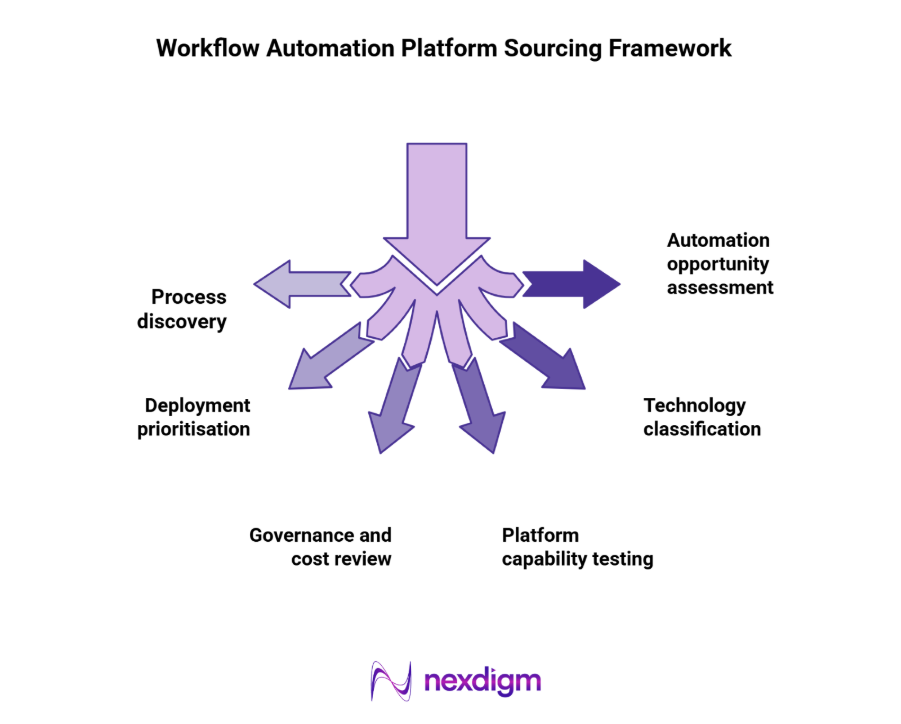
- Process discovery: Map transaction volumes, manual activities, exceptions, systems and approval dependencies.
- Automation opportunity assessment: Prioritise workflows according to repetition, business impact, complexity and measurable improvement potential.
- Technology classification: Determine whether the requirement calls for low-code automation, RPA, BPM or AI-enabled capabilities.
- Platform capability testing: Evaluate integrations, workflow design, monitoring, exception handling and scalability through representative use cases.
- Governance and cost review: Examine access controls, auditability, human oversight, licensing and implementation expenditure.
- Deployment prioritisation: Select platforms and use cases according to expected business value, technical feasibility and long-term operating requirements.
Nexdigm can support enterprises through workflow automation market research, technology supplier benchmarking, commercial assessment and procurement intelligence. This helps organisations compare automation platforms, understand the competitive landscape and identify solutions suited to their operational priorities.
Nexdigm’s Case Study: Assessing Workflow Automation Suppliers
Nexdigm evaluated 13 workflow automation providers across 5 business functions, comparing integration, process coverage, governance and pricing. The study identified 6 high-priority automation use cases, shortlisted 4 platforms and established 8 technical and commercial evaluation criteria.
To take the next step, simply visit our Request a Consultation page and share your requirements with us.
Harsh Mittal
+91-8422857704