

A training calendar tells an organisation what it plans to teach this year. It says much less about whether those courses will prepare employees for the work they will be doing two or three years from now.
That gap matters when technology, regulation and operating models are changing faster than training programmes can be designed. Employers need to anticipate which roles will change, which skills can be developed internally and where new hiring will still be necessary. Training providers need the same information to decide which programmes deserve investment.
Workforce Skills Forecasting: What Is Changing?
The World Economic Forum’s Future of Jobs Report 2025 projects that structural labour-market changes will create 170 million jobs and displace 92 million by 2030, resulting in a net increase of 78 million jobs across the modelled global labour market. It also estimates that 39% of workers’ existing skill sets will be transformed or become outdated during the period.
These projections do not mean that every industry will experience the same change or that all affected workers will need entirely new occupations. Many will need to adapt within their current roles. A finance employee may need stronger data and automation skills; a technician may need to work with connected equipment; a manager may need to interpret AI-generated information and make decisions about its use.
The implication for training demand is important. Forecasts based only on new job titles can miss the larger requirement to update skills across existing workforces.
How to Identify Future Training Needs Before They Become Urgent
Reliable forecasts combine several signals rather than extrapolating from current course enrolments.
- Business strategy provides the starting point. A company investing in automation, new markets or digital customer service will require capabilities linked to those changes. The training need should be traced back to the operating model rather than inferred from a general trend.
- Job and task analysis identifies which activities are changing. Job descriptions, interviews with managers and assessments of current employee capability can reveal where technology or new processes are changing the work.
- External labour-market evidence adds context. Hiring trends, occupational projections, skills data and industry investment plans help establish whether the need is specific to one company or appearing across a wider sector.
The International Labour Organization’s approach to skills anticipation emphasises the importance of connecting labour-market information with training and employment decisions. This is especially relevant where course development takes time and employers cannot wait until a shortage becomes acute.
Workforce Training Demand Forecast: From Signals to Enrolment
A Workforce training demand forecast should translate emerging capability gaps into an estimate of who needs training, when they need it and what type of intervention is likely to work.
The forecast needs to distinguish between three kinds of demand:
- Immediate gaps: Skills required to operate current systems, meet compliance obligations or resolve performance issues.
- Transition requirements: Capabilities needed as a company introduces new technology, processes or services.
- Longer-term capabilities: Skills that may become important as occupations evolve, even if current hiring demand remains limited.
Each category has a different time horizon. Immediate needs may support short courses or targeted workshops. Transition requirements may justify structured programmes linked to a technology rollout. Longer-term capabilities may call for pilots and periodic reassessment rather than large-scale training commitments today.
A forecast should also estimate the share of affected employees who need training, their starting proficiency and the proportion likely to complete the programme. Otherwise, a projected skills gap can be mistaken for a course-enrolment target.
Workforce Training Demand Forecasting Framework
The Future Skills Demand Forecasting Framework links business change with training investment.
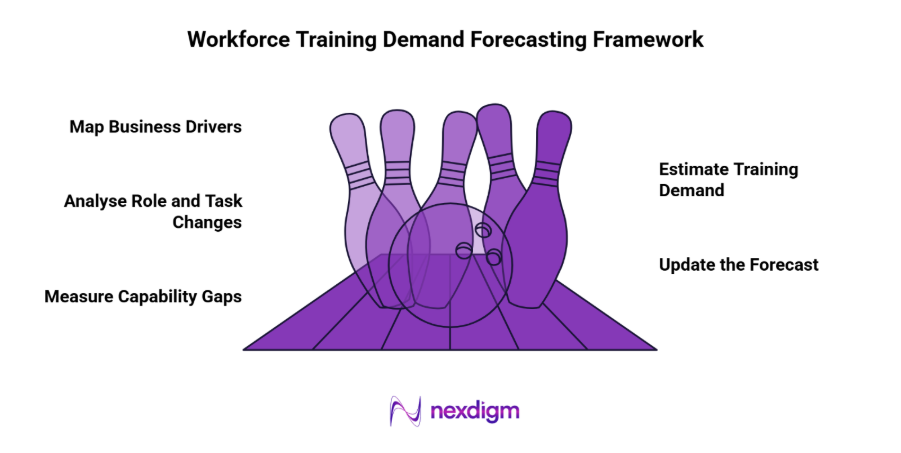
- Map Business Drivers: Identify planned technology adoption, regulation, growth priorities and changes in operating processes.
- Analyse Role and Task Changes: Determine which responsibilities are expanding, disappearing or requiring different levels of proficiency.
- Measure Capability Gaps: Compare required skills with current employee proficiency and available internal talent.
- Estimate Training Demand: Calculate the employees affected, timing, delivery format and likely learning effort.
- Update the Forecast: Revisit assumptions as hiring patterns, technology deployment and business priorities change.
The forecast should not be treated as a fixed annual number. It is a planning tool that becomes more useful when updated against actual workforce and business data.
Nexdigm Case Study: Forecasting Future Training Requirements
Nexdigm assessed capability needs across 11 functions for an organisation preparing for wider digitalisation. Role analysis and manager interviews identified eight priority skill areas, with demand concentrated in data literacy, workflow automation and technology-enabled decision-making. The assessment separated immediate training needs from capabilities required over the following three years, giving the client a staged basis for workforce development planning.
To take the next step, simply visit our Request a Consultation page and share your requirements with us.
Harsh Mittal
+91-8422857704