

Global trade is constantly evolving. Changes in consumer demand, manufacturing capacity, trade policies, geopolitical developments, and supply chain strategies can significantly influence how goods move across borders. For businesses looking for growth opportunities, understanding these shifts and factors is necessary for making informed decisions about market expansion, sourcing, investments, and supply chain management.
This is where Worldwide Import Export Data becomes a powerful source. By analyzing trade flows across countries and industries, organizations can uncover emerging demand patterns, track supply-side developments, and identify new opportunities to stand out in the highly competitive market.
Why Is Import-Export Data Important?
Worldwide Import-Export Data provides a detailed view of international trade activity, including the movement of products between countries, trade volumes, shipment values, and broader market trends. When analyzed effectively, this data helps businesses understand how global trade patterns are changing and where future opportunities may emerge. Rather than relying solely on market forecasts or assumptions, organizations can use trade intelligence to make decisions, providing a more accurate insight into market dynamics.
Import Data: Identifying Emerging Demand Trends
Import activity often serves as an important aspect of market demand. When a country experiences a sustained increase in imports of specific products, it may signal growing consumer demand, expanding industrial activity, or insufficient domestic production capacity.
By understanding import flows, businesses can:
- Identify markets experiencing rising demand
- Discover fast-growing product categories
- Monitor changing consumer preferences
- Evaluate market attractiveness for expansion
- Identify opportunities for new product launches
These insights enable organizations to prioritize markets with the strongest growth potential and develop more targeted market-entry strategies.
Export Data: Understanding Supply Shifts Across Markets
Export trends provide valuable insights into global supply capabilities and production patterns. Increasing export activity from a country may indicate growing manufacturing capacity, competitive advantages, or emerging industry specialization.
By analyzing export flows, businesses can:
- Identify leading production hubs
- Monitor shifts in manufacturing activity
- Discover alternative sourcing markets
- Track emerging export-oriented economies
- Evaluate global supply availability
Understanding these trends allows businesses to diversify strategies and adapt to changing supply-side dynamics.
How Trade Intelligence Reveals Changes in the Global Market
In recent years, market trends have demonstrated how quickly supply chains can change in response to economic, geopolitical, and operational disruptions. Businesses are increasingly seeking supply chain resilience through supplier diversification and multi-country sourcing strategies.
Trade Intelligence, here, helps businesses understand:
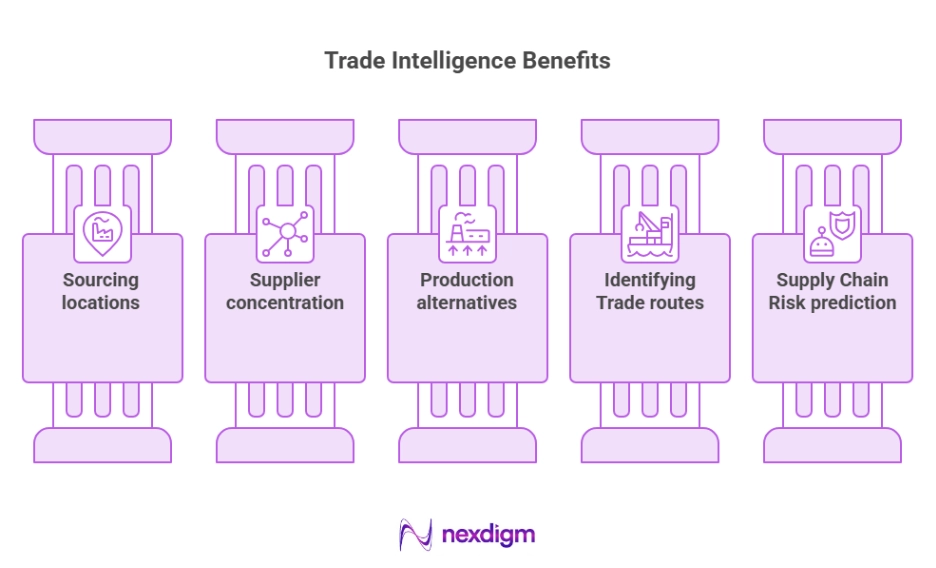
- Shifts in sourcing locations: Trade data helps identify changes in sourcing destinations, enabling businesses to understand where production is moving and adapt to the changes accordingly.
- Changes in supplier concentration: Analyzing trade patterns reveals dependency on specific suppliers or regions, helping organizations reduce concentration risks through supplier diversification.
- Emerging production alternatives: Trade intelligence highlights new manufacturing centers and growing production markets, providing businesses with investment opportunities.
- Evolving trade routes: Changes in trade flows can indicate emerging logistics corridors, helping businesses optimize transportation strategies and improve supply chain efficiency.
- Supply chain risk prediction: Trade data helps identify vulnerabilities related to geopolitical events, regulatory changes, or supplier dependencies, enabling risk mitigation and planning.
These insights support more resilient supply chain planning and help reduce dependency on individual markets or suppliers.
How Trade Intelligence Transforms Trade Data into Strategic Actions
As global markets become increasingly important in today’s world, businesses need a reliable way to evaluate opportunities and risks. Mapping international trade flows through Worldwide Import Export Data provides an objective foundation for understanding market trends, supply shifts, and emerging growth opportunities.
Whether identifying new customers, evaluating sourcing options, entering new markets, or assessing investment opportunities, trade intelligence helps organizations replace assumptions with data-driven insights and make more confident decisions. By transforming complex trade data into actionable insights, organizations can strengthen their competitive position, optimize resource allocation, and develop growth strategies that are aligned with business goals and market conditions.
Nexdigm’s Approach to Trade Intelligence and Market Expansion
Nexdigm helps organizations leverage Worldwide Import-Export Data through comprehensive trade intelligence and market analysis solutions. By combining advanced analytics with industry expertise, Nexdigm enables businesses to:
- Identify emerging demand markets and growth opportunities
- Track global supply shifts and sourcing trends
- Evaluate supplier ecosystems and trade networks
- Assess trade corridor performance and logistics efficiency
- Monitor competitive activity and market developments
- Mitigate geopolitical, regulatory, and supply chain risks
- Develop informed market-entry and expansion strategies
With a data-driven and insight-led approach, Nexdigm allows organizations to navigate evolving global trade dynamics, strengthen supply chains, and capture opportunities in an increasingly competitive global market.
Nexdigm’s Case
Nexdigm supported a manufacturer in mapping global import–export flows to identify emerging demand centers, supply shifts, and resilient sourcing markets. The engagement improved strategic planning through trade intelligence. Outcomes included a 22% improvement in demand forecasting accuracy, 17% faster market identification, and a 15% increase in sourcing efficiency within ten months.
To take the next step, simply visit our Request a Consultation page and share your requirements with us.
Harsh Mittal
+91-8422857704