
A student may attend a lecture on campus, watch a recorded explanation at home, submit an assignment online and receive feedback through a learning platform. These are no longer necessarily separate educational experiences. For many institutions, they form parts of the same learning journey.
Blended learning combines face-to-face teaching with digital learning activities. Its value depends less on the number of tools an institution adopts than on how well those activities work together. A digital platform that duplicates classroom notes adds limited value. One that supports practice, feedback and revision can change how students engage with a subject.
How Students Move Between Classroom and Digital Learning
The student journey increasingly involves several connected activities:
- Before class: Learners access readings, short videos, preparatory quizzes or background material at their own pace.
- During class: Teachers use classroom time for explanation, discussion, demonstrations, collaborative tasks and questions that reveal gaps in understanding.
- After class: Students revisit difficult concepts, complete assignments, practise skills and use feedback to correct mistakes.
- Between assessments: Learning platforms can help students review progress, identify weak areas and prepare for examinations.
- Outside scheduled teaching: Recorded resources and digital materials can support revision when students have limited access to instructors or campus facilities.
This sequence is not appropriate for every subject or learner. Laboratory work, clinical practice and some forms of collaborative learning require physical access, specialist equipment or direct supervision. Digital resources can prepare students for these activities, but may not replace them.
Student Learning Behavior Market Analysis: What Institutions Need to Understand
A Student learning behavior market analysis should examine when students engage, how they use learning resources and what helps them progress. Logging into a platform is not evidence of learning. A student may open a video without completing it, download notes without revising them or repeatedly attempt an assessment without understanding the underlying concept.
UNESCO’s 2023 Global Education Monitoring Report, Technology in Education: A Tool on Whose Terms?, cautions that robust evidence of educational technology’s added value remains limited. The report argues for evaluating technology in context rather than assuming that access to more digital tools automatically improves learning.
That distinction matters commercially. Institutions investing in learning management systems, content libraries or classroom technology need to determine whether these tools support learning objectives and fit teachers’ working practices.
Behavioural evidence can help. Attendance patterns, assignment submissions, quiz attempts, participation and student feedback may reveal where learners struggle. However, institutions should interpret these indicators carefully. Low platform activity may reflect poor connectivity, inaccessible content or an unsuitable schedule rather than lack of motivation.
What Makes a Blended Learning Experience Work?
A successful blended model begins with the learning objective. If students need to practise a complex skill, digital material should prepare them for guided application rather than replace it with passive viewing.
Teaching design is equally important. Teachers need time to plan activities across formats, understand platform data and support students who fall behind. Without that preparation, blended learning can become an additional workload layered onto an unchanged classroom model.
Accessibility also shapes participation. Students may share devices, rely on mobile data or have limited quiet study space. Downloadable content, low-bandwidth options, clear navigation and accessible materials help prevent the delivery model from excluding the students it is meant to support.
Blended Learning Experience Design Framework
The Blended Learning Journey Framework helps institutions connect digital resources with classroom teaching.
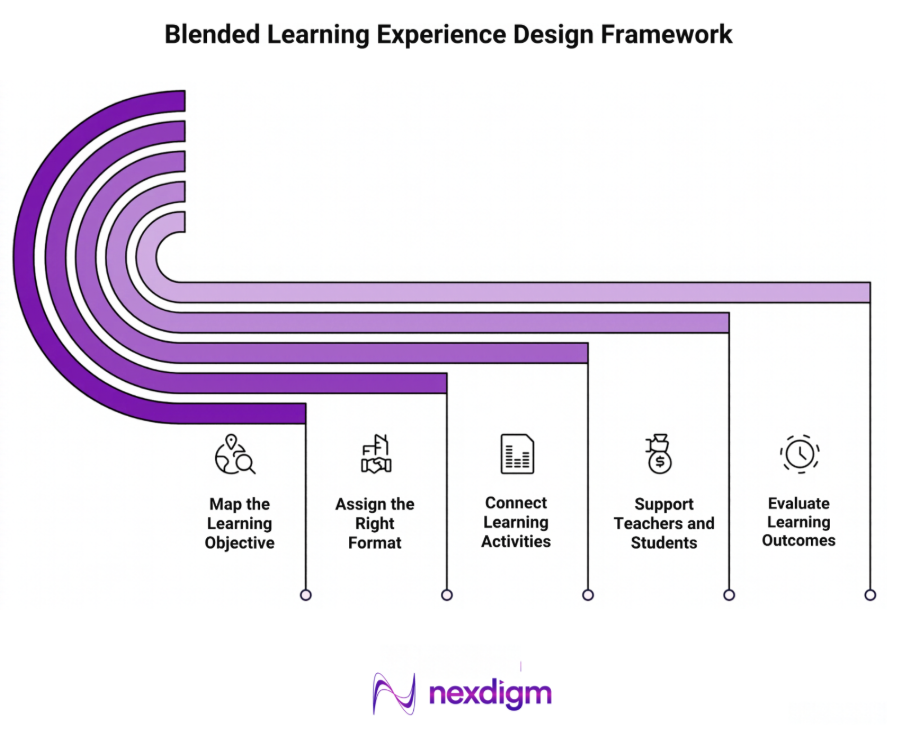
- Map the Learning Objective: Identify what students must understand, practise or demonstrate at each stage.
- Assign the Right Format: Use classroom time for activities that benefit from interaction, supervision or collaboration, and digital tools for suitable preparation and revision.
- Connect Learning Activities: Ensure that pre-class resources, in-class tasks and follow-up assessments build on one another.
- Support Teachers and Students: Provide training, technical support, accessible resources and clear expectations for participation.
- Evaluate Learning Outcomes: Review assessment performance, engagement, completion and student feedback before expanding the model.
Institutions should pilot the approach in selected courses before applying it across an entire programme. The pilot can reveal whether the design improves learning, creates extra workload or requires different technology and support.
Nexdigm Case Study: Evaluating Blended Learning Adoption
Nexdigm reviewed blended learning practices across 14 courses at a higher education institution. Student feedback and course-level engagement data showed that preparatory materials were used more consistently when linked to classroom activities and assessments. The institution prioritised redesigning six courses around connected pre-class, in-class and follow-up tasks before expanding the approach.
To take the next step, simply visit our Request a Consultation page and share your requirements with us.
Harsh Mittal
+91-8422857704