

 Download PDF
 Download PDF
Market Overview
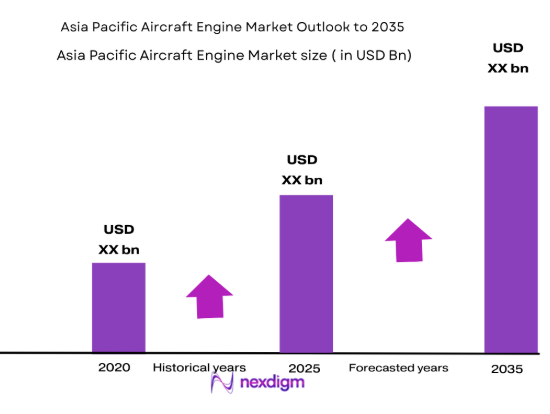
The Asia Pacific aircraft engine market is expected to witness significant growth due to increasing demand for air travel, particularly in emerging economies such as China, India, and Southeast Asia. The market is driven by the rise in passenger traffic, with the aviation sector experiencing rapid expansion in the region. Based on a recent historical assessment, the total market size for aircraft engines stands at approximately USD ~ billion. This growth is propelled by increasing airline fleets, new aircraft orders, and a shift toward more fuel-efficient engines, all supported by advancements in technology.
Countries such as China, Japan, and India dominate the Asia Pacific aircraft engine market due to their robust aviation industries and growing economies. These nations are investing heavily in airport infrastructure, expanding airline fleets, and modernizing their fleets with new-generation engines. The increase in regional air connectivity and international travel is also contributing to the demand for advanced, high-performance aircraft engines. These countries’ strategic investments in both domestic production and procurement from global manufacturers ensure their dominance in the market.
Market Segmentation
By Product Type
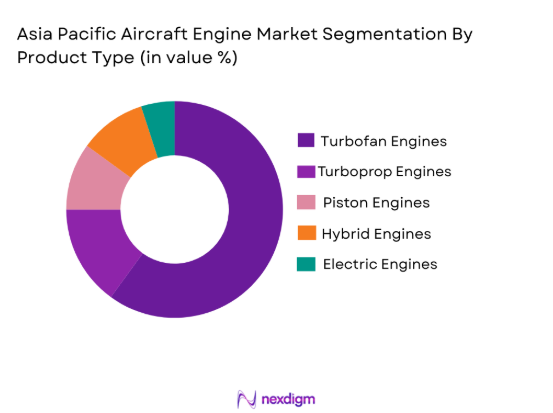
The Asia Pacific aircraft engine market is segmented by product type into turbofan engines, turboprop engines, piston engines, hybrid engines, and electric engines. Recently, turbofan engines have captured the largest market share due to their widespread use in commercial and military aviation. Turbofan engines provide greater fuel efficiency and higher thrust, which makes them the preferred choice for long-haul flights. Their demand is particularly strong in countries with large and growing aviation sectors such as China and India. As airlines continue to modernize their fleets to meet passenger demand and environmental regulations, the turbofan engine segment remains the dominant product type in the market.
By Platform Type
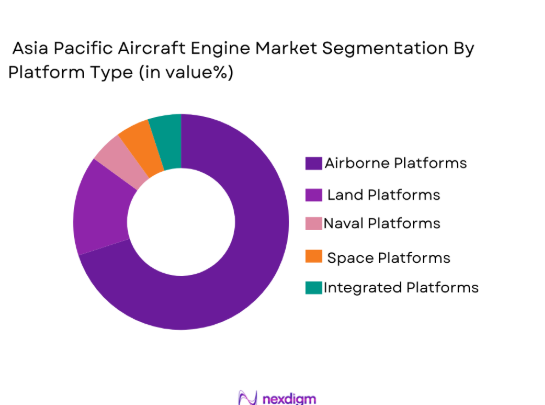
The Asia Pacific aircraft engine market is segmented by platform type into land platforms, airborne platforms, naval platforms, space platforms, and integrated platforms. Recently, airborne platforms have dominated the market share due to the rapid expansion of the aviation industry in the region, particularly in commercial aviation and military applications. The increasing demand for both passenger and cargo aircraft is driving this trend, as these platforms require advanced and fuel-efficient engines for improved performance and reduced emissions. With the growing number of airports, particularly in emerging economies like China and India, the demand for engines for airborne platforms remains high, driving the growth of this segment.
Competitive Landscape
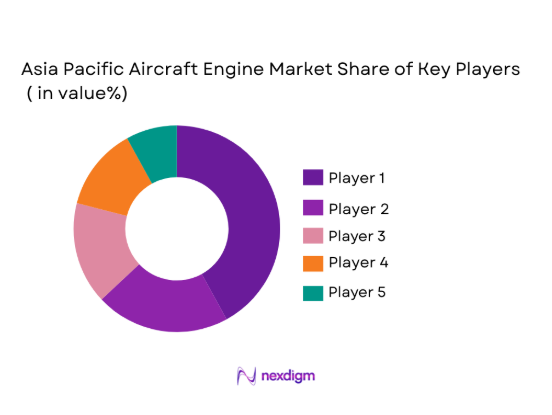
The competitive landscape of the Asia Pacific aircraft engine market is marked by the presence of both established global players and local manufacturers. Consolidation is evident, with major players focusing on collaborations, acquisitions, and partnerships to strengthen their market presence and expand technological capabilities. The influence of leading companies is significant in shaping industry trends, particularly in fuel-efficient technologies and engine performance enhancements. These companies lead through innovation, product diversification, and global reach.
|
Company Name |
Establishment Year | Headquarters | Technology Focus | Market Reach | Key Products | Revenue (USD Billion) | Additional Parameter |
| General Electric | 1892 | Boston, USA | ~ | ~ | ~ | ~ | ~ |
| Rolls-Royce | 1904 | London, UK | ~ | ~ | ~ | ~ | ~ |
| Pratt & Whitney | 1925 | East Hartford, USA | ~ | ~ | ~ | ~ | ~ |
| Safran | 2005 | Paris, France | ~ | ~ | ~ | ~ | ~ |
| Honeywell | 1906 | Charlotte, USA | ~ | ~ | ~ | ~ | ~ |
Asia Pacific Aircraft Engine Market Analysis
Growth Drivers
Increased Demand for Air Travel
The Asia Pacific region has seen a consistent rise in passenger traffic over the past decade, leading to an increased demand for aircraft engines. With more passengers traveling within and across countries, airlines are investing in larger fleets to meet this demand. As low-cost carriers expand and international air routes grow, airlines are seeking more efficient aircraft engines to handle the increased workload. This surge in air traffic, coupled with the need for reduced operational costs, is driving the demand for advanced and fuel-efficient aircraft engines. Airlines are replacing older, less efficient engines with newer technologies, contributing to market growth. Additionally, the competitive pricing strategies of engine manufacturers and airlines’ focus on operational efficiency are helping to boost demand for advanced engines. This demand is particularly pronounced in fast-developing economies such as China, India, and Southeast Asia. With the commercial aviation sector expanding rapidly, there is a clear opportunity for engine manufacturers to capitalize on this trend by offering engines that combine power and fuel efficiency.
Technological Advancements in Engine Efficiency
One of the key factors propelling the growth of the Asia Pacific aircraft engine market is the continuous development of new, more fuel-efficient engine technologies. The focus on reducing carbon emissions and improving fuel economy has led to the rise of next-generation engines such as the LEAP and GEnx. These engines offer significantly lower fuel consumption compared to their predecessors, providing both environmental and economic benefits for airlines. The development of hybrid engines and electric propulsion systems is further pushing the boundaries of engine efficiency. Governments in the Asia Pacific region are also introducing stricter environmental regulations, prompting airlines to adopt engines that meet these standards. As a result, aircraft engine manufacturers are investing heavily in research and development to bring advanced technologies to market. The demand for these efficient engines is expected to continue growing, particularly as airlines strive to improve their sustainability and reduce operational costs.
Market Challenges
High Cost of Advanced Aircraft Engines
One of the primary challenges facing the Asia Pacific aircraft engine market is the high cost of advanced engine technologies. While these engines offer improved efficiency and reduced fuel consumption, their upfront cost can be significant. Airlines in emerging economies often face budget constraints that make it difficult to justify the high initial investment in new aircraft engines. This challenge is particularly pronounced for low-cost carriers that operate on tight profit margins and prioritize cost-saving measures. Additionally, the installation and maintenance costs associated with these advanced engines further contribute to the overall financial burden. The challenge of balancing cost with technological advancements is a major consideration for airlines in the region, and many opt to extend the life of their existing engines rather than investing in new ones. As a result, aircraft engine manufacturers must find ways to make their products more affordable and accessible to a broader range of airlines without compromising on performance or efficiency.
Stringent Regulatory and Compliance Requirements
Another significant challenge for the Asia Pacific aircraft engine market is the complex regulatory environment. As governments in the region implement stricter emissions standards and noise reduction regulations, aircraft engine manufacturers must ensure their products comply with these requirements. This often involves significant investments in research and development to meet evolving regulatory demands. Additionally, compliance with international standards such as those set by the International Civil Aviation Organization (ICAO) adds an extra layer of complexity. These regulatory challenges can increase the development time and cost of new engines, potentially slowing down innovation in the market. For airlines, adhering to these regulations may require costly retrofitting of older aircraft or the adoption of new engines, adding to the overall expense of fleet modernization. The constant shift in regulatory policies requires manufacturers to remain agile and responsive to changes, which can be challenging in an already competitive market.
Opportunities
Emerging Demand for Sustainable Aviation Solutions
As environmental concerns continue to rise, there is increasing demand for sustainable aviation solutions across the Asia Pacific region. Governments, airlines, and engine manufacturers are focused on reducing carbon emissions, making the market for eco-friendly aircraft engines an area of significant growth. New technologies such as hybrid-electric and fully electric propulsion systems are gaining attention as potential solutions for reducing the aviation sector’s environmental impact. The Asia Pacific region is well-positioned to lead in this area due to its large and rapidly growing aviation market, particularly in countries like China and India. The growing awareness of sustainability, coupled with government incentives and international agreements aimed at reducing greenhouse gas emissions, presents a huge opportunity for manufacturers to innovate and develop cleaner, more efficient engine technologies. By investing in these emerging technologies, companies can capitalize on the rising demand for environmentally friendly aircraft engines and establish themselves as leaders in the sustainable aviation market.
Growth in Low-Cost Carrier (LCC) Segment
The growth of low-cost carriers (LCCs) in the Asia Pacific region presents another significant opportunity for the aircraft engine market. LCCs are expanding rapidly due to their affordability and widespread appeal among budget-conscious travelers. These carriers typically operate with smaller aircraft fleets that require cost-efficient engines, driving the demand for more economical and reliable engine options. As LCCs continue to proliferate across Asia, particularly in countries with burgeoning middle-class populations such as India and Indonesia, the market for affordable aircraft engines is expected to expand. Engine manufacturers can capitalize on this trend by offering engines that are specifically designed for the needs of low-cost carriers, providing cost savings in both fuel consumption and maintenance. This segment’s growth is expected to remain strong, creating sustained demand for new, affordable engine technologies that align with LCC operational models.
Future Outlook
The future of the Asia Pacific aircraft engine market over the next five years looks promising, with continued growth expected across the region. The rise in air travel, particularly in emerging economies, will continue to drive demand for advanced, fuel-efficient engines. Technological innovations in sustainable aviation, including hybrid-electric engines and sustainable aviation fuels, will play a pivotal role in shaping the future of the industry. Additionally, increasing regulatory pressures around emissions will encourage the development of greener engine solutions, aligning with global sustainability goals. As the region continues to expand its aviation infrastructure, the market will witness a steady influx of new aircraft, further driving demand for innovative aircraft engine technologies.
Major Players
- General Electric
- Rolls-Royce
- Pratt & Whitney
- Safran
- Honeywell
- CFM International
- MTU Aero Engines
- Mitsubishi Heavy Industries
- IHI Corporation
- United Technologies
- Aero Engine Corporation of China
- Wartsila
- Rolls-Royce Deutschland
- Doosan
- Shanghai Electric
Key Target Audience
- Investments and venture capitalist firms
- Government and regulatory bodies
- Aircraft manufacturers
- Airlines and fleet operators
- Engine manufacturers and suppliers
- Aviation consulting firms
- OEMs (Original Equipment Manufacturers)
- Aviation maintenance service providers
Research Methodology
Step 1: Identification of Key Variables
The first step involves identifying key variables that influence the aircraft engine market, such as market size, demand trends, and technological advancements.
Step 2: Market Analysis and Construction
This phase involves analyzing historical data, identifying growth trends, and segmenting the market by product type, end-use, and region.
Step 3: Hypothesis Validation and Expert Consultation
In this step, industry experts and stakeholders are consulted to validate assumptions and hypotheses based on market analysis.
Step 4: Research Synthesis and Final Output
The final step involves synthesizing all collected data into a comprehensive market report, highlighting key trends, challenges, and opportunities.

- Executive Summary
- Research Methodology (Definitions, Scope, Industry Assumptions, Market Sizing Approach, Primary & Secondary Research Framework, Data Collection & Verification Protocol, Analytic Models & Forecast Methodology, Limitations & Research Validity Checks

- Market Definition and Scope
- Value Chain & Stakeholder Ecosystem
- Regulatory / Certification Landscape
- Sector Dynamics Affecting Demand
- Strategic Initiatives & Infrastructure Growth

- Growth Drivers
Increased Demand for Air Travel
Technological Advancements in Engine Efficiency
Rising Military Budgets in Asia Pacific
Increase in Airline Fleet Expansion
Government Policies Supporting Aviation Industry Growth - Market Challenges
High Capital Investment in Advanced Engines
Stringent Regulatory and Compliance Requirements
Complexities in Engine Maintenance and Service Life Extension
Fluctuating Fuel Prices Impacting Demand for Efficient Engines
Limited Availability of Skilled Workforce for Engine Maintenance - Market Opportunities
Emerging Demand for Sustainable Aviation Solutions
Growth in Low-Cost Carrier (LCC) Segment
Technological Innovations in Hybrid and Electric Engines - Trends
Rise in Demand for Fuel-Efficient Engines
Integration of Artificial Intelligence in Engine Design
Expansion of Aerospace Manufacturing in Asia Pacific
Increased Focus on Engine Sustainability and Environmental Impact
Advancements in 3D Printing for Engine Components - Government Regulations & Defense Policy
Aviation Emission Standards
Military Procurement Regulations
Government Subsidies and Investments in Aviation - SWOT Analysis
- Stakeholder and Ecosystem Analysis
- Porter’s Five Forces Analysis
- Competition Intensity and Ecosystem Mapping

- By Market Value, 2020-2025
- By Installed Units, 2020-2025
- By Average System Price, 2020-2025
- By System Complexity Tier, 2020-2025

- By System Type (In Value%)
Turbofan Engines
Turboprop Engines
Piston Engines
Hybrid Engines
Electric Engines - By Platform Type (In Value%)
Airborne Platforms
Land Platforms
Naval Platforms
Space Platforms
Integrated Platforms - By Fitment Type (In Value%)
OEM (Original Equipment Manufacturer)
Aftermarket
Refurbishment
Retrofit
Upgrades - By End User Segment (In Value%)
Commercial Aviation
Military Aviation
Private Aircraft Operators
Cargo Operators
Government Entities - By Procurement Channel (In Value%)
Direct Procurement
Government Tenders
Private Sector Procurement
Online Bidding Platforms
Third-Party Distributors - By Material / Technology (in Value%)
Aluminum Alloys
Titanium Alloys
Composites
Ceramic Matrix Composites
Advanced Polymers

- Market share snapshot of major players
- Cross Comparison Parameters (System Type, Platform Type, End User Segment, Fitment Type, Procurement Channel)
- SWOT Analysis of Key Competitors
- Pricing & Procurement Analysis
- Key Players
General Electric
Rolls-Royce
Pratt & Whitney
Safran
Honeywell
CFM International
MTU Aero Engines
Mitsubishi Heavy Industries
IHI Corporation
United Technologies
Aero Engine Corporation of China
Wartsila
Rolls-Royce Deutschland
Doosan
Shanghai Electric

- Commercial Aviation’s Growing Fleet Needs
- Military Aviation’s Shift Towards Advanced Engine Technologies
- Private Aircraft Operators Seeking Fuel-Efficient Solutions
- Government Entities’ Strategic Investments in Aviation

- Forecast Market Value, 2026-2035
- Forecast Installed Units, 2026-2035
- Price Forecast by System Tier, 2026-2035
- Future Demand by Platform, 2026-2035


 Request a Sample
 Ask for Customization
 Get a Quote
 Enquire Now