

 Download PDF
 Download PDF
Market Overview
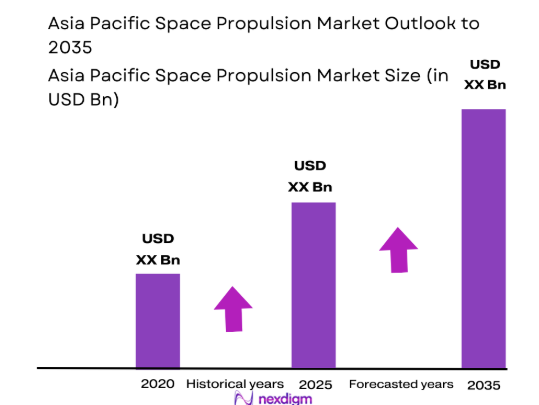
The space propulsion market in the Asia Pacific region has seen significant growth, with a market size reaching USD ~ billion in recent assessments. The demand for space propulsion systems has surged due to the increasing number of satellite launches, advancements in propulsion technologies, and the growing presence of private players in the space sector. Market expansion is driven by the rise of space exploration missions and government initiatives to bolster space infrastructure, leading to a robust forecast for the future.
Asia Pacific countries like China and India lead the market in space propulsion technology. These nations’ dominance stems from their growing investments in space exploration, satellite programs, and space-related infrastructure. China, in particular, has made remarkable strides in propulsion technology, while India benefits from its cost-effective solutions and strategic partnerships with other countries. Japan and South Korea also contribute significantly due to their advanced technological capabilities and active participation in global space missions.
Market Segmentation
By Product Type
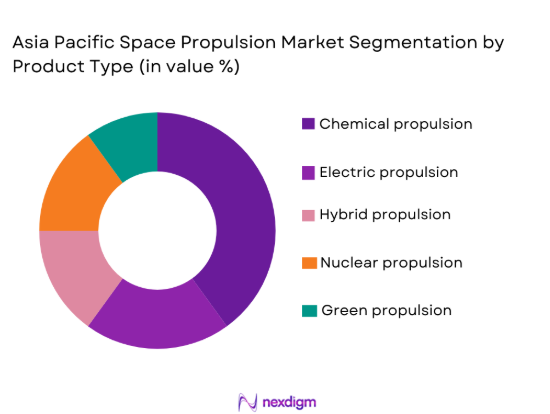
The Asia Pacific space propulsion market is segmented by product type into chemical propulsion, electric propulsion, hybrid propulsion, nuclear propulsion, and green propulsion. Recently, chemical propulsion has a dominant market share due to its reliable performance, widespread use in launch vehicles, and proven technology in space missions. Chemical propulsion remains the preferred option for high-thrust applications, especially in satellite launches and deep space exploration, as it offers higher efficiency and has been extensively tested over the years.
By Platform Type
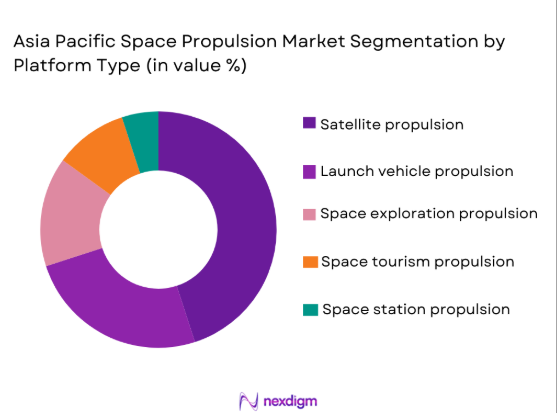
The Asia Pacific space propulsion market is segmented by platform type into satellite propulsion, launch vehicle propulsion, space exploration propulsion, space tourism propulsion, and space station propulsion. Recently, satellite propulsion has a dominant market share due to the increasing demand for small satellites, particularly in telecommunications and earth observation. The growth of the satellite communications industry, combined with advancements in propulsion systems for satellites, has contributed significantly to its dominance in the market.
Competitive Landscape
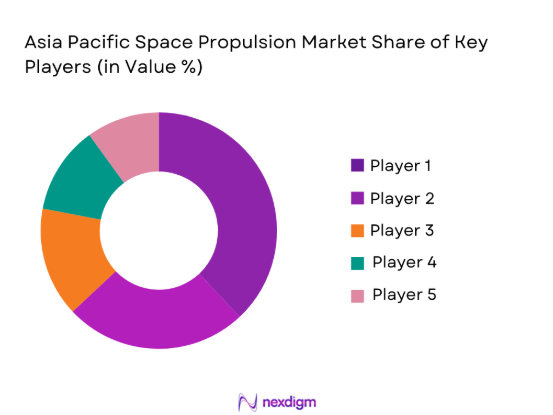
The Asia Pacific space propulsion market is characterized by fierce competition among key players, with significant consolidation occurring as companies seek to acquire specialized capabilities and expand their market presence. Major players with substantial technological expertise are continuously innovating to improve propulsion systems’ efficiency, cost-effectiveness, and environmental sustainability. Partnerships and collaborations between private and government entities are also common, further intensifying the competitive environment.
| Company Name | Establishment Year | Headquarters | Technology Focus | Market Reach | Key Products | Revenue | Additional Parameter |
| ISRO | 1969 | India | ~ | ~ | ~ | ~ | ~ |
| SpaceX | 2002 | USA | ~ | ~ | ~ | ~ | ~ |
| Rocket Lab | 2006 | USA | ~ | ~ | ~ | ~ | ~ |
| Northrop Grumman | 1939 | USA | ~ | ~ | ~ | ~ | ~ |
| Arianespace | 1980 | France | ~ | ~ | ~ | ~ | ~ |
Asia Pacific Space Propulsion Market Analysis
Growth Drivers
Increase in satellite launches
The growing demand for satellite-based services in telecommunications, earth observation, and navigation has significantly driven the space propulsion market. Increased satellite launches, driven by government agencies and private companies, have resulted in a surge in demand for advanced propulsion systems. The development of smaller and more cost-effective satellites has expanded the market for propulsion systems, particularly in low Earth orbit (LEO). Additionally, innovations in propulsion technology, such as electric and green propulsion systems, have opened new opportunities in the satellite industry. As the number of satellite constellations increases, the need for efficient propulsion systems capable of precise maneuvering and orbit adjustments has also risen. Furthermore, international collaborations in space missions have created a steady demand for propulsion systems, with commercial space companies playing an increasingly vital role. The surge in satellite launches across the region contributes to the overall market growth and the development of next-generation propulsion systems.
Technological advancements in propulsion systems
The rapid evolution of propulsion technologies has been a significant growth driver in the Asia Pacific space propulsion market. Recent advancements in electric propulsion, such as ion thrusters and Hall effect thrusters, offer higher fuel efficiency and longer operational lifespans, making them increasingly attractive for commercial satellite operators. The development of green propulsion technologies, which are more environmentally friendly, has also attracted attention due to the growing focus on sustainability in space operations. These innovations have increased the adoption of alternative propulsion systems, reducing reliance on traditional chemical-based propulsion. Additionally, hybrid propulsion systems that combine the advantages of both chemical and electric propulsion are gaining popularity for deep space exploration. The ongoing research and development efforts by government and private entities are expected to continue driving technological advancements, offering new propulsion solutions for various space applications, thus fostering growth in the market.
Market Challenges
High cost of space propulsion systems
One of the key challenges in the Asia Pacific space propulsion market is the high cost associated with developing and deploying advanced propulsion systems. The intricate design, manufacturing, and testing processes of space propulsion systems contribute to their significant expense. As a result, companies and space agencies often face budget constraints when seeking to procure and deploy propulsion systems, which can limit market growth. Additionally, the costs associated with maintaining and upgrading existing propulsion systems add to the financial burden. While some government programs have received substantial funding, smaller private players may struggle to afford the necessary technologies. To overcome this challenge, there is a growing emphasis on developing cost-effective solutions, including reusable propulsion systems, which could help reduce overall costs in the long term. However, overcoming the high upfront costs remains a significant hurdle for market participants, particularly those aiming to enter the space industry with limited resources.
Regulatory and certification hurdles
The space propulsion market in the Asia Pacific region faces several regulatory and certification challenges, which hinder the market’s growth. Different countries have their own set of regulations, and compliance with these regulations often requires extensive testing, documentation, and approval processes. This can significantly delay the deployment of propulsion systems and add to the overall costs of space missions. Additionally, varying standards across the region make it difficult for companies to scale their products across borders, limiting their market reach. Moreover, the complex nature of propulsion technologies means that certification authorities require thorough assessments to ensure safety and reliability, which can be a time-consuming process. Despite the regulatory efforts to standardize space regulations globally, these challenges remain a bottleneck in the industry. Space agencies and companies are working toward more streamlined processes, but navigating the regulatory environment continues to pose significant challenges.
Opportunities
Development of more cost-effective propulsion technologies
A significant opportunity in the Asia Pacific space propulsion market lies in the development of more cost-effective propulsion systems. As the demand for satellite launches and space missions grows, the need for affordable propulsion technologies becomes more apparent. Developing more cost-effective propulsion solutions, particularly in the field of electric and hybrid propulsion systems, could open up new markets for small satellite operators and emerging space economies. The advent of reusable propulsion systems, which allow for multiple uses with minimal additional cost, has the potential to revolutionize the market. As government and private entities invest in research and development for more affordable propulsion technologies, this will likely lead to a decrease in the overall cost of space operations, providing new opportunities for market expansion. This trend could be especially beneficial for countries in the Asia Pacific region, where cost-efficiency is a critical factor in driving space exploration and satellite deployments.
Advancements in green propulsion technologies
Another key opportunity in the Asia Pacific space propulsion market is the growing demand for environmentally sustainable propulsion technologies. Green propulsion systems, which use non-toxic and environmentally friendly propellants, have become a focus of research and development in the space sector. As global awareness about the environmental impact of space missions increases, space agencies and commercial operators are exploring green alternatives to reduce their carbon footprints. The development of such technologies is seen as a step toward more sustainable space operations, aligning with global sustainability goals. The ability to offer green propulsion systems will likely attract significant attention from governments, regulatory bodies, and private companies seeking to mitigate their environmental impact. This demand for greener solutions presents a significant opportunity for companies in the space propulsion market to innovate and capture a new segment of environmentally conscious customers.
Future Outlook
The space propulsion market in the Asia Pacific region is expected to experience substantial growth over the next five years. Key drivers include technological advancements, increased government and private sector investments, and the rise in satellite launches. As demand for space exploration and satellite communications expands, the market will see continued innovations, particularly in electric and hybrid propulsion technologies. With favorable regulatory frameworks and increasing focus on sustainability, propulsion systems will evolve to meet the growing demands of space missions, both in low Earth orbit and deep space.
Major Players
- ISRO
- SpaceX
- Rocket Lab
- Northrop Grumman
- Arianespace
- Blue Origin
- Lockheed Martin
- Boeing
- Roscosmos
- United Launch Alliance
- China National Space Administration
- Thales Alenia Space
- Mitsubishi Heavy Industries
- Relativity Space
- Sierra Nevada Corporation
Key Target Audience
- Investments and venture capitalist firms
- Government and regulatory bodies
- Space technology manufacturers
- Space exploration companies
- Satellite operators
- Aerospace defense contractors
- Commercial space companies
- Space tourism companies
Research Methodology
Step 1: Identification of Key Variables
This step involves identifying the key variables influencing the market, such as technological trends, demand patterns, and regulatory factors, to ensure an accurate market assessment.
Step 2: Market Analysis and Construction
Comprehensive analysis of the space propulsion market is conducted by reviewing historical data, current market trends, and future projections to build a reliable market model.
Step 3: Hypothesis Validation and Expert Consultation
The initial hypothesis is validated through consultations with industry experts, stakeholders, and key players to confirm the accuracy of the market model and assumptions.
Step 4: Research Synthesis and Final Output
Data from various sources are synthesized, and a final report is produced, summarizing the key findings and insights about the space propulsion market in the Asia Pacific region.

- Executive Summary
- Research Methodology (Definitions, Scope, Industry Assumptions, Market Sizing Approach, Primary & Secondary Research Framework, Data Collection & Verification Protocol, Analytic Models & Forecast Methodology, Limitations & Research Validity Checks)

- Market Definition and Scope
- Value Chain & Stakeholder Ecosystem
- Regulatory / Certification Landscape
- Sector Dynamics Affecting Demand
- Strategic Initiatives & Infrastructure Growth

- Growth Drivers
Increase in satellite launches
Expansion of private space companies
Rise in space exploration missions
Technological advancements in propulsion systems
Growing demand for space tourism - Market Challenges
High cost of propulsion technology
Limited availability of advanced propulsion materials
Regulatory and certification hurdles
Technological limitations of current propulsion systems
Environmental concerns regarding propulsion emissions - Market Opportunities
Development of more cost-effective propulsion systems
Rise of reusable launch vehicles
Advancements in eco-friendly propulsion technologies - Trends
Adoption of electric and hybrid propulsion systems
Increased collaboration between private and government sectors
Rise in demand for small satellite propulsion
Innovation in green propellant technologies
Focus on reducing the environmental impact of propulsion systems - Government Regulations & Defense Policy
Increasing government investment in space exploration
Emerging space treaties focusing on propulsion technologies
Strengthening of national security policies related to space propulsion - SWOT Analysis
- Stakeholder and Ecosystem Analysis
- Porter’s Five Forces Analysis
- Competition Intensity and Ecosystem Mapping

- By Market Value, 2020-2025
- By Installed Units, 2020-2025
- By Average System Price, 2020-2025
- By System Complexity Tier, 2020-2025

- By System Type (In Value%)
Chemical propulsion
Electric propulsion
Hybrid propulsion
Nuclear propulsion
Green propulsion - By Platform Type (In Value%)
Satellite propulsion
Launch vehicle propulsion
Space exploration propulsion
Space tourism propulsion
Space station propulsion - By Fitment Type (In Value%)
Primary propulsion
Auxiliary propulsion
Attitude control propulsion
Orbital maneuvering propulsion
Deep space propulsion - By EndUser Segment (In Value%)
Government space agencies
Private space companies
Commercial satellite operators
Defense & military agencies
Research institutions - By Procurement Channel (In Value%)
Direct procurement from manufacturers
Procurement through government contracts
Procurement through commercial agreements
Third-party procurement
International procurement partnerships - By Material / Technology (In Value%)
Ion thrusters
Chemical propellants
Hall effect thrusters
Solar electric propulsion
Green propellant technology

- Market share snapshot of major players
- Cross Comparison Parameters (Performance, Price, Innovation, Market Share, Customer Service, R&D Investment, Environmental Impact, Manufacturing Capacity, Strategic Alliances)
- SWOT Analysis of Key Players
- Pricing & Procurement Analysis
- Key Players
ISRO
China National Space Administration (CNSA)
SpaceX
Arianespace
Blue Origin
Northrop Grumman Innovation Systems
Lockheed Martin
Rocket Lab
Airbus Defence and Space
Boeing
Relativity Space
Virgin Galactic
Sierra Nevada Corporation
Thales Alenia Space
OneWeb

- Government space agencies investing in next-gen propulsion
- Private companies focusing on cost-effective propulsion systems
- Commercial operators seeking efficient propulsion for satellite constellations
- Space research organizations developing advanced propulsion technologies

- Forecast Market Value, 2026-2035
- Forecast Installed Units, 2026-2035
- Price Forecast by System Tier, 2026-2035
- Future Demand by Platform, 2026-2035


 Request a Sample
 Ask for Customization
 Get a Quote
 Enquire Now