
 Download PDF
 Download PDF
Market Overview
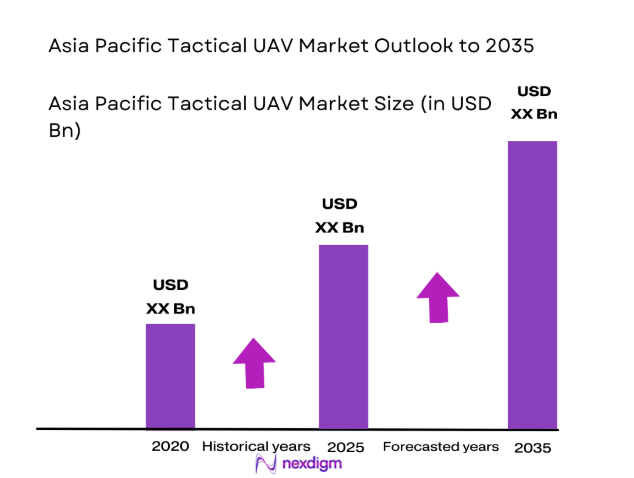
Based on a recent historical assessment, the Asia Pacific Tactical UAV market is expected to reach a value of USD ~ billion in the given year. This growth is driven by increasing demand from the defense sector, with governments and military forces investing heavily in unmanned aerial vehicles for surveillance, reconnaissance, and tactical operations. The region’s economic growth, defense modernization initiatives, and a rising need for border security and counter-terrorism operations are significant contributors to the market’s expansion. Technological advancements, including enhanced AI capabilities, miniaturization, and improved battery life, further accelerate the adoption of tactical UAVs across the region.
Asia Pacific has emerged as a global hub for UAV development and adoption, with countries like China, India, Japan, and South Korea taking center stage. China, in particular, leads in UAV production and export, supported by its robust defense budget and extensive manufacturing capabilities. India follows closely, driven by its focus on modernizing its military forces. Japan and South Korea prioritize UAV technology as part of their advanced defense strategies and regional security objectives. The growing defense budgets, governmental investments in infrastructure, and strategic military alliances further contribute to their dominance in the market.
Market Segmentation
By Product Type:
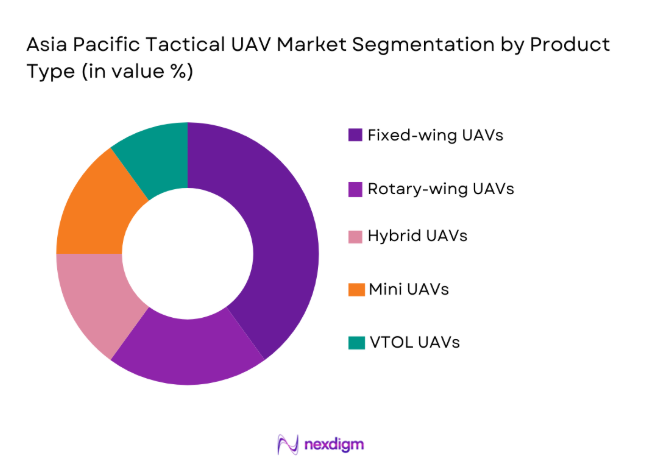
Asia Pacific Tactical UAV market is segmented by product type into fixed-wing UAVs, rotary-wing UAVs, hybrid UAVs, mini UAVs, and VTOL (Vertical Take-Off and Landing) UAVs. Recently, fixed-wing UAVs have a dominant market share due to their long endurance, high payload capacity, and ability to cover vast areas, making them suitable for surveillance, reconnaissance, and intelligence gathering. Fixed-wing UAVs offer superior stability and performance over long distances, which is why they are preferred by military and defense agencies for strategic missions. Their ability to operate for extended periods and at higher altitudes without the need for frequent landings for fuel or battery replacements positions them as a key market driver in the region.
By Platform Type:
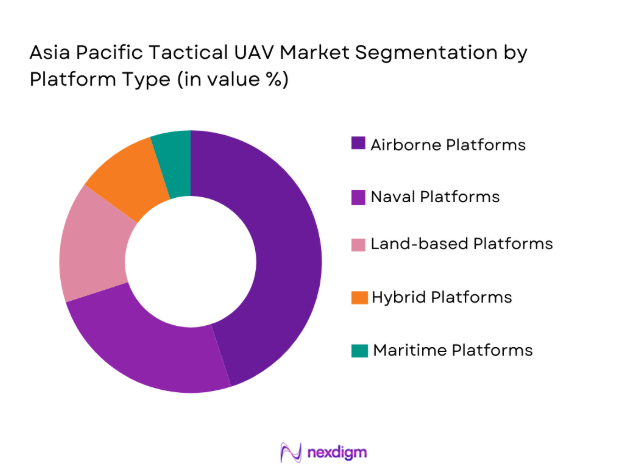
Asia Pacific Tactical UAV market is segmented by platform type into airborne platforms, naval platforms, land-based platforms, hybrid platforms, and maritime platforms. Airborne platforms have a dominant market share due to their broad applications in surveillance and reconnaissance missions, as well as their versatility across various operational theaters. Airborne platforms are widely adopted by military forces because of their high-altitude capabilities, which allow for real-time surveillance over large geographical areas, enhancing intelligence-gathering processes. These platforms are increasingly integrated with advanced technologies such as AI, providing enhanced situational awareness and precision targeting in military operations.
Competitive Landscape
The Asia Pacific Tactical UAV market is highly competitive, with consolidation happening among key players to strengthen their market position. Leading players are focusing on technological innovation, strategic partnerships, and mergers and acquisitions to gain a larger share of the market. The dominance of established defense contractors and companies specializing in unmanned systems contributes to the competitive dynamics. These major players not only provide UAV systems but also offer critical support services, including maintenance, training, and technical integration, further consolidating their presence in the market. As demand for tactical UAVs continues to grow, these companies are expected to lead in providing advanced, customizable solutions that meet specific defense needs.
| Company Name | Establishment Year | Headquarters | Technology Focus | Market Reach | Key Products | Revenue | Product Customization Capability |
| DJI Innovations | 2006 | China | ~ | ~ | ~ | ~ | ~ |
| AeroVironment | 1979 | USA | ~ | ~ | ~ | ~ | ~ |
| Elbit Systems | 1966 | Israel | ~ | ~ | ~ | ~ | ~ |
| Northrop Grumman | 1939 | USA | ~ | ~ | ~ | ~ | ~ |
| Boeing | 1916 | USA | ~ | ~ | ~ | ~ | ~ |
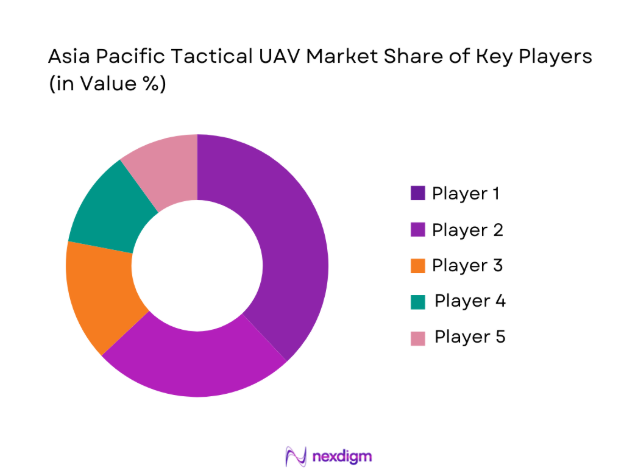
Asia Pacific Tactical UAV Market Analysis
Growth Drivers
Government Investments in Defense:
Government investments in defense modernization are a significant driver of the tactical UAV market in Asia Pacific. Countries such as China, India, Japan, and South Korea have been ramping up their defense spending, particularly focusing on unmanned aerial vehicle technologies. These investments aim to enhance military surveillance, reconnaissance, and combat capabilities. In addition, regional governments are increasingly funding the development of indigenous UAV technologies, which boosts the local defense industry’s growth while creating a conducive environment for the proliferation of tactical UAVs. Furthermore, these government-funded projects often include UAVs for border security and counter-terrorism efforts, further driving market demand.
Technological Advancements in UAV Systems:
Another key growth driver is the continuous improvement in UAV technology, including artificial intelligence, autonomous operations, and advanced payload systems. As UAVs become more intelligent and capable of performing complex missions, their adoption increases. Military agencies in the region are integrating AI into UAVs for better decision-making and enhanced operational efficiency. Moreover, advancements in battery life, materials, and miniaturization of components have resulted in more cost-effective, reliable, and durable UAVs. These technological advancements make UAVs more attractive to both military and commercial sectors, driving market growth and enabling wider deployment in various applications.
Market Challenges
High Cost of Advanced UAVs:
A major challenge in the Asia Pacific Tactical UAV market is the high cost associated with advanced UAV systems. These systems often require significant investment, especially for high-performance models used by military forces. The development, production, and integration of cutting-edge technologies such as AI, advanced sensors, and sophisticated flight control systems increase production costs. Smaller nations with limited defense budgets face financial constraints, which can slow down UAV adoption. Additionally, the maintenance and operational costs associated with these systems can further restrict their accessibility to many potential buyers, thereby limiting overall market growth.
Regulatory and Airspace Challenges:
Regulatory restrictions and airspace management are also significant hurdles for the market. Many countries in the region still have strict regulations governing UAV flight, especially for military applications, which can delay or hinder the deployment of new systems. Airspace congestion, particularly in densely populated regions, makes it challenging to integrate UAVs safely into civilian airspace. Furthermore, some nations face resistance from civil aviation authorities who are concerned about the safety and security implications of increased UAV activity in shared airspace. These regulatory challenges can limit the speed at which UAV technologies are adopted, particularly for military use.
Opportunities
Emerging Commercial Applications:
One of the most promising opportunities in the Asia Pacific Tactical UAV market lies in the growing commercial sector. Beyond military and defense, UAVs are increasingly being used in various commercial applications such as agriculture, logistics, and environmental monitoring. These UAVs offer cost-effective solutions for tasks such as crop surveillance, package delivery, and disaster relief efforts. Governments in the region are providing support through policies and subsidies to encourage the adoption of UAV technology in these sectors. As UAVs become more mainstream in commercial industries, this shift offers substantial growth potential for the market, particularly for smaller, more affordable UAV models.
Expansion of Military Alliances:
Another significant opportunity is the expansion of regional military alliances and collaborations, which often involve joint UAV development and procurement efforts. As countries within the Asia Pacific region face common security threats, they are increasingly working together to develop and deploy UAV technologies. The United States, India, Japan, and South Korea have formed strategic alliances to jointly develop advanced UAVs and share technologies. This collaboration not only benefits the defense capabilities of these countries but also creates a larger market for tactical UAV systems, which could lead to increased production volumes and lower costs, benefiting all parties involved.
Future Outlook
Over the next five years, the Asia Pacific Tactical UAV market is poised for significant growth. The increasing need for advanced surveillance and reconnaissance capabilities in defense and commercial applications will continue to drive demand. Technological developments, such as AI integration, enhanced autonomy, and advanced materials, will make UAVs more capable and cost-effective. Additionally, favorable regulatory environments, coupled with regional defense cooperation, will support the wider adoption of UAV systems. As a result, the market is expected to experience continued expansion, with innovations in both military and commercial UAV sectors shaping the future of the industry.
Major Players
• DJI Innovations
• AeroVironment
• Elbit Systems
• Northrop Grumman
• Boeing
• General Atomics Aeronautical Systems
• Textron Systems
• Thales Group
• Lockheed Martin
• Leonardo
• Israel Aerospace Industries
• Saab
• Raytheon Technologies
• L3 Technologies
• BAE Systems
Key Target Audience
• Investments and venture capitalist firms
• Government and regulatory bodies
• Military agencies
• Aerospace and defense contractors
• UAV manufacturers
• Commercial drone service providers
• Aviation authorities
• Environmental monitoring agencies
Research Methodology
Step 1: Identification of Key Variables
This step involves identifying the critical market variables that influence the demand and supply dynamics in the tactical UAV market.
Step 2: Market Analysis and Construction
In this phase, an in-depth market analysis is conducted to understand historical trends, current market dynamics, and future growth patterns.
Step 3: Hypothesis Validation and Expert Consultation
Experts in the field are consulted to validate hypotheses and assumptions, ensuring the research is based on accurate, real-world data.
Step 4: Research Synthesis and Final Output
The final step synthesizes the collected data into actionable insights and market projections, providing a comprehensive view of the tactical UAV market.

- Executive Summary
- Research Methodology (Definitions, Scope, Industry Assumptions, Market Sizing Approach, Primary & Secondary Research Framework, Data Collection & Verification Protocol, Analytic Models & Forecast Methodology, Limitations & Research Validity Checks)

- Market Definition and Scope
- Value Chain & Stakeholder Ecosystem
- Regulatory / Certification Landscape
- Sector Dynamics Affecting Demand
- Strategic Initiatives & Infrastructure Growth

- Growth Drivers
Rising Military Expenditures
Increasing Border Surveillance Needs
Advancements in UAV Technology
Growing Use in Disaster Management
Government Initiatives and Funding - Market Challenges
High Initial Investment Costs
Regulatory Challenges and Airspace Limitations
Technological Integration Issues
Cybersecurity Threats
Operational Reliability Concerns - Market Opportunities
Integration of AI and Machine Learning
Expansion of Commercial UAV Applications
Development of Next-Generation UAV Systems - Trends
Autonomous UAV Operations
Miniaturization of UAV Components
Rise in Drone Swarm Technology
Development of Hybrid UAV Models
Increased Adoption of UAVs for Environmental Monitoring - Government Regulations & Defense Policy
Government Support for UAV Innovations
Increasing Airspace Management Regulations
Regional Defense Cooperation Agreements - SWOT Analysis
Stakeholder and Ecosystem Analysis
Porter’s Five Forces Analysis
Competition Intensity and Ecosystem Mapping

- By Market Value, 2020-2025
- By Installed Units, 2020-2025
- By Average System Price, 2020-2025
- By System Complexity Tier, 2020-2025

- By System Type (In Value%)
Mini UAVs
Micro UAVs
Pico UAVs
Vertical Take-Off and Landing (VTOL) UAVs
Fixed-Wing UAVs - By Platform Type (In Value%)
Airborne Platforms
Naval Platforms
Land-Based Platforms
Hybrid Platforms
Maritime Platforms - By Fitment Type (In Value%)
Combat UAVs
Surveillance UAVs
Reconnaissance UAVs
Transport UAVs
Target UAVs - By EndUser Segment (In Value%)
Military & Defense
Commercial & Civil
Research & Development
Government & Public Safety
Aerospace & Aviation - By Procurement Channel (In Value%)
Direct Sales
Distributors
Government Contracts
OEMs
Third-Party Resellers - By Material / Technology (in Value%)
Carbon Fiber
Titanium Alloy
Lightweight Composite Materials
Lithium-ion Batteries
AI-based Technologies

- Market structure and competitive positioning
- Market share snapshot of major players
CrossComparison Parameters (Price, Innovation, Distribution Network, Product Quality, Customer Support, Operational Efficiency, Regulatory Compliance, Strategic Partnerships, Global Reach) - SWOT Analysis of Key Players
- Pricing & Procurement Analysis
- Key Players
DJI Innovations
AeroVironment
Parrot SA
Elbit Systems
Northrop Grumman
General Atomics Aeronautical Systems
Boeing
Lockheed Martin
Leonardo
Thales Group
Israel Aerospace Industries
Textron Systems
Raytheon Technologies
L3 Technologies
SAAB

- Growing Demand for Military UAVs in Border Security
- Increased Use of UAVs for Surveillance and Reconnaissance Missions
- Commercial Sector Adoption of UAVs for Delivery Services
- Demand for UAVs in Environmental Protection and Monitoring

- Forecast Market Value, 2026-2035
- Forecast Installed Units, 2026-2035
- Price Forecast by System Tier, 2026-2035
- Future Demand by Platform, 2026-2035


 Request a Sample
 Ask for Customization
 Get a Quote
 Enquire Now