

 Download PDF
 Download PDF
Market Overview
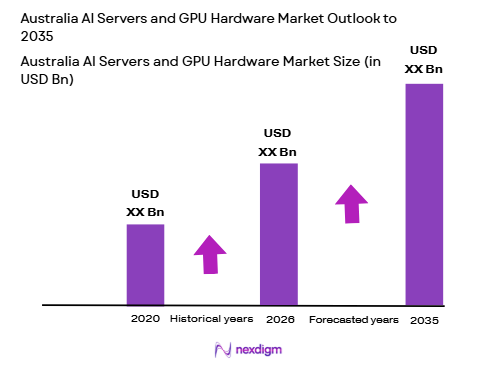
Australia AI servers and GPU hardware market is valued at approximately USD ~ billion based on a recent historical assessment, driven by hyperscale cloud expansion, enterprise AI adoption, and research computing investments. Demand for GPU-accelerated servers supporting machine learning, analytics, and simulation workloads is rising across financial services, healthcare, and public sector organizations. Growth of generative AI applications and cloud-based AI platforms is accelerating procurement of high-performance AI servers and specialized GPU hardware across data center and enterprise environments.
Sydney and Melbourne dominate the Australia AI servers and GPU hardware market due to concentration of hyperscale data centers, enterprise headquarters, and advanced connectivity infrastructure. These cities host major cloud regions and financial institutions requiring high-performance AI computing systems. Canberra supports government and defense AI computing programs, while Brisbane is emerging as a digital infrastructure hub linked to research institutions and data center expansion. Proximity to users, power availability, and fiber networks reinforces regional leadership in AI hardware deployment nationwide.
Market Segmentation
By Product Type
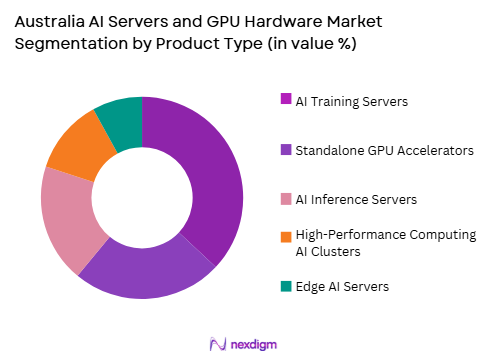
Australia AI Servers and GPU Hardware market is segmented by product type into AI training servers, AI inference servers, standalone GPU accelerators, edge AI servers, and high-performance computing AI clusters. Recently, AI training servers has a dominant market share due to factors such as hyperscale cloud investment, generative AI model development, and enterprise demand for large-scale training infrastructure. Organizations deploy GPU-dense training servers to build and refine AI models locally. Cloud providers expand training clusters within Australian regions to support AI services. Research institutions procure large GPU systems for scientific computing. Increasing computational intensity of AI training workloads sustains highest capital allocation toward training server infrastructure in Australia.
By End-Use Industry
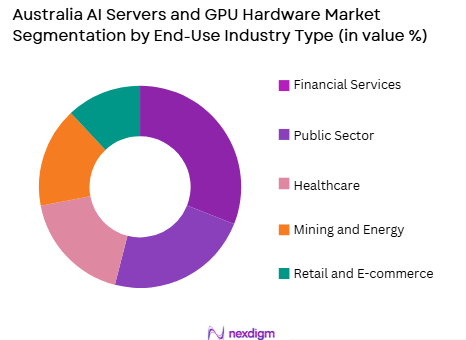
Australia AI Servers and GPU Hardware market is segmented by end-use industry into financial services, public sector, healthcare, mining and energy, and retail and e-commerce. Recently, financial services has a dominant market share due to factors such as strong adoption of AI analytics, risk modeling, and fraud detection infrastructure across banks and insurers. Financial institutions deploy GPU servers for large-scale data analysis and algorithmic modeling. Strict data governance requirements encourage domestic AI hardware deployment. Integration of AI into digital banking and trading platforms increases compute demand. These factors position financial services as the leading industry consumer of AI servers and GPU hardware in Australia.
Competitive Landscape
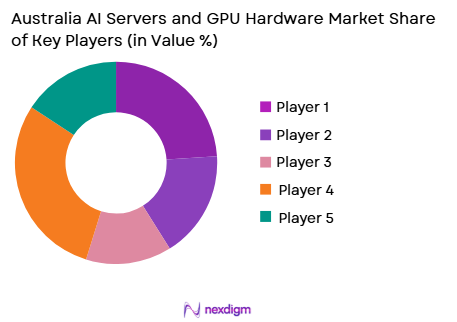
The Australia AI servers and GPU hardware market is moderately consolidated with global GPU vendors and server OEMs dominating supply, complemented by domestic cloud and data center operators driving deployment. Hyperscale providers influence procurement volumes and technology selection. Partnerships between hardware vendors, cloud platforms, and colocation providers shape market structure. Global firms lead in GPU architecture and AI server platforms, while local infrastructure operators provide hosting environments for enterprise and government AI systems.
| Company Name | Establishment Year | Headquarters | Technology Focus | Market Reach | Key Products | Revenue | Australia AI Hardware Deployment Presence |
| NVIDIA | 1993 | Santa Clara, USA | ~ | ~ | ~ | ~ | ~ |
| Dell Technologies | 1984 | Texas, USA | ~ | ~ | ~ | ~ | ~ |
| Hewlett Packard Enterprise | 1939 | Texas, USA | ~ | ~ | ~ | ~ | ~ |
| Lenovo | 1984 | Beijing, China | ~ | ~ | ~ | ~ | ~ |
| Supermicro | 1993 | California, USA | ~ | ~ | ~ | ~ | ~ |
Australia AI Servers and GPU Hardware Market Analysis
Growth Drivers
Hyperscale Cloud AI Infrastructure Expansion and Generative AI Workload Growth
Rapid expansion of hyperscale cloud regions and generative artificial intelligence applications in Australia is driving substantial procurement of GPU-accelerated servers and AI hardware across domestic data centers and enterprise environments. Cloud providers are deploying high-density GPU training clusters to support AI model development, inference services, and data analytics platforms hosted within Australian regions. Enterprises increasingly consume AI services locally due to data sovereignty and latency considerations, stimulating domestic hardware investment. Financial services, healthcare, and government sectors are integrating AI into digital platforms and analytics systems, raising computational requirements. Generative AI applications in content creation, automation, and decision support significantly increase processing intensity per workload. Research institutions and AI startups are procuring specialized GPU servers for experimentation and model training. Expansion of AI cloud services portfolios requires continuous hardware scaling. Partnerships between GPU vendors and cloud operators accelerate deployment cycles. These structural dynamics collectively sustain strong growth of AI servers and GPU hardware demand across Australia.
Enterprise and Public Sector AI Adoption for Advanced Analytics and Automation
Widespread adoption of artificial intelligence across enterprises and government agencies in Australia is accelerating deployment of AI servers and GPU hardware to support advanced analytics, automation, and decision-making applications across industries. Financial institutions deploy AI infrastructure for fraud detection, algorithmic trading, and risk modeling. Government agencies use AI for defense analytics, public services optimization, and cybersecurity monitoring, requiring secure local compute environments. Healthcare providers implement AI-driven diagnostics and genomics analysis, expanding high-performance computing demand. Mining and energy firms apply AI for exploration modeling and predictive maintenance at scale. Enterprises transition AI from pilot to production environments, increasing hardware capacity requirements. Data governance regulations encourage domestic hosting of AI workloads. Integration of AI into enterprise software platforms expands compute intensity. Organizations invest in on-premise and hybrid AI infrastructure for performance and control. These adoption trends sustain long-term growth of AI servers and GPU hardware deployment across Australia.
Market Challenges
High Cost and Power Requirements of GPU-Intensive AI Infrastructure
Deployment of AI servers and GPU hardware in Australia faces significant cost and energy challenges due to high capital expenditure and operational power consumption associated with GPU-dense computing systems. Advanced AI servers and accelerators are expensive to procure and integrate, limiting adoption among smaller enterprises. GPU clusters consume substantial electricity, increasing data center operating costs. Availability of sufficient power capacity near major urban data centers constrains deployment scale. Cooling requirements for dense GPU racks increase infrastructure complexity. Energy price volatility affects operating economics. Sustainability commitments require energy-efficient infrastructure investment. Hardware lifecycle costs including maintenance and upgrades are high. Financial barriers slow widespread AI infrastructure adoption. These factors constrain rapid expansion of GPU-based computing environments across Australia.
Dependence on Imported GPUs and Limited Domestic AI Hardware Ecosystem
Australia’s AI servers and GPU hardware market relies heavily on imported GPUs and server platforms due to absence of domestic semiconductor manufacturing and limited local AI hardware ecosystem, creating supply chain vulnerabilities and cost exposure. Global GPU supply shortages can delay infrastructure projects. Currency fluctuations influence hardware pricing. Lack of local fabrication reduces technology sovereignty. Domestic innovation in AI hardware is minimal compared with major manufacturing economies. Enterprises depend on foreign vendors for advanced compute systems. Supply chain disruptions affect procurement timelines. Limited local expertise in hardware engineering constrains ecosystem growth. These structural limitations restrict flexibility and scalability of AI infrastructure deployment. Building domestic AI hardware capability remains a long-term challenge.
Opportunities
Renewable Energy-Powered AI Data Centers Supporting GPU Infrastructure Growth
Australia’s abundant renewable energy resources provide opportunity to develop cost-efficient and sustainable AI data centers supporting large-scale GPU server deployment while addressing power and sustainability challenges. Co-location of AI data centers with solar and wind generation reduces electricity costs and carbon footprint. Hyperscale providers increasingly prioritize renewable-powered facilities. Regional renewable hubs offer land and power capacity for GPU clusters. Green AI infrastructure attracts environmentally conscious enterprises. Government clean energy incentives support development. Integration of energy storage improves reliability. Sustainable infrastructure enables long-term scaling of AI hardware deployment. Export of green AI cloud services expands market potential. This opportunity supports growth of AI servers and GPU hardware demand in Australia.
Regional AI Compute Hub Development Serving Asia-Pacific Markets
Australia can position itself as a regional AI compute hub serving Asia-Pacific markets by leveraging stable regulatory environment, advanced connectivity, and renewable-powered data centers to host large GPU clusters for international workloads. Subsea cable connectivity enables cross-border data flows. Hyperscale providers can deploy regional AI compute zones in Australia. Multinational enterprises seek secure and reliable hosting environments. Regional AI service demand continues to expand. Export of AI cloud and compute services increases utilization of domestic hardware infrastructure. Partnerships with global technology firms support hub positioning. Stable political and legal environment attracts investment. This opportunity diversifies demand beyond domestic consumption. Regional hub development strengthens long-term AI hardware market growth.
Future Outlook
Australia AI servers and GPU hardware market is expected to expand steadily as enterprise AI adoption, hyperscale cloud investment, and generative AI workloads accelerate demand for GPU-enabled computing systems nationwide. Renewable-powered data center development will support sustainable scaling. Government digital and AI strategies will encourage domestic infrastructure deployment. Regional connectivity and cloud hub positioning will further expand AI hardware investment across Australia.
Major Players
- NVIDIA
- Dell Technologies
- Hewlett Packard Enterprise
- Lenovo
- Supermicro
- Cisco Systems
- IBM
- Oracle
- Amazon Web Services
- Microsoft
- Fujitsu
- Inspur
- ASUS
- Gigabyte
Key Target Audience
- Hyperscale cloud providers
- Data center operators
- Enterprise IT infrastructure teams
- Financial institutions
- Government and defense agencies
- Investments and venture capitalist firms
- Government and regulatory bodies
- AI software platform companies
Research Methodology
Step 1: Identification of Key Variables
Key variables include AI server shipments, GPU accelerator deployments, hyperscale data center capacity, enterprise AI adoption rates, and industry demand patterns. Variables are mapped across product types and industries to define market structure.
Step 2: Market Analysis and Construction
Supply-side analysis evaluates GPU vendor shipments and server OEM deployment, while demand-side analysis examines enterprise and cloud AI infrastructure adoption. Data triangulation constructs market size and segmentation estimates.
Step 3: Hypothesis Validation and Expert Consultation
Industry experts from cloud providers, hardware vendors, and enterprise IT leaders validate assumptions on AI infrastructure growth, technology adoption, and supply constraints. Feedback refines segmentation shares and competitive positioning.
Step 4: Research Synthesis and Final Output
Validated quantitative datasets and qualitative insights are synthesized into market forecasts, competitive analysis, and strategic outlook. Consistency checks ensure alignment across market size, segmentation, and trend narratives.

- Executive Summary
- Research Methodology (Definitions, Scope, Industry Assumptions, Market Sizing Approach, Primary & Secondary Research Framework, Data Collection & Verification Protocol, Analytic Models & Forecast Methodology, Limitations & Research Validity Checks)

- Market Definition and Scope
- Value Chain & Stakeholder Ecosystem
- Regulatory / Certification Landscape
- Sector Dynamics Affecting Demand
- Strategic Initiatives & Infrastructure Growth

- Growth Drivers
Expansion of hyperscale and AI data center investments
AI adoption in mining, energy, and healthcare sectors
Growing demand for sovereign AI compute infrastructure - Market Challenges
High capital and operating cost of GPU clusters
Dependence on imported GPUs and accelerators
Power and cooling constraints in data centers - Market Opportunities
National AI supercomputing and HPC deployments
AI integration in resource and industrial automation
Edge AI deployment in remote operations - Trends
Adoption of liquid-cooled high-density GPU servers
Integration of AI accelerators across telecom and edge
Convergence of AI and cloud infrastructure ecosystems - Government regulations
National AI and digital economy strategies
Data sovereignty and critical infrastructure policies
Research and supercomputing funding programs - SWOT analysis
- Porters five forces

- By Market Value, 2020-2025
- By Installed Units, 2020-2025
- By Average System Price, 2020-2025
- By System Complexity Tier, 2020-2025

- By System Type (In Value%)
GPU-Accelerated AI Servers
AI Training Clusters
AI Inference Servers
High-Density GPU Racks
Edge AI Servers - By Platform Type (In Value%)
Hyperscale Data Centers
Enterprise Data Centers
Telecom AI Cloud Platforms
Research and Academic HPC
Autonomous Systems Compute - By Fitment Type (In Value%)
New AI Infrastructure Deployment
GPU Cluster Expansion
Accelerator Retrofit Upgrades
Modular AI Rack Integration
Cloud-Managed AI Hardware - By EndUser Segment (In Value%)
Cloud and Internet Platforms
Telecommunications Operators
Mining and Energy Companies
Healthcare and Life Sciences Organizations
Government and Research Institutes - By Procurement Channel (In Value%)
Direct OEM Procurement
Accelerator Vendor Supply
System Integrator Deployment
Cloud Provider Procurement
Government AI Programs

- Market Share Analysis
- Cross Comparison Parameters (GPU Compute Density, Training Throughput Performance, Inference Latency Optimization, Energy Efficiency per TFLOP, Memory Bandwidth and Capacity, Interconnect Bandwidth and Topology, Cluster Scalability Architecture, Cooling and Thermal Design, Rack Power Density, AI Software Stack Compatibility, Deployment Flexibility, Sovereign AI Compliance Readiness)
- SWOT Analysis of Key Competitors
- Pricing & Procurement Analysis
- Key Players
NVIDIA Australia
Dell Technologies Australia
Hewlett Packard Enterprise Australia
Lenovo Australia
Supermicro Australia
Cisco Systems Australia
Fujitsu Australia
IBM Australia
Oracle Australia
Amazon Web Services Australia
Microsoft Azure Australia
Google Cloud Australia
NextDC
AirTrunk
Macquarie Data Centres

- Cloud providers expanding GPU clusters for AI services
- Telecom operators deploying AI infrastructure for networks
- Mining and energy firms adopting AI compute systems
- Government and academia investing in national AI HPC

- Forecast Market Value, 2026-2035
- Forecast Installed Units, 2026-2035
- Price Forecast by System Tier, 2026-2035
- Future Demand by Platform, 2026-2035


 Request a Sample
 Ask for Customization
 Get a Quote
 Enquire Now