

 Download PDF
 Download PDF
Market Overview
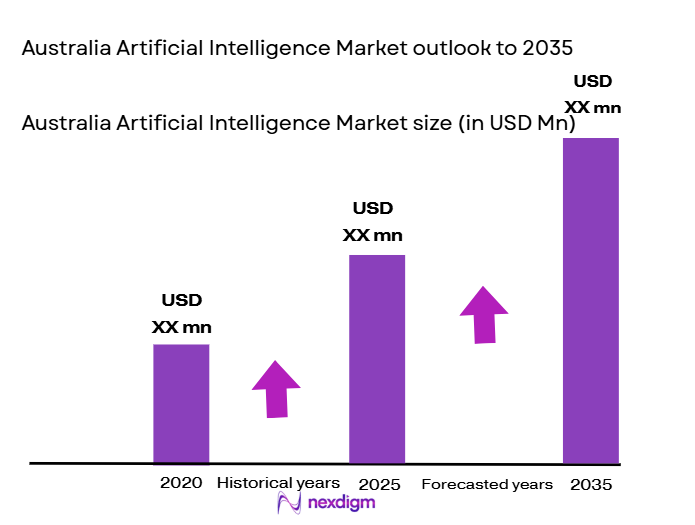
The Australian artificial intelligence market is experiencing robust growth, driven by advancements in machine learning, natural language processing, and automation technologies. Based on a recent historical assessment, the market size is valued at approximately USD ~ billion, with industries such as healthcare, retail, and finance driving AI adoption. This growth is fueled by significant investments from both government and private sectors, with major players focusing on expanding their AI offerings and integrating AI technologies into existing infrastructures.
Cities like Sydney, Melbourne, and Brisbane dominate the AI market due to their well-established tech ecosystems and the presence of top research institutions and companies. These urban centers are the primary drivers of AI innovation, supported by government initiatives such as the National Artificial Intelligence Strategy. Moreover, Australia’s strong regulatory framework, combined with access to skilled talent, positions these cities as key players in AI development within the Asia-Pacific region.
Market Segmentation
By System Type
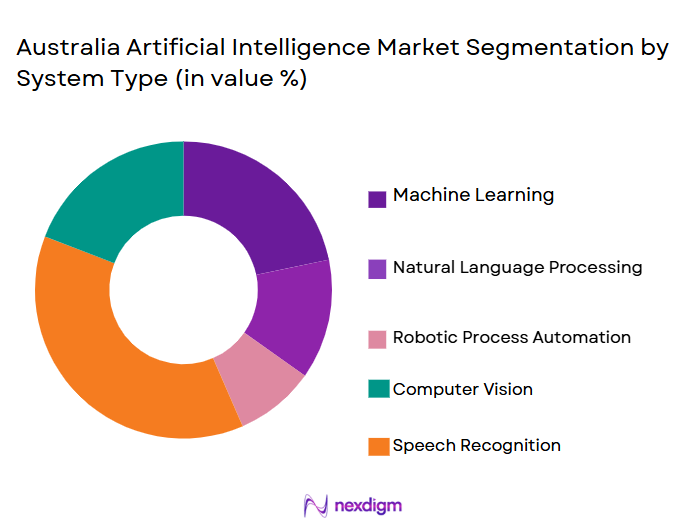
The Australian artificial intelligence market is segmented by product type into machine learning, natural language processing, robotic process automation, computer vision, and speech recognition. Recently, machine learning has a dominant market share due to factors such as its broad application across various industries, including healthcare, finance, and marketing. The continuous development of deep learning algorithms and cloud computing infrastructure has significantly contributed to its widespread use, making machine learning the most prominent sub-segment. This sub-segment benefits from increasing demand for data-driven decision-making and automation in business processes, enabling faster and more efficient services.
By Platform Type
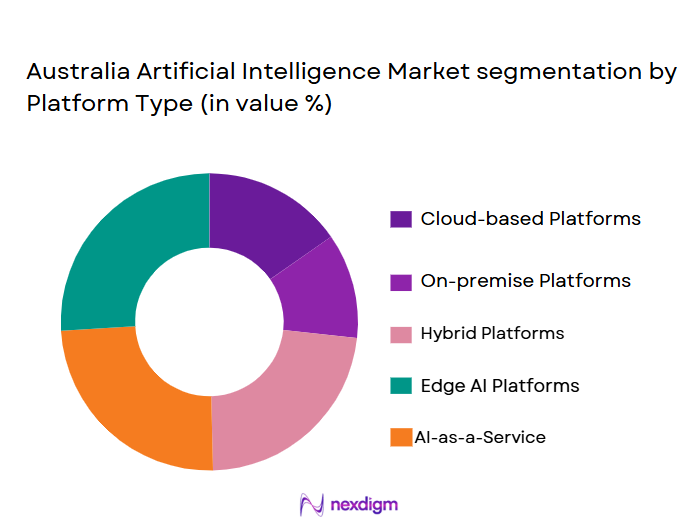
The market is segmented by platform type into cloud-based platforms, on-premise platforms, hybrid platforms, edge AI platforms, and AI-as-a-Service. Cloud-based platforms currently hold the largest share of the market due to their scalability, ease of integration, and lower upfront investment requirements. The rise of cloud computing services provided by global giants like Amazon Web Services, Microsoft Azure, and Google Cloud has enabled businesses to access AI-powered services without heavy infrastructure investment. This sub-segment’s growth is further driven by the increasing need for flexible, remote, and scalable AI solutions.
Competitive Landscape
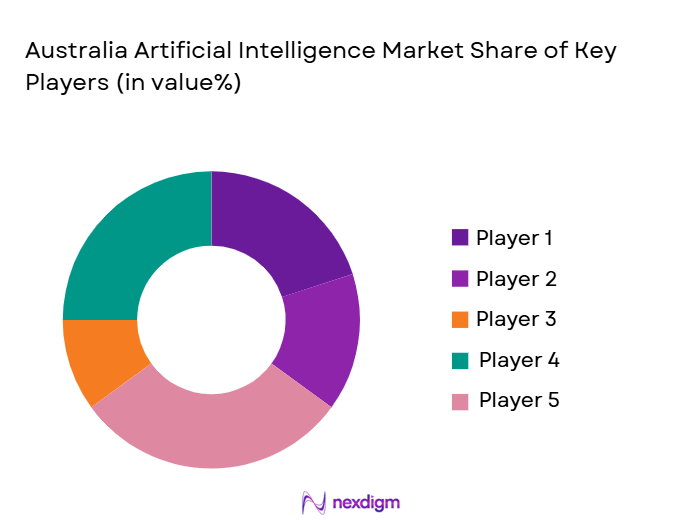
The Australian AI market is highly competitive, with a mix of global tech giants, local startups, and academic institutions driving innovation. Key players continue to focus on AI-driven solutions, contributing to market consolidation as larger companies acquire startups with cutting-edge AI technologies. The competitive landscape is characterized by rapid technological advancements, regulatory influence, and strategic collaborations, enhancing market dynamics and ensuring that Australia remains a global AI leader.
| Company Name | Establishment Year | Headquarters | Technology Focus | Market Reach | Key Products | Revenue (USD) | Additional Parameter |
| 1998 | Mountain View, USA | ~ | ~ | ~ | ~ | ~ | |
| Microsoft | 1975 | Redmond, USA | ~ | ~ | ~ | ~ | ~ |
| IBM | 1911 | Armonk, USA | ~ | ~ | ~ | ~ | ~ |
| AWS (Amazon) | 1994 | Seattle, USA | ~ | ~ | ~ | ~ | ~ |
| Atlassian | 2002 | Sydney, Australia | ~ | ~ | ~ | ~ | ~ |
Australia artificial intelligence Market Analysis
Growth Drivers
Government Support
Government initiatives and funding programs play a pivotal role in driving the Australian AI market’s expansion. The Australian government has recognized the potential of AI to boost economic growth, with investments in AI research and development becoming a core component of its national strategy. The government’s support through initiatives like the National Artificial Intelligence Strategy aims to make Australia a leader in AI innovation. In addition, funding opportunities and policy reforms designed to accelerate AI adoption in critical sectors such as healthcare, defense, and agriculture are essential to the market’s growth. Furthermore, the government’s push for regulatory frameworks that foster ethical AI development helps create a conducive environment for AI companies to thrive. With public-private partnerships, Australia is positioned to lead in AI development across the Asia-Pacific region.
Industry Demand for Automation
The increasing demand for automation across various industries is a key driver for the Australian AI market. Businesses are adopting AI solutions to automate routine tasks, improve operational efficiency, and reduce costs. The rise of AI-powered automation tools in sectors such as finance, healthcare, and manufacturing has led to widespread industry adoption. AI-driven automation not only enhances productivity but also improves decision-making by enabling businesses to leverage large datasets for insightful analysis. Moreover, the need for automation in customer service through chatbots and virtual assistants is growing, contributing to the demand for AI solutions. As companies strive to gain a competitive edge, automation via AI is seen as a critical enabler, thereby propelling market growth in Australia.
Market Challenges
Data Privacy and Security Concerns
One of the major challenges facing the Australian AI market is the growing concern around data privacy and security. As AI solutions heavily rely on large datasets, concerns about the safety of sensitive information have become a significant barrier to adoption. Stricter regulations and public awareness of data misuse have put pressure on companies to implement robust security measures. AI companies in Australia must ensure that their systems comply with global data protection regulations such as GDPR and Australia’s own privacy laws. Data breaches can damage consumer trust and lead to hefty fines, thus deterring businesses from fully adopting AI technologies. The cost of ensuring data security, coupled with the evolving regulatory landscape, creates significant hurdles for AI companies to address.
Talent Shortage
The AI market in Australia is facing a shortage of skilled professionals, which hampers the growth potential of the industry. As AI technologies evolve rapidly, the demand for highly specialized talent, including data scientists, machine learning engineers, and AI researchers, is outpacing the supply. The competition for skilled professionals is intense, with companies often struggling to find qualified candidates. Furthermore, the shortage of AI talent is not just a local issue, but a global challenge, leading to fierce competition for top talent. This lack of skilled workers limits the ability of businesses to develop and implement AI-driven solutions, slowing down innovation in the market. Addressing this challenge requires investment in education, training, and workforce development initiatives.
Opportunities
AI in Healthcare
One of the most significant opportunities in the Australian AI market lies in the healthcare sector. AI technologies are revolutionizing the healthcare industry by improving diagnostics, enabling personalized treatments, and optimizing hospital operations. The application of machine learning and deep learning models to analyze medical data has the potential to greatly enhance the accuracy and speed of diagnoses. AI is also being used to develop predictive models that can forecast patient outcomes, helping healthcare providers offer proactive care. Moreover, the increasing use of AI in telemedicine and remote patient monitoring is driving market expansion. With the aging population and the increasing demand for healthcare services, AI presents a transformative opportunity to improve healthcare delivery and reduce costs.
AI in Autonomous Vehicles
The development of autonomous vehicles represents a significant opportunity for AI in Australia. AI-powered technologies, including computer vision, machine learning, and sensor fusion, are integral to the development of self-driving cars. Australia’s vast road networks and urban expansion make it an ideal environment for testing and deploying autonomous vehicle technologies. The government’s support for smart city initiatives and autonomous vehicle trials further accelerates the adoption of AI in this space. Additionally, AI’s role in enhancing vehicle safety through advanced driver-assistance systems (ADAS) presents another growth opportunity. As consumer acceptance of autonomous vehicles grows, AI companies in Australia can capitalize on this opportunity to drive innovation in the automotive sector.
Future Outlook
The future outlook for the Australian AI market is highly optimistic, with continued growth expected across various industries such as healthcare, finance, and automotive. Technological advancements in machine learning, robotics, and natural language processing are likely to further enhance AI applications. Regulatory support, especially in data privacy and AI ethics, will play a crucial role in shaping the market’s evolution. As demand for automation and smart technologies increases, Australia is expected to solidify its position as a leader in AI development in the Asia-Pacific region.
Major Players
- Microsoft
- IBM
- AWS (Amazon)
- Atlassian
- Intel
- Nvidia
- Oracle
- Accenture
- SAP
- Cognizant
- Salesforce
- SAP
- Huawei
- Adobe
Key Target Audience
- Investments and venture capitalist firms
- Government and regulatory bodies
- Technology developers
- Healthcare providers
- Automotive companies
- Retailers
- Financial institutions
- AI solution providers
Research Methodology
Step 1: Identification of Key Variables
This step involves defining the market scope and identifying variables that impact the AI market in Australia, such as technology adoption, industry trends, and government policies.
Step 2: Market Analysis and Construction
We conduct a detailed analysis using primary and secondary research to assess current market trends, customer preferences, and the competitive landscape in Australia.
Step 3: Hypothesis Validation and Expert Consultation
Expert consultations are held with industry leaders to validate initial assumptions and refine market models.
Step 4: Research Synthesis and Final Output
The final output is synthesized from comprehensive data and analysis, focusing on actionable insights for stakeholders.

- Executive Summary
- Australia Artificial Intelligence Research Methodology
(Definitions, Scope, Industry Assumptions, Market Sizing Approach, Primary & Secondary Research Framework, Data Collection & Verification Protocol, Analytic Models & Forecast Methodology, Limitations & Research Validity Checks)

- Market Definition and Scope
- Value Chain & Stakeholder Ecosystem
- Regulatory / Certification Landscape
- Sector Dynamics Affecting Demand
- Strategic Initiatives & Infrastructure Growth

- Growth Drivers
Government support and funding for AI research
Increased adoption of AI in healthcare and automation
Rising demand for AI in customer experience and marketing - Market Challenges
Data privacy and security concerns
Lack of skilled AI professionals
High implementation costs for small and medium enterprises - Market Opportunities
Expansion of AI-powered healthcare solutions
Growth in AI for autonomous vehicles and transportation
Advancements in AI for smart city development - Trends
Increasing AI adoption in fintech
AI-driven automation in manufacturing industries
Integration of AI in consumer electronics and home appliances - Government Regulations & Defense Policy
Strict data privacy regulations in AI development
Government incentives for AI-driven defense technologies
Support for AI in public safety and smart city initiatives - SWOT Analysis (Capability Strengths, Cost Vulnerabilities, Competitive Pressures)
- Porter’s Five Forces (Procurement Power, Supplier Concentration, Substitutes, Barriers to Entry)

- By Market Value, 2020-2025
- By Installed Units, 2020-2025
- By Average System Price, 2020-2025
- By System Complexity Tier, 2020-2025

- By System Type (In Value%)
Machine Learning
Natural Language Processing
Robotic Process Automation
Computer Vision
Speech Recognition - By Platform Type (In Value%)
Cloud-based Platforms
On-premise Platforms
Hybrid Platforms
Edge AI Platforms
AI-as-a-Service - By Fitment Type (In Value%)
Embedded AI Systems
AI in Hardware
AI in Software
AI in Robotics
AI in Autonomous Vehicles - By EndUser Segment (In Value%)
Healthcare
Retail
Manufacturing
Finance
Automotive - By Procurement Channel (In Value%)
Direct Procurement
Online Platforms
Resellers and Distributors
System Integrators
OEM Partnerships

- Market Share Analysis
- Cross Comparison Parameters
(Technology Leadership, Pricing Strategy, Product Innovation, Market Penetration, Customer Base, Distribution Channels, Mergers & Acquisitions, Regulatory Compliance, Sustainability Practices) - SWOT Analysis of Key Competitors
- Pricing & Procurement Analysis
- Key Players
Google
Microsoft
IBM
Amazon Web Services
Cognizant
NVIDIA
Intel
SAS
Oracle
Accenture
Siemens
Tata Consultancy Services
SAP
Qualcomm
Baidu

- Healthcare providers utilizing AI for diagnostics
- Retailers adopting AI for personalized shopping experiences
- Financial institutions leveraging AI for fraud detection
- Automotive companies integrating AI into autonomous systems

- Forecast Market Value, 2026-2035
- Forecast Installed Units, 2026-2035
- Price Forecast by System Tier, 2026-2035
- Future Demand by Platform, 2026-2035


 Request a Sample
 Ask for Customization
 Get a Quote
 Enquire Now