
 Download PDF
 Download PDF
Market Overview
The Australia Battery Energy Storage System market is expected to reach a valuation of USD ~ billion based on a recent historical assessment. The market is driven by the increasing demand for renewable energy sources and the need for energy storage solutions to ensure grid reliability and energy security. Furthermore, favorable government policies, subsidies, and incentives are supporting the adoption of battery energy storage systems across residential, commercial, and industrial sectors. These systems play a key role in managing intermittent renewable energy sources, stabilizing the grid, and enhancing energy efficiency.
Australia continues to dominate the market due to its large-scale investment in renewable energy projects, especially in regions like New South Wales and Queensland. The country’s commitment to achieving net-zero emissions by 2050 has resulted in aggressive policies promoting renewable energy infrastructure, driving the demand for energy storage solutions. Additionally, the combination of abundant natural resources and a growing emphasis on sustainability has made Australia a key player in the energy storage space. 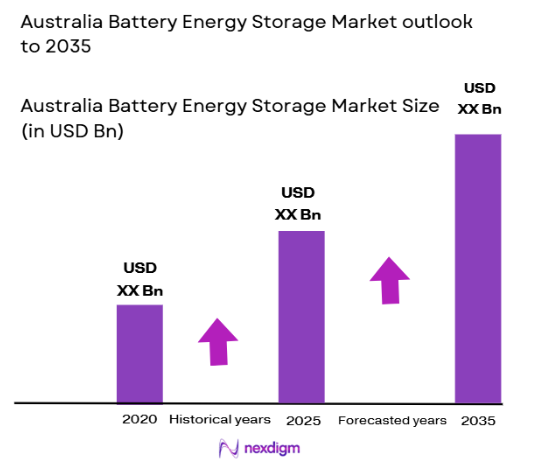
Market Segmentation
By Product Type:
The Australia Battery Energy Storage System market is segmented by product type into utility-scale storage systems, residential battery storage, commercial & industrial storage systems, hybrid energy storage systems, and off-grid storage systems. Recently, utility-scale storage systems have dominated the market share due to factors such as the rising demand for grid stability, government investment in renewable energy integration, and the increasing need to balance energy supply and demand. These large-scale systems are increasingly deployed to manage fluctuations in power generation, especially from renewable sources, ensuring a reliable power supply to urban centers. The Australian government has also supported the expansion of such systems with incentives and policies designed to enhance the grid infrastructure, making utility-scale storage systems the most significant segment of the market.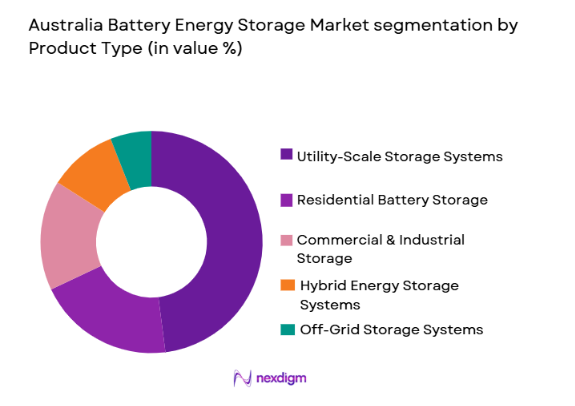
By Platform Type:
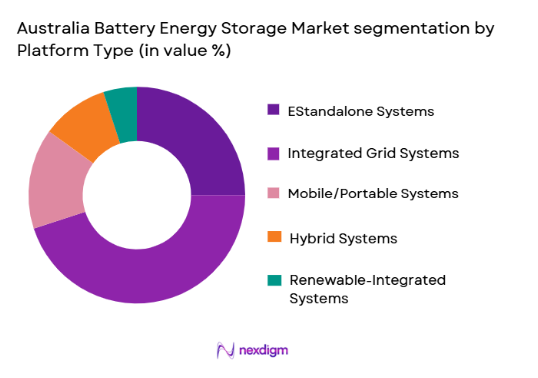
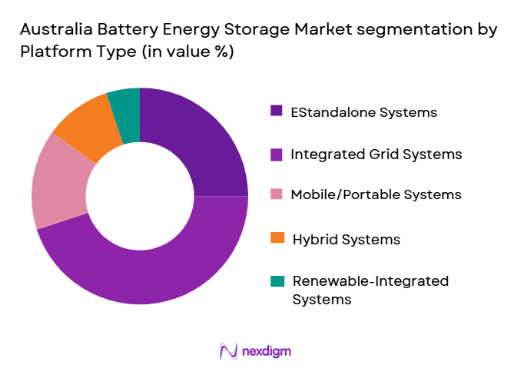
The market is segmented into standalone systems, integrated grid systems, and mobile/portable systems. Integrated grid systems dominate the Australian market as they allow seamless connectivity to the national electricity grid. Their adoption is primarily driven by utilities and large industrial players who seek reliable, scalable, and cost-effective solutions to store energy during off-peak hours and supply it during peak demand. These systems also aid in stabilizing the grid and balancing renewable energy fluctuations.
Competitive Landscape
The competitive landscape of the Australia Battery Energy Storage System market is shaped by the presence of several leading players focusing on technological innovations, strategic partnerships, and the expansion of their product portfolios. Major companies are leveraging their research and development capabilities to enhance product efficiency, reduce costs, and meet the growing demand for scalable energy storage solutions. Market consolidation is evident, as large firms collaborate with utility providers and other stakeholders to accelerate the deployment of energy storage systems across various sectors. The role of these players in shaping the regulatory framework through lobbying and collaboration with government agencies further enhances their influence in the market.
| Company Name | Establishment Year | Headquarters | Technology Focus | Market Reach | Key Products | Revenue (USD Billion) | Additional Parameter |
| Tesla | 2003 | USA | ~ | ~ | ~ | ~ | ~ |
| LG Chem | 1947 | South Korea | ~ | ~ | ~ | ~ | ~ |
| BYD | 1995 | China | ~ | ~ | ~ | ~ | ~ |
| Sonnen | 2010 | Germany | ~ | ~ | ~ | ~ | ~ |
| Fluence | 2011 | USA | ~ | ~ | ~ | ~ | ~ |
Australia Battery Energy Storage System Market Analysis
Growth Drivers
Government Incentives for Clean Energy:
Government incentives play a significant role in driving the growth of the Australia Battery Energy Storage System market. With increasing pressure to meet carbon emission reduction targets, the Australian government has introduced a variety of incentives aimed at promoting the use of renewable energy sources and energy storage systems. These incentives include subsidies, tax credits, and grants for businesses and households to adopt battery storage solutions. The government’s commitment to achieving net-zero emissions by 2050 is a driving force behind these initiatives, contributing to the expansion of the market. The demand for efficient and reliable energy storage solutions is expected to grow as these incentives continue to be implemented across the country, especially in regions with high renewable energy penetration.
Technological Advancements in Energy Storage Systems:
Technological advancements in energy storage systems have been a key driver for the growth of the market. Over the past few years, significant progress has been made in enhancing battery efficiency, energy density, and lifespan, which has made these systems more cost-effective and reliable. With innovations in lithium-ion technology, solid-state batteries, and hybrid systems, energy storage solutions are becoming more efficient and scalable, which is attracting a wide range of consumers, including residential, commercial, and industrial users. Furthermore, the integration of artificial intelligence and advanced battery management systems into energy storage solutions has improved operational efficiency, reducing downtime and maintenance costs. As the technology continues to improve, energy storage systems will become even more attractive for large-scale renewable energy integration and grid stability.
Market Challenges
High Initial Capital Costs:
One of the primary challenges in the Australia Battery Energy Storage System market is the high initial capital investment required for the installation of energy storage systems. Despite the decreasing costs of battery technologies over the years, the upfront costs of purchasing and installing large-scale storage solutions remain a significant barrier for many consumers. Utility-scale storage systems, in particular, require large investments, which may deter small-scale operators and households from adopting these systems, even with the availability of government incentives. Additionally, the long payback periods associated with these systems, coupled with the fluctuating costs of energy, may cause hesitation among potential buyers. While the total cost of ownership for energy storage systems has been improving, the initial capital investment remains a key challenge to market adoption.
Integration with Existing Grid Infrastructure:
Integrating battery storage systems into the existing grid infrastructure poses a significant challenge for the market. As the demand for renewable energy sources increases, the existing energy grid infrastructure may not be equipped to efficiently handle the influx of intermittent energy from sources like solar and wind. Energy storage systems play a vital role in stabilizing the grid, but the integration of large-scale storage solutions requires significant upgrades to existing grid infrastructure. These upgrades are costly and time-consuming, and in some cases, require regulatory approvals, which can delay the deployment of battery storage systems. The lack of standardization across different grid operators also complicates the integration process, further hindering the widespread adoption of energy storage systems.
Opportunities
Expansion in Off-Grid and Remote Area Applications:
One of the major opportunities in the Australia Battery Energy Storage System market is the growing demand for off-grid and remote area applications. Australia’s vast geographical landscape includes many areas that are not connected to the national electricity grid, and these regions often rely on expensive and unreliable diesel generators for power. Battery storage systems offer a viable alternative by storing energy generated from renewable sources such as solar, providing a consistent and sustainable power supply. As renewable energy adoption continues to grow in remote regions, there is a significant opportunity for battery storage systems to expand their presence in these markets. The government’s focus on improving energy access to remote communities further accelerates this opportunity, creating a potential market for off-grid energy storage solutions.
Partnerships with Renewable Energy Providers:
The increasing collaboration between battery energy storage system providers and renewable energy companies presents another significant opportunity in the market. As more renewable energy sources are integrated into the grid, the need for efficient energy storage solutions becomes more critical. By partnering with renewable energy providers, battery storage system companies can enhance the performance of renewable energy systems by providing reliable energy storage options. These partnerships enable both sectors to meet the growing demand for clean and sustainable energy while improving grid stability. Furthermore, as governments continue to implement policies supporting the growth of renewable energy, partnerships between energy storage and renewable energy companies will likely grow, creating synergies that will drive further market expansion.
Future Outlook
The future of the Australia Battery Energy Storage System market looks promising, with continued growth expected over the next five years. Advancements in battery technologies, such as solid-state and hybrid systems, will make energy storage solutions more efficient, scalable, and affordable. Additionally, the Australian government’s commitment to decarbonizing the energy sector will lead to further incentives and policy support, driving the adoption of energy storage systems. Increased demand for renewable energy and grid stability, along with rising awareness of the environmental benefits of energy storage, will continue to fuel market growth. Furthermore, technological innovations in smart grids and energy-as-a-service models will enhance the efficiency and reliability of battery storage systems, further strengthening their role in Australia’s energy transition.
Major Players
- Tesla
- LG Chem
- BYD
- Sonnen
- Fluence
- Panasonic
- Samsung SDI
- VARTA
- Enphase Energy
- Redflow
- Wärtsilä
- Schneider Electric
- Siemens Gamesa
- GE Renewable Energy
- Saft
Key Target Audience
- Government bodies
- Energy utilities
- Residential developers
- Commercial and industrial facilities
- Renewable energy companies
- Battery manufacturers
- Private investors
- Venture capital firms
Research Methodology
Step 1: Identification of Key Variables
We begin by identifying the key market drivers, challenges, and opportunities, which serve as the foundation for the entire research process. These variables are critical for structuring the market framework.
Step 2: Market Analysis and Construction
We analyze the market’s historical data, current trends, and future projections, constructing a detailed market model that includes segmentation, geographical insights, and technological advancements.
Step 3: Hypothesis Validation and Expert Consultation
We validate our findings and hypotheses through consultation with industry experts, including stakeholders in the renewable energy and battery storage sectors, ensuring the accuracy and reliability of the insights.
Step 4: Research Synthesis and Final Output
We synthesize the collected data and insights into a comprehensive report, providing actionable recommendations and an in-depth analysis of the Australia Battery Energy Storage System market.

- Executive Summary
- Research Methodology (Definitions, Scope, Industry Assumptions, Market Sizing Approach, Primary & Secondary Research Framework, Data Collection & Verification Protocol, Analytic Models & Forecast Methodology, Limitations & Research Validity Checks)

- Market Definition and Scope
- Value Chain & Stakeholder Ecosystem
- Regulatory / Certification Landscape
- Sector Dynamics Affecting Demand
- Strategic Initiatives & Infrastructure Growth

- Growth Drivers
Government Incentives for Clean Energy
Rising Energy Storage Demand from Renewable Sources
Technological Advancements in Battery Efficiency
Increasing Demand for Grid Stability and Reliability
Declining Battery Costs - Market Challenges
High Initial Capital Investment
Regulatory and Compliance Hurdles
Grid Integration Issues
Limited Availability of Suitable Land for Large-Scale Projects
Battery Recycling and Disposal Concerns - Market Opportunities
Growing Investment in Renewable Energy Integration
Expansion of Smart Grid Infrastructure
Increase in Off-Grid and Remote Area Applications - Trends
Advances in Battery Management Systems
Integration with Electric Vehicle Charging Infrastructure
Rise of Energy-as-a-Service Models
Adoption of Artificial Intelligence in Energy Storage
Increase in Energy Storage for Commercial and Industrial Applications - Government Regulations & Defense Policy
Incentives for Renewable Energy Storage
Grid Storage Standards and Certification
Government Initiatives for Distributed Energy Systems - SWOT Analysis
- Stakeholder and Ecosystem Analysis
- Porter’s Five Forces Analysis
- Competition Intensity and Ecosystem Mapping

- By Market Value, 2020-2025
- By Installed Units, 2020-2025
- By Average System Price, 2020-2025
- By System Complexity Tier, 2020-2025

- By System Type (In Value%)
Utility-Scale Storage Systems
Residential Battery Storage
Commercial & Industrial Storage Systems
Hybrid Energy Storage Systems
Off-Grid Storage Systems - By Platform Type (In Value%)
Grid-Connected Systems
Off-Grid Systems
Microgrid Systems
Standalone Battery Energy Storage Systems
Integrated Energy Systems - By Fitment Type (In Value%)
Retrofit Solutions
New Build Solutions
Modular Systems
Integrated Systems
Plug-and-Play Solutions - By EndUser Segment (In Value%)
Residential Users
Commercial & Industrial Users
Utility Providers
Government & Public Sector
Off-Grid Communities - By Procurement Channel (In Value%)
Direct Procurement
Distributor & Reseller Networks
Online Retailers
Public Tenders
Third-Party Integrators - By Material / Technology (in Value%)
Lithium-Ion Technology
Lead-Acid Technology
Flow Battery Technology
Sodium-Ion Technology
Solid-State Battery Technology

- Market structure and competitive positioning
- Market share snapshot of major players
- CrossComparison Parameters (System Type, Platform Type, Procurement Channel, EndUser Segment, Fitment Type, Technology, Application, Price Tier, Energy Source, System Complexity)
- SWOT Analysis of Key Players
- Pricing & Procurement Analysis
- Key Players
Tesla
LG Chem
Samsung SDI
BYD
VARTA
Sonnen
Fluence
Panasonic
SAFT
Vestas
Siemens
GE Renewable Energy
Redflow
EDF Renewables
SMA Solar Technology

- Growing Adoption of Residential Energy Storage Systems
- Increased Deployment of Battery Storage in Commercial & Industrial Sectors
- Government Support for Utility-Scale Projects
- Off-Grid and Remote Area Storage Solutions

- Forecast Market Value, 2026-2035
- Forecast Installed Units, 2026-2035
- Price Forecast by System Tier, 2026-2035
- Future Demand by Platform, 2026-2035


 Request a Sample
 Ask for Customization
 Get a Quote
 Enquire Now