

 Download PDF
 Download PDF
Market Overview
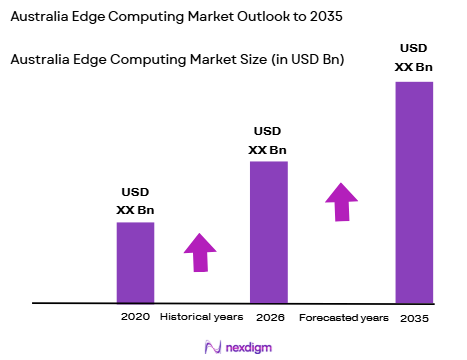
Australia edge computing market is valued at approximately USD ~ billion based on a recent historical assessment, driven by 5G network rollout, IoT adoption, and demand for low-latency data processing across industries. Telecommunications operators and cloud providers are deploying distributed edge nodes to support real-time analytics, autonomous systems, and digital services. Growth of smart infrastructure connected devices, and industrial automation further accelerates investment in localized computers, storage, and networking infrastructure across metropolitan and regional environments.
Sydney and Melbourne dominate the Australia edge computing market due to concentration of telecom network hubs, hyperscale data centers, and enterprise demand for low-latency digital services. These cities host major 5G deployments, financial institutions, and technology firms requiring distributed processing capabilities. Brisbane and Perth are emerging edge infrastructure hubs linked to mining, logistics, and resource industries. Proximity to population centers, fiber backbones, and telecom exchanges reinforces regional leadership in edge computing deployment nationwide.
Market Segmentation
By Component Type
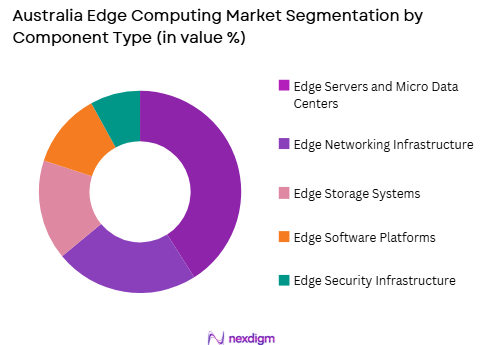
Australia Edge Computing market is segmented by product type into edge servers and micro data centers, edge networking infrastructure, edge storage systems, edge software platforms, and edge security infrastructure. Recently, edge servers and micro data centers has a dominant market share due to factors such as telecom edge deployment, enterprise low-latency computing demand, and distributed AI workloads. Telecom operators install micro data centers at base stations and exchanges to support 5G services and network functions virtualization. Enterprises deploy edge servers for industrial automation and real-time analytics. Cloud providers extend services to edge locations using localized compute nodes. Increasing demand for near-device processing sustains highest capital allocation toward edge servers and micro data center infrastructure in Australia.
By End-Use Industry
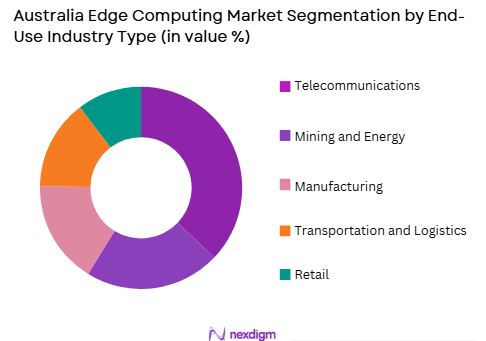
Australia Edge Computing market is segmented by end-use industry into telecommunications, manufacturing, mining and energy, transportation and logistics, and retail. Recently, telecommunications has a dominant market share due to factors such as nationwide 5G rollout, network edge virtualization, and distributed content delivery requirements. Telecom operators deploy edge infrastructure to reduce latency for mobile services and IoT applications. Integration of edge computing with 5G enables real-time analytics and automation. Telecom firms also offer edge platforms to enterprises. These factors position telecommunications as the largest consumer of edge computing infrastructure capacity in Australia.
Competitive Landscape
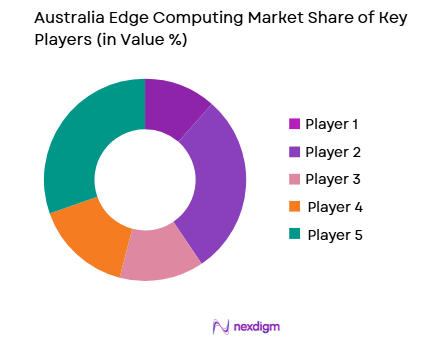
The Australia edge computing market is moderately consolidated with telecom operators, cloud providers, and data center firms leading infrastructure deployment. Telecom networks provide physical distribution for edge nodes, while cloud platforms supply software orchestration and services. Partnerships between telecom and hyperscale firms shape market structure. Equipment vendors and industrial solution providers complement deployments. Competitive positioning depends on network footprint, platform capabilities, and regional infrastructure presence.
| Company Name | Establishment Year | Headquarters | Technology Focus | Market Reach | Key Products | Revenue | Edge Network Footprint in Australia |
| Telstra | 1975 | Melbourne, Australia | ~ | ~ | ~ | ~ | ~ |
| Optus | 1991 | Sydney, Australia | ~ | ~ | ~ | ~ | ~ |
| Amazon Web Services | 2006 | Seattle, USA | ~ | ~ | ~ | ~ | ~ |
| Microsoft | 1975 | Redmond, USA | ~ | ~ | ~ | ~ | ~ |
| Nokia | 1865 | Espoo, Finland | ~ | ~ | ~ | ~ | ~ |
Australia Edge Computing Market Analysis
Growth Drivers
5G Network Expansion and Telecom Edge Virtualization Infrastructure
Nationwide deployment of 5G networks in Australia is driving extensive investment in distributed edge computing infrastructure embedded within telecom networks to enable ultra-low latency services and real-time data processing capabilities. Telecom operators deploy edge servers at base stations, aggregation points, and exchanges to support network functions virtualization and mobile edge computing platforms. Applications such as autonomous vehicles, smart cities, augmented reality, and IoT analytics require localized compute resources close to users. Integration of edge computing with 5G architecture reduces latency and backhaul bandwidth consumption. Telecom firms monetize edge platforms by offering enterprise services and application hosting. Content delivery and video streaming services rely on edge nodes for performance optimization. Industrial IoT deployments use telecom edge for real-time control. Expansion of 5G coverage across urban and regional areas increases number of edge sites. Continuous growth of latency-sensitive applications sustains demand for telecom edge infrastructure nationwide.
Industrial Automation, IoT, and Real-Time Analytics Adoption Across Sectors
Rapid adoption of industrial automation, connected devices, and real-time analytics across mining, manufacturing, logistics, and energy sectors in Australia is accelerating deployment of enterprise edge computing infrastructure near operational environments. Mining operations deploy edge servers at remote sites to process sensor data and autonomous equipment control locally. Manufacturing plants use edge analytics for predictive maintenance and quality monitoring. Logistics hubs apply edge computing for fleet tracking and warehouse automation. Energy utilities deploy edge nodes for grid monitoring and smart infrastructure management. Local processing reduces latency and connectivity dependence. Edge AI applications enable on-site decision making and safety systems. Enterprises integrate edge with cloud platforms for hybrid analytics. Growth of IoT device deployments increases data volume requiring local processing. Operational efficiency and reliability requirements sustain long-term enterprise edge infrastructure demand across industries.
Market Challenges
Geographic Dispersion and Connectivity Limitations Across Remote Regions
Australia’s vast geography and dispersed industrial operations create challenges for deployment and connectivity of edge computing infrastructure, particularly in remote mining and energy regions lacking high-capacity fiber networks and reliable power supply. Edge sites in remote areas require satellite or microwave backhaul, increasing latency and cost. Limited infrastructure availability complicates installation and maintenance of edge nodes. Harsh environmental conditions affect equipment reliability. Workforce availability for remote operations is constrained. Power supply instability affects edge system uptime. Integration with centralized cloud platforms becomes complex. Capital expenditure for remote connectivity infrastructure is high. These factors slow deployment and scalability of edge computing across non-urban Australia.
Interoperability, Management Complexity, and Security Risks in Distributed Edge Environments
Distributed edge computing infrastructure across numerous sites introduces operational complexity in management, orchestration, and cybersecurity for enterprises and telecom operators in Australia. Heterogeneous hardware and software platforms create interoperability challenges. Managing thousands of edge nodes requires advanced orchestration tools. Security risks increase due to expanded attack surface across distributed locations. Data protection and compliance must be maintained at each edge site. Software updates and maintenance across remote nodes are complex. Integration with cloud and enterprise systems requires standardized interfaces. Monitoring performance and reliability across distributed infrastructure is challenging. Lack of unified management frameworks increases operational cost. These issues complicate large-scale edge infrastructure deployment.
Opportunities
Edge AI and Autonomous Systems Deployment in Mining and Resource Industries
Australia’s globally significant mining and resource sector offers substantial opportunity for deployment of edge AI infrastructure enabling autonomous vehicles, robotics, and real-time operational analytics at remote industrial sites. Edge computing supports local processing of sensor and machine data for safety and productivity. Autonomous haulage and drilling systems rely on low-latency edge AI control. Environmental monitoring and predictive maintenance require on-site analytics. Integration of edge AI with industrial IoT enhances efficiency. Resource firms invest heavily in automation infrastructure. Remote operations favor localized computing to reduce connectivity dependence. Collaboration with technology vendors accelerates deployment. Expansion of autonomous mining ecosystems increases demand for ruggedized edge systems. This opportunity positions edge computing as core digital infrastructure in resource industries.
Telecom-Cloud Edge Platform Integration and Enterprise Edge Services
Integration of telecom edge infrastructure with hyperscale cloud platforms in Australia creates opportunity to deliver enterprise edge computing services combining low-latency network access with scalable cloud capabilities. Telecom operators partner with cloud providers to deploy multi-access edge computing platforms. Enterprises access localized compute integrated with cloud services. Edge-cloud integration supports real-time analytics, AI inference, and content delivery. Telecom firms monetize infrastructure through platform services. Cloud providers extend application ecosystems to edge locations. Industry vertical solutions emerge across manufacturing, healthcare, and logistics. Unified orchestration enables hybrid deployment models. Expansion of enterprise edge applications increases service demand. This opportunity accelerates commercialization of edge infrastructure nationwide.
Future Outlook
Australia edge computing market is expected to expand steadily as 5G coverage, industrial automation, and IoT adoption accelerate demand for distributed low-latency computing infrastructure. Telecom-cloud integration will enable scalable edge platforms. Growth of autonomous systems and real-time analytics will drive enterprise deployment. Regional digitalization and smart infrastructure programs will further expand edge computing capacity across urban and remote environments.
Major Players
- Telstra
- Optus
- Amazon Web Services
- Microsoft
- Nokia
- Ericsson
- Cisco Systems
- HPE
- Dell Technologies
- IBM
- Huawei
- Juniper Networks
- Schneider Electric
- Vertiv
- Edge Centres
Key Target Audience
- Telecommunications operators
- Mining and energy companies
- Manufacturing enterprises
- Logistics and transportation firms
- Data center operators
- Investments and venture capitalist firms
- Government and regulatory bodies
- Industrial automation providers
Research Methodology
Step 1: Identification of Key Variables
Key variables include edge node deployments, 5G coverage expansion, industrial IoT adoption, telecom infrastructure investment, and enterprise edge spending. Variables are mapped across components and industries to define market structure.
Step 2: Market Analysis and Construction
Supply-side analysis evaluates telecom and enterprise edge infrastructure deployment, while demand-side analysis examines industry automation and latency-sensitive application adoption. Data triangulation constructs market size and segmentation estimates.
Step 3: Hypothesis Validation and Expert Consultation
Industry experts from telecom operators, industrial firms, and technology vendors validate assumptions on edge deployment growth, technology integration, and operational constraints. Feedback refines segmentation shares and competitive positioning.
Step 4: Research Synthesis and Final Output
Validated datasets and qualitative insights are synthesized into market forecasts, competitive analysis, and strategic outlook. Consistency checks ensure alignment across market size, segmentation, and trend narratives.

- Executive Summary
- Research Methodology (Definitions, Scope, Industry Assumptions, Market Sizing Approach, Primary & Secondary Research Framework, Data Collection & Verification Protocol, Analytic Models & Forecast Methodology, Limitations & Research Validity Checks)

- Market Definition and Scope
- Value Chain & Stakeholder Ecosystem
- Regulatory / Certification Landscape
- Sector Dynamics Affecting Demand
- Strategic Initiatives & Infrastructure Growth

- Growth Drivers
5G and low-latency network expansion across Australia
Edge AI adoption in mining, energy, and transport sectors
Demand for localized compute in remote operations - Market Challenges
High deployment cost across vast geographic regions
Power and connectivity limitations in remote sites
Interoperability across telecom and enterprise systems - Market Opportunities
Edge AI for autonomous mining and energy operations
Low-latency edge for immersive media and gaming
Smart infrastructure and transport edge platforms - Trends
Convergence of telecom and enterprise edge architectures
Adoption of modular and containerized edge data centers
Integration of AI accelerators into edge nodes - Government regulations
Critical infrastructure and data sovereignty policies
National digital and connectivity programs
Smart infrastructure and transport initiatives - SWOT analysis
- Porters five forces

- By Market Value, 2020-2025
- By Installed Units, 2020-2025
- By Average System Price, 2020-2025
- By System Complexity Tier, 2020-2025

- By System Type (In Value%)
Edge Data Centers
Micro Edge Nodes
On-Premise Edge Servers
Edge AI Gateways
Ruggedized Edge Platforms - By Platform Type (In Value%)
Telecom Network Edge
Enterprise Campus Edge
Industrial Edge Systems
Autonomous Systems Edge
Content Delivery Edge - By Fitment Type (In Value%)
New Edge Deployment
Retrofit Edge Enablement
Integrated OEM Edge Systems
Modular Edge Units
Cloud-Managed Edge Integration - By EndUser Segment (In Value%)
Telecommunications Operators
Mining and Energy Companies
Transport and Logistics Operators
Media and Content Platforms
Government and Smart Infrastructure Agencies - By Procurement Channel (In Value%)
Direct OEM Procurement
Telecom Operator Contracts
System Integrator Deployment
Cloud Service Bundling
Public Sector Tenders

- Market Share Analysis
- Cross Comparison Parameters (Latency Performance, Edge Compute Density, Power Efficiency per Node, Network Proximity and Coverage, Scalability Architecture, Edge AI Acceleration Capability, Orchestration and Management Platform, Ruggedization and Environmental Tolerance, Interconnect Bandwidth, Deployment Flexibility, Remote Operations Support, Energy Autonomy Capability)
- SWOT Analysis of Key Competitors
- Pricing & Procurement Analysis
- Key Players
Telstra
Optus
TPG Telecom
NextDC
Equinix Australia
AirTrunk
Schneider Electric Australia
Vertiv Australia
Dell Technologies Australia
Hewlett Packard Enterprise Australia
Cisco Systems Australia
Nokia Australia
Ericsson Australia
Fujitsu Australia
DXC Technology Australia

- Telecom operators deploying edge for 5G services
- Mining and energy firms using edge for automation
- Transport and logistics deploying real-time edge
- Government implementing smart infrastructure edge

- Forecast Market Value, 2026-2035
- Forecast Installed Units, 2026-2035
- Price Forecast by System Tier, 2026-2035
- Future Demand by Platform, 2026-2035


 Request a Sample
 Ask for Customization
 Get a Quote
 Enquire Now