

 Download PDF
Market Overview
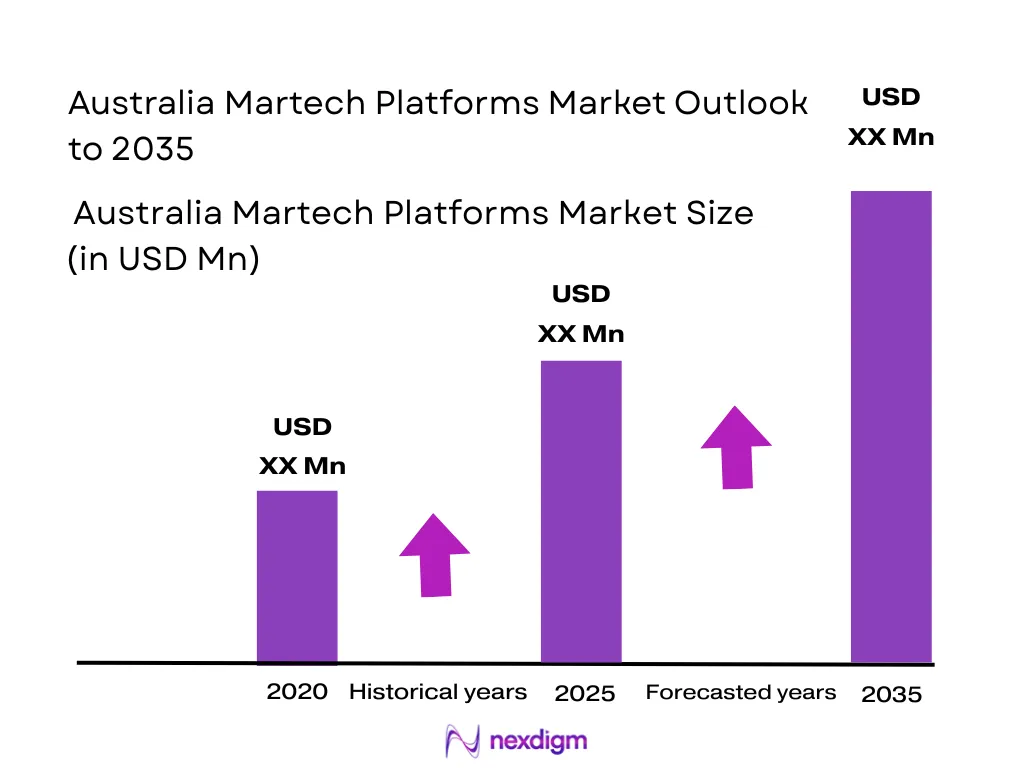
The Australia-specific benchmark for this market puts digital marketing software revenue at USD ~ million in 2025. Demand is being supported by a much larger marketing and customer-acquisition base: Australia’s online advertising market reached AUD ~ billion in 2024 and AUD ~ billion in 2025, showing that brands are increasing spend across channels that require campaign orchestration, analytics, personalization, and automation platforms. This makes martech platform investment a direct operational extension of rising digital engagement and performance marketing budgets.
Within Australia, Sydney and Melbourne dominate the martech platforms market because they combine enterprise headquarters, agency concentration, startup density, and digital talent at scale. Sydney/NSW attracted 65% of Australia’s startup funding in 2024, while NSW’s digital technologies sector has a 340,000+ tech workforce and contributes AUD 67 billion annually. Victoria adds depth through a digital technology base that generated over AUD 142 billion in FY24, while its ICT sector contributed AUD 34.1 billion in FY23.
Market Segmentation
By Deployment Model
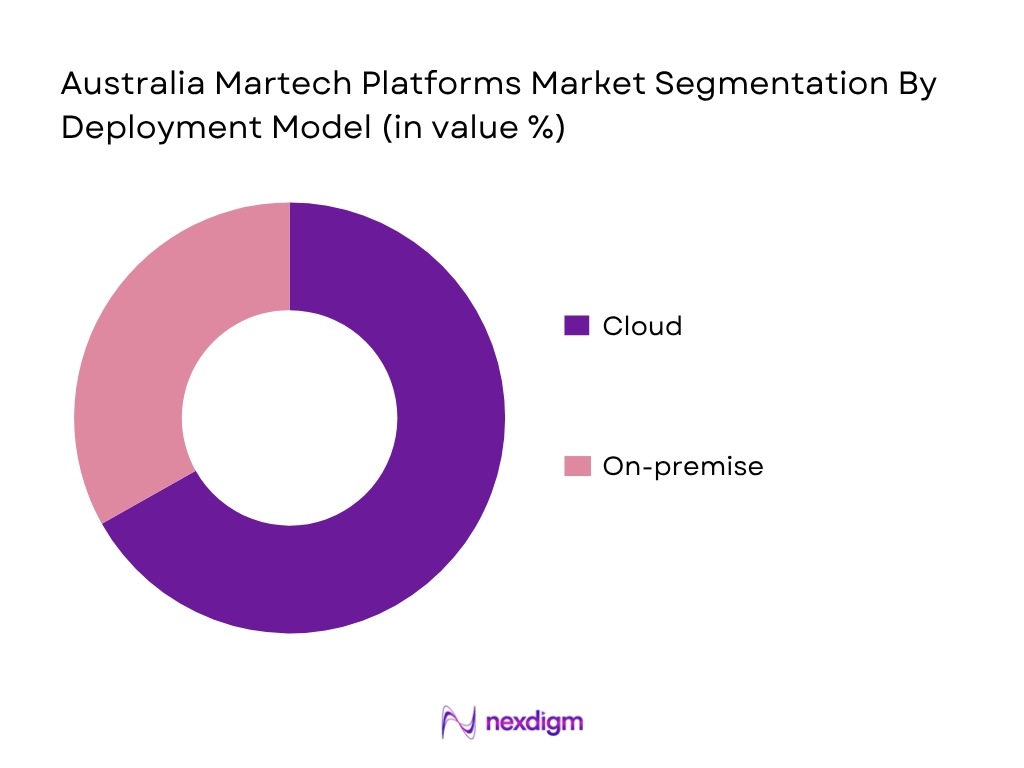
Cloud deployment dominates the Australia Martech Platforms Vendor Comparison & Pricing Analysis Market because buyers increasingly want faster implementation, easier integrations, lower infrastructure overhead, and continuous product updates. In practical terms, cloud martech fits the needs of Australian enterprises that are managing omnichannel campaigns across web, mobile, email, paid media, and CRM from distributed teams. It also supports API-led connection with commerce, service, analytics, and data platforms. The strength of cloud is especially visible in mid-market and enterprise buying, where teams prioritize scalability, easier experimentation, and lower maintenance burden compared with on-premise systems. Public Australia-focused market tracking shows cloud platforms accounted for 66.5% of digital marketing software revenue in the latest year, making cloud the clear deployment leader in this market. The remaining 33.5% is the residual share held by on-premise and other legacy environments.
By Organization Size
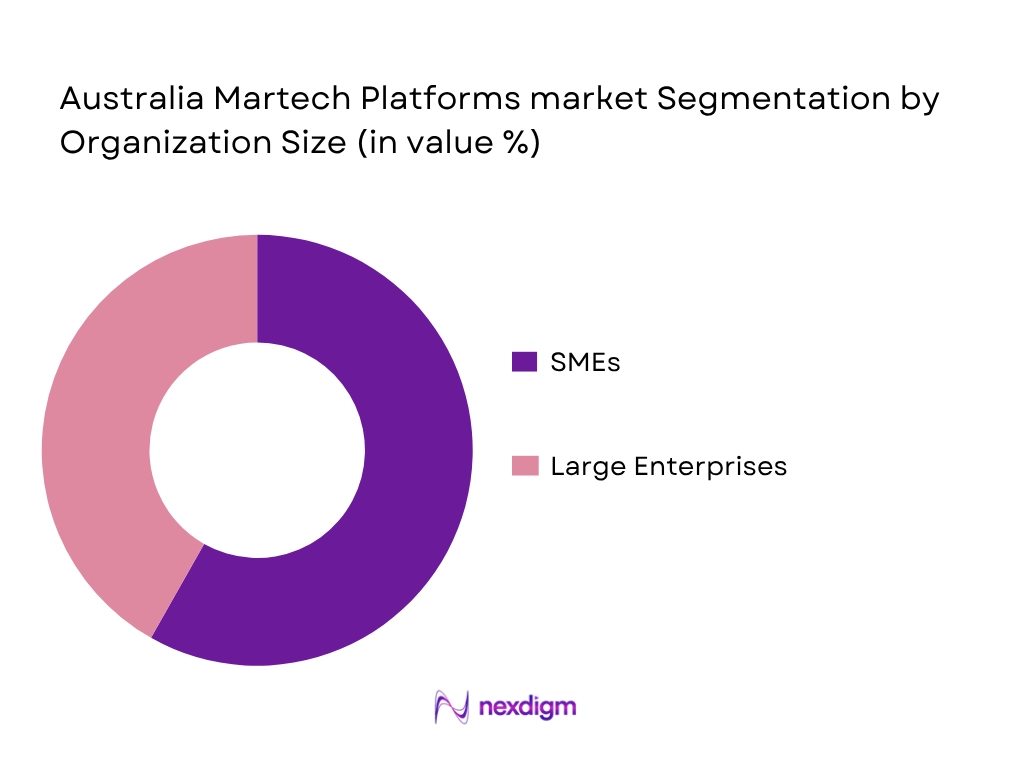
SMEs dominate the Australia Martech Platforms Vendor Comparison & Pricing Analysis Market because the country has a large base of growth-focused small and mid-sized firms that increasingly depend on digital acquisition, lifecycle automation, CRM-linked campaigns, and self-serve SaaS tools to compete efficiently. Platforms such as HubSpot, Mailchimp, Klaviyo, and Zoho have helped normalize subscription-led martech adoption by offering modular onboarding, transparent entry pricing, and lower implementation complexity. SMEs also tend to move faster on marketing automation because they need to improve lead conversion and retention without building large internal marketing operations teams. Australia-specific market tracking shows SMEs captured 58.2% of digital marketing software spending in the latest year, ahead of large enterprises. Large enterprises still represent a major share at 41.8%, but SME-led demand currently provides the widest user base and strongest volume adoption in the market.
Competitive Landscape
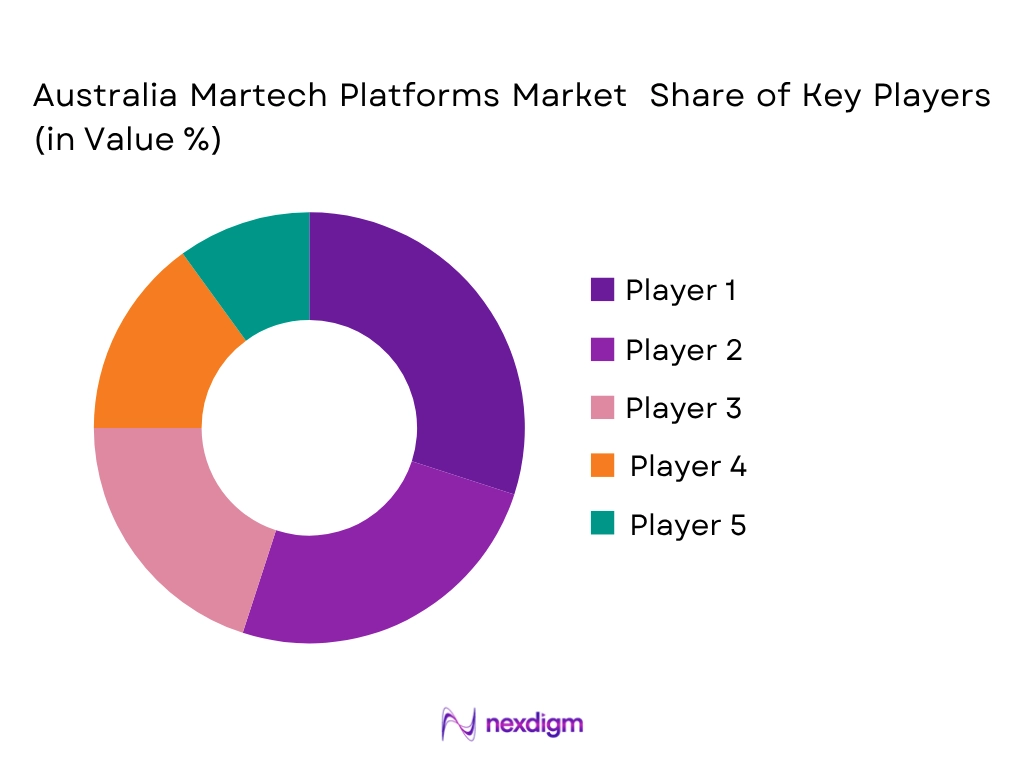
The Australia Martech Platforms Vendor Comparison & Pricing Analysis Market is led primarily by global platform vendors with strong cloud delivery, broad partner ecosystems, and established ANZ operations. The competitive field is split between enterprise suites such as Salesforce, Adobe, Oracle, and SAP, which sell broader customer experience, automation, and data capabilities, and growth-oriented SaaS vendors such as HubSpot and Braze, which are often preferred for faster deployment and clearer product-led adoption. As a result, competition in Australia is shaped less by raw feature lists and more by integration breadth, pricing model, AI readiness, data governance, and local support capability.
| Company | Established | Headquarters | Core Martech Strength | Pricing Orientation | AI / Personalization Layer | Integration / Ecosystem Strength | Australia / ANZ Footprint | Primary Buyer Fit |
| Adobe | 1982 | San Jose, California | – | – | – | – | – | – |
| Salesforce | 1999 | San Francisco, California | – | – | – | – | – | – |
| HubSpot | 2006 | Cambridge, Massachusetts | – | – | – | – | – | – |
| Oracle | 1977 | Austin, Texas | – | – | – | – | – | – |
| Braze | 2011 | New York, New York | – | – | – | – | – | – |
Australia Martech Platforms Market Analysis
Growth Drivers
Digital Ad Spend
Australia’s martech platforms market is being pushed upward by the sheer scale and diversification of digital advertising activity. Internet advertising spend in Australia reached AUD 16.4 billion for the full calendar period, with search and directories at AUD 7.2 billion, video at AUD 4.5 billion, classifieds at AUD 2.6 billion, display excluding video at AUD 2.0 billion, and audio at AUD 313 million. In the September quarter alone, internet advertising expenditure reached AUD 4.2 billion, including AUD 1.8 billion in search, AUD 1.15 billion in video, AUD 0.7 billion in classifieds, AUD 0.5 billion in display, and AUD 79 million in audio. This channel spread directly supports martech demand because advertisers require campaign orchestration, attribution, audience management, content delivery, and cross-channel measurement tools to manage so many formats at once. The macro backdrop is also supportive: Australia’s economy stood at USD 1.76 trillion in GDP, with USD 64,604 GDP per capita, giving brands the spending capacity to keep investing in digital customer acquisition and retention technologies.
Customer Data Explosion
Customer data volumes are rising fast in Australia because digital interaction has become near-universal and increasingly multi-device. At June 2024, 98% of Australians had internet access at home, 93% had fixed or wireless home internet, and 81% were connected via the NBN. Internet usage is now highly frequent, with 92% accessing the internet through their mobile phones multiple times a day, while connected-device ownership is broadening: 37% of adults had wearable devices, 26% had smart home appliances, 23% had voice-controlled smart speakers, and 11% had smart displays. This means customer journeys are now generating signals across websites, apps, smart devices, retail transactions, loyalty systems, and service interactions. Commerce data is also expanding: ABS reported AUD 4,411.2 million in online retail sales in December 2024 and AUD 4,703.8 million in June 2025. For martech vendors, that level of connected consumer activity creates sustained need for CDPs, automation engines, identity resolution, analytics, and journey orchestration. Australia’s USD 1.76 trillion economy provides the scale for this data-led marketing infrastructure to keep deepening.
Market Challenges
Vendor Fragmentation
Vendor fragmentation is a structural challenge in Australia because the demand side of the market is highly diverse across channels, industries, and business sizes. The ad ecosystem itself is fragmented: in one year, brands allocated AUD 7.2 billion to search, AUD 4.5 billion to video, AUD 2.6 billion to classifieds, AUD 2.0 billion to display, and AUD 313 million to audio. Each of these channels often brings its own specialist tools for media activation, analytics, customer engagement, content, personalization, measurement, and commerce integration. At the same time, the Australian business base is broad and dynamic. ABS counted 2,729,648 actively trading businesses at 30 June 2025, including 994,178 employing businesses, with 437,150 business entries and 370,500 exits in 2024–25 alone. That churn creates very different martech needs across micro firms, growth-stage SMEs, and large enterprises. In practice, this fragments the vendor field into enterprise suites, point solutions, vertical specialists, and low-code tools, making platform comparison harder for buyers. The challenge is amplified in a USD 1.76 trillion economy where digital competition is strong and software decisions directly affect revenue capture.
Integration Complexity
Integration complexity is intensifying because Australian marketers now operate in an environment with many consumer touchpoints, many data types, and a heavier compliance burden. On the demand side, 98% of households had home internet access, 92% of adults accessed the internet via mobile multiple times a day, and connected-device penetration kept rising across wearables, smart appliances, speakers, and displays. On the risk side, the OAIC recorded 1,113 data breach notifications in 2024, including 518 in the first half and 595 in the second half. In July–December 2024 alone, 404 breaches were attributed to malicious or criminal attack, including 247 cyber incidents and 115 social engineering or impersonation cases. The same half-year period also saw 100 notifications from Australian Government entities, 54 from finance, and 34 from retail, underlining how sensitive customer data has become across sectors. For martech deployments, this means integrating CRM, commerce, media, analytics, consent, and service systems is not just a technical task; it is a governance and security challenge. In a USD 1.76 trillion economy with high digital penetration, integration failure can quickly become both a revenue and compliance problem.
Opportunities
Composable Martech
Composable martech represents a strong opportunity in Australia because local businesses are operating in a fast-changing digital environment where fixed, monolithic stacks are often too rigid. ABS recorded 2,729,648 actively trading businesses at 30 June 2025, with 437,150 entries and 370,500 exits during 2024–25, showing how dynamic the customer base is. At the same time, ACMA data shows consumer interaction points are becoming more varied: 37% of adults had wearables, 26% smart home appliances, 23% smart speakers, and 11% smart displays, all adding new streams of behavioral data. The media side is equally complex, with digital ad spend spread across search, video, classifieds, display, and audio rather than concentrated in one format. That mix favors composable architectures where brands can connect a CDP, campaign engine, analytics layer, content tool, and commerce connector based on actual use case rather than buying one oversized suite. For Australian enterprises and upper mid-market firms, composability offers a practical way to reduce overlap, modernize gradually, and align martech investments with operating needs in a USD 1.76 trillion economy.
AI-driven Campaign Automation
AI-driven campaign automation is one of the clearest future growth opportunities because current business adoption data already shows marketing use cases moving into the mainstream. The Department of Industry’s AI Adoption Tracker shows that in 2025 Q1, 20% of SMEs said AI could definitely enhance engagement and response to marketing activities, while 17% said it could definitely improve customer experience and engagement. On actual applications, 27% reported using generative AI assistants, 21% predictive analytics, and 20% marketing automation. Adoption is especially notable in commercial sectors relevant to martech: 46% of retail trade businesses in the tracker were adopting AI, while adoption reached 82% among firms with 200–500 employees and 68% among those with 20–199 employees. Government support is also building capacity: the Australian Government has referenced a AUD 17 million network of AI Adopt Centres to help SMEs adopt AI tools responsibly. For martech vendors, this creates a near-term opening to sell AI-led workflow optimization, journey automation, audience scoring, content generation, and campaign decisioning. In an economy worth USD 1.76 trillion, AI is moving from experimentation toward operational marketing infrastructure.
Future Outlook
The Australia Martech Platforms Vendor Comparison & Pricing Analysis Market is positioned for sustained expansion as customer acquisition, retention, and personalization become more software-intensive. The most likely growth path is toward fewer but more connected platforms, with enterprises reducing stack sprawl and prioritizing tools that combine data management, orchestration, analytics, and AI-assisted execution. At the same time, SMEs are expected to keep driving adoption through modular SaaS platforms with faster onboarding and lower operational complexity.
Pricing and Vendor Intelligence
Pricing in the Australia Martech Platforms Vendor Comparison & Pricing Analysis Market is increasingly polarized. At one end, vendors such as HubSpot and entry-level Salesforce packages use transparent, tiered pricing to attract SMEs and mid-market buyers. At the other, Adobe, Oracle, and Braze rely more heavily on packaged or customized enterprise pricing tied to modules, data volumes, seats, environments, or value-based usage. This matters because Australian buyers are no longer comparing only subscription fees; they are comparing total cost of ownership, including implementation, integrations, storage, support tiers, and AI add-ons. In vendor comparison exercises, this means “cheapest plan” is rarely the real benchmark. Buyers increasingly screen vendors for pricing clarity, upgrade predictability, and whether commercial models scale with contacts, campaigns, users, or business value. For procurement teams, pricing analysis has therefore become inseparable from architecture and vendor-fit analysis.
Major Players
- Adobe
- Salesforce
- HubSpot
- Oracle
- SAP
- Braze
- Zoho
- Mailchimp
- ActiveCampaign
- Klaviyo
- Segment
- Amplitude
- Mixpanel
- Sprinklr
- Canva
Key Target Audience
- Martech platform vendors and ANZ regional leadership teams
- Chief Marketing Officers and marketing operations leaders
- Chief Digital Officers, CIOs, and customer data platform teams
- Enterprise procurement and SaaS sourcing teams
- Retail and e-commerce brands with omnichannel marketing budgets
- BFSI, telecom, travel, and media customer engagement teams
- Investments and venture capitalist firms
- Government and regulatory bodies (ACCC, OAIC, Department of Industry, Science and Resources, Austrade, Investment NSW)
Research Methodology
Step 1: Identification of Key Variables
The first step maps the martech ecosystem in Australia across vendors, enterprise buyers, SMEs, agencies, cloud providers, and data partners. Secondary research is used to define the closest measurable market boundaries, especially because published Australia datasets split the category between digital marketing software and wider martech. The outcome is a variable set covering platform type, deployment, pricing model, buyer size, integration depth, and local ANZ operating presence.
Step 2: Market Analysis and Construction
In this step, historical market indicators are assembled from Australia-specific published benchmarks, industry reports, and company disclosures. The model compares software market value, advertising intensity, cloud deployment preferences, and organization-size adoption patterns. This allows the market to be constructed through a blended top-down and bottom-up view, linking demand indicators such as digital ad spend to martech platform procurement.
Step 3: Hypothesis Validation and Expert Consultation
The working hypotheses are then validated through structured discussions with marketers, procurement teams, platform specialists, and implementation partners. These expert interviews help test commercial assumptions such as pricing transparency, buyer migration from point tools to suites, and the reasons certain vendors win in enterprise versus SME environments. The purpose is to refine market interpretation beyond published data alone.
Step 4: Research Synthesis and Final Output
The final stage synthesizes market sizing, segmentation, pricing benchmarks, and vendor intelligence into a decision-ready output. Special attention is given to commercial variables that matter in actual vendor selection: AI readiness, ecosystem strength, deployment flexibility, support structure, and contract design. This produces a report that is useful not just for understanding the market, but for evaluating vendors and identifying whitespace opportunities.

- Executive Summary
- Research Methodology (Market Definitions and Scope of Martech Platforms, Pricing Benchmarking Framework, Vendor Shortlisting Criteria, Data Normalization Approach for Subscription Pricing, Primary Research with CMOs & Martech Heads, Secondary Sources from Analyst Reports & Vendor Filings, Competitive Intelligence Framework, Limitations and Assumptions)

- Definition and Scope
- Evolution of Martech Ecosystem in Australia
- Martech Adoption Lifecycle Across Enterprises and SMEs
Marketing Technology Value Chain (Data → Engagement → Conversion → Analytics) - Integration Architecture (CDP, CRM, DMP, API-led Ecosystems)
- Martech Stack Complexity and Vendor Consolidation Trends
- Role of AI, Automation, and Personalization Engines
- Australia Digital Advertising & Martech Spend Linkage

- Growth Drivers (Digital Ad Spend, Customer Data Explosion, AI Adoption in Marketing Workflows, Personalization Demand, Omnichannel Engagement Needs)
- Market Challenges (Vendor Fragmentation, Integration Complexity, Data Privacy Compliance – Privacy Act, Rising Martech Costs, Talent Gap in Martech Stack Management)
- Opportunities (Composable Martech, AI-driven Campaign Automation, CDP-led Unified Customer View, Cookieless Marketing Solutions, Real-Time Analytics Platforms)
- Trends (Shift to First-Party Data, Martech Stack Consolidation, Low-Code/No-Code Marketing Tools, Generative AI in Campaign Creation, Hyper-Personalization Engines)
- Regulatory Landscape (Australian Privacy Principles (APPs), Data Residency Requirements, Consumer Data Right (CDR) Implications)
- Value Chain & Ecosystem Analysis (Vendors, System Integrators, Agencies, Data Providers, Cloud Providers)
- Porter’s Five Forces Analysis (Vendor Bargaining Power, Buyer Negotiation Power, Threat of New SaaS Entrants, Substitution via In-house Tools, Competitive Rivalry Intensity)
- Stakeholder Ecosystem (CMOs, Martech Heads, CIOs, Digital Agencies, SaaS Vendors, Cloud Providers)

- By Value, 2020-2025
- By Number of Martech Deployments, 2020-2025
- By Average Contract Value (ACV), 2020-2025
- By Subscription Pricing Model Mix, 2020-2025

- By Platform Type (In Value %)
Customer Data Platforms (CDP)
Marketing Automation Platforms
Customer Engagement & Omnichannel Platforms
Content & Experience Platforms (DXP/CMS)
Advertising & Media Management Platforms - By Pricing Model (In Value %)
Subscription-Based (SaaS Tiered Pricing)
Usage-Based (API Calls, Contacts, Events)
Freemium + Add-ons
Enterprise Licensing (Custom Contracts)
Performance-Based Pricing - By Deployment Model (In Value %)
Public Cloud (AWS, Azure, GCP)
Private Cloud
Hybrid Cloud
On-Premise Legacy Systems - By Enterprise Size (In Value %)
Large Enterprises
Mid-Sized Enterprises
SMEs & Startups - By End-User Industry (In Value %)
Retail & E-commerce
BFSI
Telecom & Media
Travel & Hospitality
Healthcare & Pharmaceuticals
Education & EdTech

- Vendor Go-to-Market Strategy Benchmarking (Direct Sales vs Partner-Led vs Self-Serve SaaS Acquisition Models)
- Customer Acquisition Channels Analysis (Inbound Marketing, Performance Marketing, Channel Partnerships, Agency Ecosystems)
- Industry-Specific Penetration Analysis (Retail Martech Dominance vs BFSI vs Telecom Deployments)
- Product Innovation & Roadmap Intelligence (AI Copilots, Generative Campaign Engines, Predictive Analytics Modules)
- M&A and Strategic Partnerships Landscape (CDP Integrations, Cloud Alliances, Data Marketplace Collaborations)
- Vendor Ecosystem Strength Analysis (Marketplace Integrations, API Ecosystems, Third-Party App Availability)
- Customer Retention & Expansion Strategies (Upsell/Cross-sell Models, Tier Upgrades, Add-on Monetization)
- Regional Strategy Benchmarking (Localization for Australia – Data Residency, Compliance, Industry Use Cases)
- Competitive Differentiation Mapping (Full-Stack Suites vs Point Solutions vs Composable Martech Players)

- Market Share Analysis (Vendor Revenue Share, Customer Base, Enterprise Penetration)
- Vendor Positioning Matrix (Enterprise vs SME Focus, Breadth vs Depth of Capabilities)
- Cross Comparison Parameters (Product Portfolio Breadth, Pricing Model Structure, Average Contract Value (ACV), Integration Capabilities (API/SDK Availability), AI/ML Capabilities in Marketing Automation, Customer Support & SLA Levels, Data Security & Compliance Certifications (ISO, SOC2), Ecosystem Partnerships & Marketplace Integrations)
- Pricing Analysis Across Vendors
- SWOT Analysis of Key Vendors
- Detailed Vendor Profiles
Salesforce
Adobe
HubSpot
Oracle
SAP
Braze
Mailchimp
ActiveCampaign
Klaviyo
Zoho
Marketo
Segment
Amplitude
Mixpanel
Sprinklr

- Martech Stack Penetration by Industry (Stack Size, Tool Adoption Depth)
- Average Martech Budget Allocation (Tool Spend vs Media Spend Ratio)
- Decision-Making Criteria (ROI Measurement, Integration Ease, Scalability, Vendor Support)
- Pain Points (Tool Redundancy, Data Silos, Attribution Complexity, Cost Overruns)
- Buyer Journey Mapping (Awareness → Evaluation → Vendor Shortlisting → Pilot → Deployment)

- By Value, 2026-2035
- By Number of Deployments, 2026-2035
- By Average Contract Value, 2026-2035
- By Pricing Model Evolution, 2026-2035

- Pricing Architecture Comparison (Per-User, Per-Contact, Event-Based, API Consumption Models)
- Platform-Wise Pricing Benchmarking (CDP vs Automation vs Engagement Platforms Cost Structures)
- Tier-Based Pricing Deep Dive (Starter, Growth, Enterprise Plans – Feature vs Price Correlation)
- Cost of Ownership Analysis (Subscription + Integration + Maintenance + Data Storage Costs)
- Pricing Elasticity Across Enterprise Segments (SME vs Mid-Market vs Enterprise Deal Structures)
- Discounting & Negotiation Trends (Annual Commitments, Volume Discounts, Multi-Year Contracts)
- Add-on Monetization Analysis (AI Features, Advanced Analytics, Premium Integrations, Data Enrichment Tools)
- Competitive Pricing Positioning Map (Premium Vendors vs Mid-Tier vs Low-Cost SaaS Players)
- ROI-Based Pricing Effectiveness (Cost per Lead, Cost per Conversion, Marketing Efficiency Gains)


 Request a Sample
 Ask for Customization
 Get a Quote
 Enquire Now