
 Download PDF
 Download PDF
Market Overview
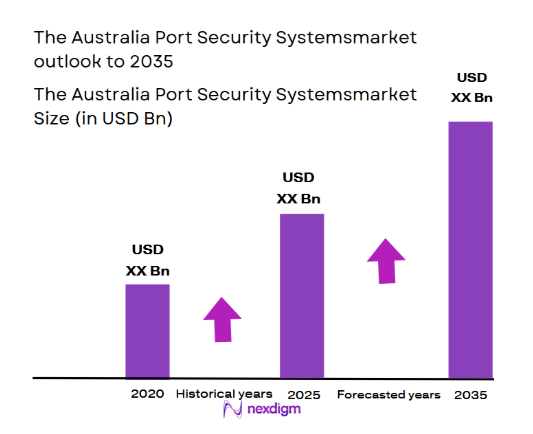
Based on a recent historical assessment, the Australia Port Security Systems market is projected to reach a value of USD ~ billion by 2024, driven by increasing government investments in port infrastructure security and advanced surveillance technologies. The growth of the market is primarily attributed to the rising demand for enhanced safety measures in the maritime industry, as well as the need to protect critical infrastructure from evolving security threats. The market is expected to witness significant technological advancements, including AI-driven systems, cybersecurity integration, and automated monitoring tools.
The dominant regions driving the growth of the Australia Port Security Systems market include Sydney, Melbourne, and Brisbane. These cities are critical hubs for maritime trade and logistics, with well-established port facilities and growing infrastructure. The dominance is attributed to the continuous expansion of port operations, increased import-export activities, and the growing awareness of the need for robust security measures against both physical and cyber threats. The government’s focus on improving port security standards and compliance with international regulations also contributes to the growth in these regions.
Market Segmentation
By Product Type
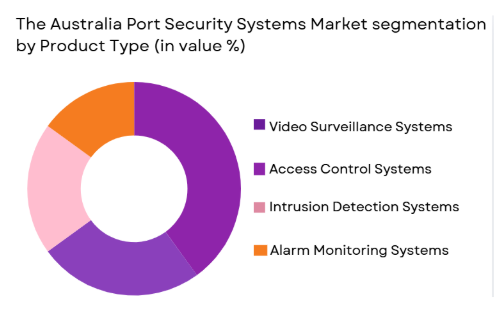
The Australia Port Security Systems market is segmented by product type into video surveillance systems, access control systems, intrusion detection systems, and alarm monitoring systems. Recently, video surveillance systems have dominated the market share due to factors such as demand for real-time monitoring, the ability to integrate with other security systems, and technological advancements like high-definition cameras and AI-driven analytics. These systems are crucial for monitoring vast port areas and ensuring the safety of both personnel and goods.
By Platform Type
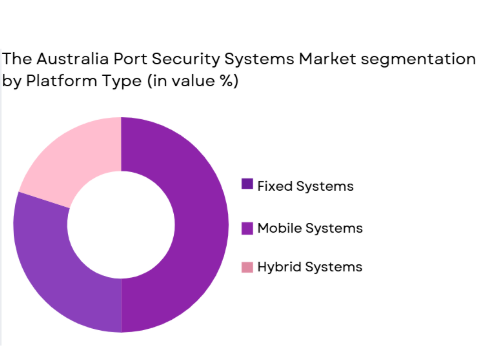
The Australia Port Security Systems market is segmented by platform type into fixed systems, mobile systems, and hybrid systems. Fixed systems currently dominate the market due to their ability to provide continuous, 24/7 surveillance and monitoring at key locations within the ports, such as entry points, warehouses, and restricted areas. The increased installation of fixed systems is driven by the need for round-the-clock security and the growing demand for integration with other port operations, like inventory tracking and cargo handling.
Competitive Landscape
The Australia Port Security Systems market is highly competitive, with several leading players consolidating their positions through strategic partnerships, technological advancements, and acquisitions. These players are focusing on expanding their product portfolios and providing integrated solutions that cater to the complex security needs of ports.
| Company Name | Establishment Year | Headquarters | Technology Focus | Market Reach | Key Products | Revenue (USD) | Additional Parameter |
| Bosch Security Systems | 1886 | Australia | ~ | ~ | ~ | ~ | ~ |
| Honeywell International | 1906 | United States | ~ | ~ | ~ | ~ | ~ |
| Axis Communications | 1984 | Sweden | ~ | ~ | ~ | ~ | ~ |
| Dahua Technology | 2001 | China | ~ | ~ | ~ | ~ | ~ |
| FLIR Systems | 1978 | United States | ~ | ~ | ~ | ~ | ~ |
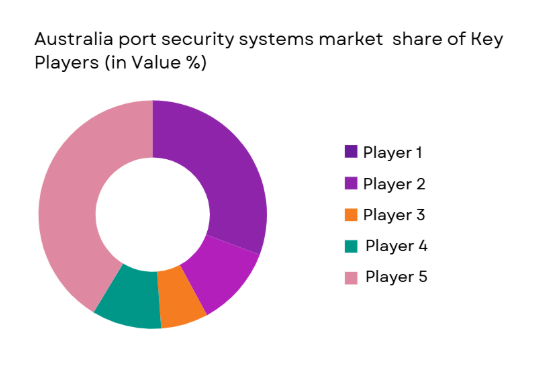
The Australia Port Security Systems Market Analysis
Growth Drivers
Technological Advancements
The growth of the Australia Port Security Systems market is primarily driven by continuous advancements in surveillance technology. The integration of AI, machine learning, and real-time data analytics into security systems has made it possible to enhance threat detection and improve decision-making processes. AI-driven video analytics, facial recognition, and behaviour detection technologies are gaining traction in the market, allowing security personnel to detect anomalies and potential threats much faster than traditional systems. Furthermore, advancements in thermal imaging and radar-based surveillance have revolutionized port security by improving visibility during adverse weather conditions and at night. These innovations enable more accurate monitoring, thus ensuring better security coverage for ports and maritime infrastructure. The integration of cyber-physical security solutions, which combine physical security systems with cybersecurity protocols, is also a key driver of growth. As cyber threats to critical infrastructure rise, the demand for cyber-secure port systems that can detect both physical and cyber threats is rapidly increasing.
Rising Global Trade
Another significant growth driver is the expansion of global trade and the increased demand for secure ports. As global supply chains grow in complexity, the need to secure critical infrastructure such as ports, which are crucial for international trade, has intensified. With the continuous increase in import-export activities, ports are becoming more vulnerable to various security risks, including smuggling, terrorism, and cyber-attacks. The need to address these risks has led to greater investments in port security systems to ensure seamless operations and safety. The increasing frequency of international cargo shipments, coupled with a rise in container traffic, has made ports high-priority targets for security investments. Governments and port authorities are thus increasing their expenditure on security infrastructure, ensuring that ports are equipped with the latest technologies to mitigate risks. The rising focus on automation, which allows ports to handle larger volumes of goods more efficiently, also complements the growth of advanced port security systems. Automated systems not only streamline cargo handling but also provide a safer and more secure operational environment.
Market Challenges
High Initial Investment
One of the key challenges faced by the Australia Port Security Systems market is the high initial investment required for setting up state-of-the-art security infrastructure. Port security systems, especially those that include advanced surveillance cameras, AI-based analytics, and integrated cybersecurity features, often come with substantial upfront costs. This poses a significant barrier for smaller ports and authorities that may have limited budgets for such investments. Despite the long-term benefits of enhanced security and operational efficiency, the capital-intensive nature of these systems discourages some port authorities from upgrading or expanding their security infrastructure. Moreover, the complexity of integrating new technologies with existing legacy systems further raises costs, as significant time and resources are required to ensure compatibility. This challenge is particularly pertinent for smaller ports or those in regions with limited funding, hindering the widespread adoption of advanced security solutions across the entire port network.
Regulatory Compliance
Another challenge is the increasingly stringent regulatory requirements surrounding port security. As international trade and shipping activities continue to grow, global regulatory bodies, such as the International Maritime Organization (IMO) and the World Customs Organization (WCO), are imposing stricter standards on port security. These regulations mandate the implementation of comprehensive security measures, including access controls, video surveillance, and cybersecurity protocols. While compliance with these regulations is critical for ensuring the safety and security of ports, meeting these requirements can be complex and costly. Ports must continuously upgrade their systems to remain compliant, and failure to do so can result in hefty fines, reputational damage, and disruptions to port operations. Additionally, the regulatory landscape is subject to frequent changes, which requires port operators to stay updated with the latest standards and adapt their systems accordingly. This adds to the financial burden on port authorities, especially smaller players in the market who may struggle to keep up with the evolving compliance requirements.
Opportunities
AI and Automation Integration
The integration of AI and automation into port security systems presents significant opportunities for growth in the Australia Port Security Systems market. AI-powered systems can offer enhanced security through real-time threat detection, pattern recognition, and predictive analytics. By automating routine security monitoring tasks, AI can help port security personnel focus on more complex situations, increasing the efficiency of port operations. Additionally, automated systems such as drones and robotic security guards are becoming increasingly popular in port security, offering cost-effective solutions for surveillance and monitoring. These technologies provide a high level of flexibility, enabling port authorities to expand their security coverage without needing additional personnel or significant infrastructure. As ports continue to modernize and move towards smart port concepts, AI and automation are expected to be critical drivers of innovation in port security systems, opening new market opportunities for technology providers and integrators.
Cybersecurity Integration
With the growing integration of IT and operational technology in port systems, cybersecurity has become a major concern for port authorities. The increasing reliance on digital systems, from logistics management to automated cranes, exposes ports to cyber threats, including hacking, data breaches, and ransomware attacks. As a result, there is an increasing demand for port security systems that combine physical security with robust cybersecurity measures. The opportunity to integrate advanced cybersecurity solutions into port security systems is significant, as ports look to protect both their physical assets and their digital infrastructure. By offering solutions that safeguard ports from both physical and cyber threats, security system providers can tap into a growing market need. This presents opportunities for technology providers to develop advanced integrated solutions that protect critical infrastructure, ensuring the safe and efficient flow of goods while safeguarding sensitive data.
Future Outlook
The future outlook for the Australia Port Security Systems market is promising, with continued growth expected over the next five years. Key drivers of this growth include the ongoing advancements in technology, particularly AI, automation, and cybersecurity integration. As ports strive to meet evolving security threats, there will be a greater emphasis on integrating advanced security systems that offer real-time monitoring, predictive analytics, and automated threat detection. Additionally, government regulations and increased investments in port infrastructure will support the demand for robust security solutions. Technological innovations, such as the adoption of blockchain and IoT for cargo tracking and port operations, will further enhance port security, creating a more secure and efficient environment for global trade.
Major Players
- Bosch Security Systems
- Honeywell International
- Axis Communications
- Dahua Technology
- FLIR Systems
- Johnson Controls
- Raytheon Technologies
- Siemens AG
- Thales Group
- Hikvision Digital Technology
- ADT Inc.
- ABB Ltd.
- Tyco International
- General Electric
- SICK AG
Key Target Audience
- Investments and venture capitalist firms
- Government and regulatory bodies
- Port authorities and operators
- Security integrators and system providers
- Cargo handling companies
- International trade associations
- Technology developers and innovators
- Maritime logistics firms
Research Methodology
Step 1: Identification of Key Variables
This step involves identifying the critical variables that influence market trends and dynamics, such as technological advancements, regulatory frameworks, and economic conditions.
Step 2: Market Analysis and Construction
In this step, data is collected from both primary and secondary sources to analyze the market structure, including product types, technology adoption, and end-user demands.
Step 3: Hypothesis Validation and Expert Consultation
Key hypotheses about market trends, growth drivers, and challenges are validated through consultations with industry experts, including port security managers and technology developers.
Step 4: Research Synthesis and Final Output
The final research synthesis involves compiling all findings into a comprehensive market report that provides actionable insights for stakeholders.

- Executive Summary
- Australia Port Security Systems Research Methodology (Definitions, Scope, Industry Assumptions, Market Sizing Approach, Primary & Secondary Research Framework, Data Collection & Verification Protocol, Analytic Models & Forecast Methodology, Limitations & Research Validity Checks)

- Market Definition and Scope
- Value Chain & Stakeholder Ecosystem
- Regulatory / Certification Landscape
- Sector Dynamics Affecting Demand
- Strategic Initiatives & Infrastructure Growth

- Growth Drivers
Rising maritime security threats
Government investments in port modernization
Increased global trade and logistics activities
Advancements in security technology
Regulatory compliance requirements - Market Challenges
High capital and maintenance costs
Complexity of integrating new systems
Cybersecurity threats to port security networks
Regulatory hurdles in port security procurement
Limited skilled workforce for advanced security technologies - Market Opportunities
Technological advancements in AI and automation
Collaboration with private sector security firms
Expansion of port security solutions in emerging markets - Trends
Increasing use of AI in surveillance
Integration with IoT for smarter ports
Growing emphasis on cyber-physical security
Rise of autonomous security solutions
Shift towards green and sustainable security technologies - Government Regulations & Defense Policy
International Maritime Organization (IMO) regulations
Local port security standards
Cybersecurity mandates for critical infrastructure - SWOT Analysis
- Stakeholder and Ecosystem Analysis
- Porter’s Five Forces Analysis
- Competition Intensity and Ecosystem Mapping

- By Market Value, 2020-2025
- By Installed Units, 2020-2025
- By Average System Price, 2020-2025
- By System Complexity Tier, 2020-2025

- By System Type (In Value%)
Surveillance Systems
Access Control Systems
Intrusion Detection Systems
Perimeter Security Systems
Automated Security Solutions - By Platform Type (In Value%)
Seaport Terminals
Harbor Entrances
Docking Areas
Cargo Handling Facilities
Maritime Security Agencies - By Fitment Type (In Value%)
OEM Port Security Systems
Aftermarket Port Security Systems
Integrated Port Security Systems
Custom Port Security Systems
Modular Port Security Systems - By EndUser Segment (In Value%)
Port Authorities
Shipping Companies
Cargo Operators
Government Agencies
Logistics Providers - By Procurement Channel (In Value%)
Direct Procurement
Third-party Procurement
Government Procurement
OEM Procurement
Online Procurement - By Material / Technology (in Value%)
Surveillance Camera Technology
Biometric Access Technology
Radar Detection Systems
Infrared Security Systems
Data Encryption and Networking

- Market structure and competitive positioning
Market share snapshot of major players - Cross Comparison Parameters (Technology Integration, System Flexibility, Market Penetration, Regulatory Compliance, Product Customization, Customer Support, Pricing, Procurement Channels, Innovation, Security Effectiveness)
- SWOT Analysis of Key Players
- Pricing & Procurement Analysis
- Key Players
Naval Group Australia
Safi-Tech Security Solutions
Austal Limited
BMT Group
Thales Australia
Macquarie Telecom Group
SABRE Group
Leidos Australia
Tenix Solutions
Elbit Systems Australia
Harris Corporation
Cognizant Technology Solutions
SCS Global Services
BAE Systems Australia
General Electric Australia

- Port authorities’ role in securing maritime zones
- Shipping companies adopting port security solutions
- Increasing demand for integrated port security systems
- Government agencies supporting port security upgrades

- Forecast Market Value, 2026-2035
- Forecast Installed Units, 2026-2035
- Price Forecast by System Tier, 2026-2035
- Future Demand by Platform, 2026-2035


 Request a Sample
 Ask for Customization
 Get a Quote
 Enquire Now