
 Download PDF
 Download PDF
Market Overview
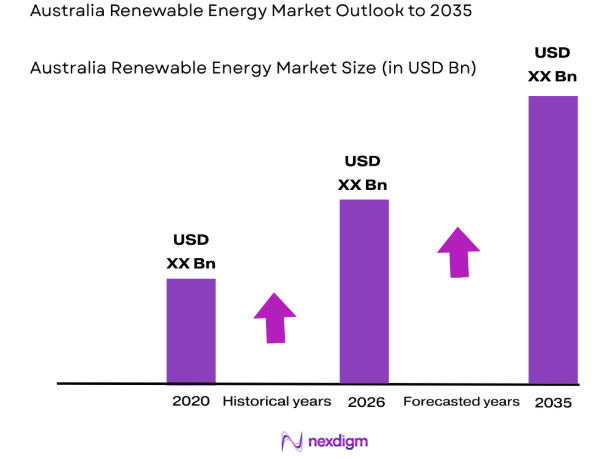
The Australian renewable energy market is valued at approximately USD ~ billion based on a recent historical assessment. The market is primarily driven by the country’s strong commitment to reducing carbon emissions and transitioning towards sustainable energy sources. Government policies and incentives supporting solar, wind, and hydroelectric power, alongside the growing public demand for cleaner energy, are key factors propelling the market. The increase in renewable energy generation capacity, along with decreasing costs of renewable technologies, are central to market expansion.
The dominant cities in Australia, including Sydney, Melbourne, and Brisbane, play a crucial role in the renewable energy sector due to their large population base and substantial industrial activities. Sydney, as the country’s economic hub, has made significant strides in renewable energy adoption, driven by both public and private sector initiatives. Melbourne follows closely, with substantial investments in solar energy and green technologies. Brisbane, with its rapidly growing clean energy projects, further boosts Australia’s renewable energy market, ensuring widespread adoption across urban and regional areas.
Market Segmentation
By Product Type
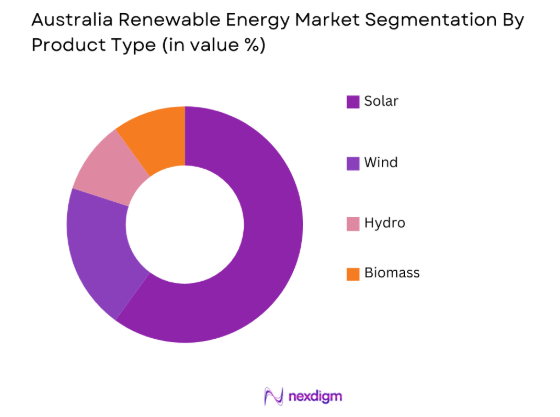
The Australian renewable energy market is segmented by Product type into solar power, wind power, hydroelectric power, and others. Recently, solar power has dominated the market due to the rapid growth of residential and commercial solar installations. The significant reduction in the cost of solar panels, paired with government incentives like the Small-scale Renewable Energy Scheme (SRES), has made solar energy highly attractive for consumers. Additionally, Australia’s geographic location and high solar irradiance make it an ideal market for solar power generation, which continues to drive the dominance of solar energy in the country’s renewable energy landscape.
By End-User
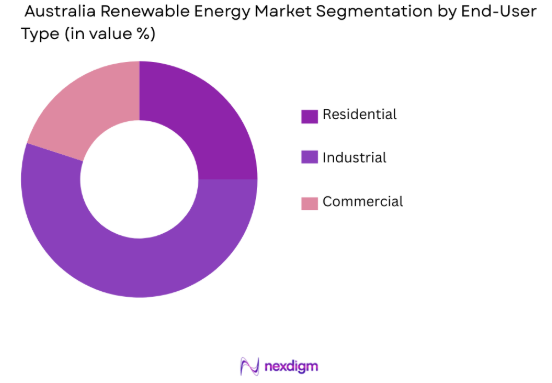
The Australian renewable energy market is segmented by end-user into residential, commercial, and industrial. Recently, the residential segment has been the dominant market driver due to the increasing popularity of rooftop solar systems. Government-backed incentives and rebates for residential solar installations, such as the SRES, have encouraged homeowners to adopt renewable energy solutions. Additionally, the rising awareness of environmental concerns and the desire for lower electricity bills have made renewable energy a preferred choice for residential consumers. As more homes adopt solar energy, this segment is expected to maintain a leading share of the market in the coming years.
Competitive Landscape
The Australian renewable energy market is highly competitive, with numerous players from both local and international backgrounds offering renewable energy solutions. Major global and domestic energy providers, along with specialized renewable energy firms, are vying for market share by investing in advanced technologies, such as solar panel manufacturing, wind turbine installation, and energy storage systems. The competition is further fueled by government incentives, which encourage both new entrants and established players to invest heavily in renewable energy technologies. Consolidation is taking place as large companies seek to expand their portfolios, leading to greater investments in large-scale projects and energy storage solutions.
| Company Name | Establishment Year | Headquarters | Technology Focus | Market Reach | Key Products | Revenue | Market-specific Parameter |
| AGL Energy | 1837 | Australia | ~ | ~ | ~ | ~ | ~ |
| Origin Energy | 2000 | Australia | ~ | ~ | ~ | ~ | ~ |
| Infigen Energy | 1997 | Australia | ~ | ~ | ~ | ~ | ~ |
| First Solar | 1999 | USA | ~ | ~ | ~ | ~ | ~ |
| Vestas | 1945 | Denmark | ~ | ~ | ~ | ~ | ~ |
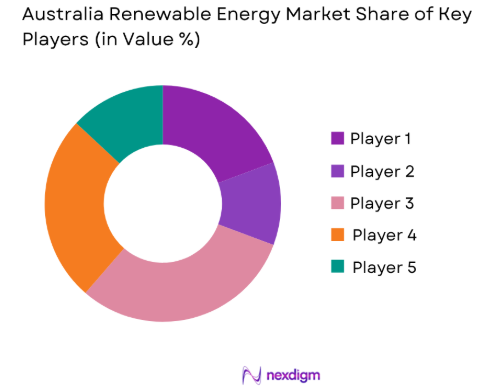
Australia Renewable Energy Market Analysis
Growth Drivers
Government Support for Renewable Energy
The Australian government’s proactive policies and incentives are one of the major growth drivers in the renewable energy market. The Renewable Energy Target (RET) set by the government aims to achieve 33,000 GWh of renewable energy by 2020, and while this target has been surpassed, further targets continue to push for an increase in renewable energy generation. Additionally, schemes such as the Small-scale Renewable Energy Scheme (SRES) provide financial incentives to residential and small-scale commercial installations of solar panels. With the government’s continued push for a clean energy future, including renewable energy targets and carbon emission reduction commitments, renewable energy adoption is set to accelerate, driving investments into wind, solar, and storage technologies. Government-led initiatives like the Clean Energy Finance Corporation (CEFC) and Australian Renewable Energy Agency (ARENA) further support market growth through funding and innovation in renewable technologies. These efforts are critical in providing the market with the infrastructure and regulatory framework needed to expand renewable energy capacity in Australia.
Increasing Environmental Awareness and Corporate Sustainability
Increasing environmental awareness among the public and businesses is another significant driver of growth in the Australian renewable energy market. Consumers are becoming more conscious of the environmental impact of fossil fuels, leading to greater demand for cleaner, renewable energy sources. Businesses, too, are setting corporate sustainability goals, with many large companies opting to shift to renewable energy in their operations. Corporate Social Responsibility (CSR) initiatives are increasingly centered around sustainability, and energy procurement strategies are evolving to incorporate more renewable energy. This shift is driven by a combination of factors, including the decreasing costs of renewable technologies, the availability of renewable energy credits, and consumer demand for more sustainable products. As the public and private sectors align in their efforts to reduce carbon footprints, the demand for renewable energy in both residential and commercial sectors will continue to increase. This is expected to further accelerate market growth, particularly in the residential solar energy segment, where people are eager to adopt clean energy solutions and reduce their reliance on conventional electricity.
Market Challenges
Intermittency and Energy Storage
One of the key challenges facing the Australian renewable energy market is the intermittency of renewable energy sources, particularly solar and wind power. While these sources are environmentally friendly, their generation depends on weather conditions, which can lead to fluctuations in power supply. Solar energy production is limited during the night and on cloudy days, while wind energy is dependent on consistent wind patterns. To address this issue, the development of large-scale energy storage systems, such as battery storage, is critical. However, the high cost of energy storage systems remains a significant barrier to widespread adoption. While technological advances are helping to reduce costs, large-scale storage solutions are still in their infancy and require further investment in research and development. Additionally, integrating renewable energy into the existing grid infrastructure remains a complex challenge, especially in remote areas where energy storage and grid stability are more difficult to achieve. As the demand for renewable energy grows, it will be essential for Australia to address these intermittency and storage challenges to ensure a reliable and stable energy supply.
High Initial Investment and Infrastructure Development
The high initial investment required for renewable energy projects is another major challenge facing the Australian market. Although the cost of renewable energy technologies, such as solar panels and wind turbines, has significantly decreased, the upfront costs of large-scale installations, including land acquisition, grid connection, and energy storage, remain a barrier. The capital-intensive nature of renewable energy projects requires significant financial resources, which may deter small or medium-sized businesses from investing in renewable energy infrastructure. In addition, the infrastructure needed to support the widespread adoption of renewable energy, such as upgraded transmission lines and grid management systems, is still underdeveloped in some areas. Australia’s remote geography, with significant distances between urban centers and renewable energy sources, exacerbates this issue. To accelerate the transition to renewable energy, substantial investments in infrastructure development and financing mechanisms are needed to make renewable energy more accessible and affordable for businesses and consumers.
Opportunities
Technological Advancements in Energy Storage
One of the most promising opportunities in the Australian renewable energy market lies in advancements in energy storage technologies. As renewable energy generation becomes more widespread, the need for efficient and cost-effective energy storage solutions becomes increasingly critical. Energy storage systems, such as advanced batteries, can help smooth out the intermittency of renewable energy sources by storing excess energy generated during peak production periods and releasing it when demand is high or generation is low. The development of large-scale energy storage systems presents a significant growth opportunity for the market, as it can improve grid reliability and stability. Australian companies, along with international partners, are already investing heavily in the research and development of new storage technologies that are both more affordable and efficient. In addition, Australia’s natural resources, including vast land areas for large solar and wind farms, provide a unique opportunity to deploy energy storage systems alongside renewable energy projects. This dual focus on renewable energy generation and storage capacity will be critical in enabling Australia to achieve its renewable energy goals and provide a more resilient energy infrastructure.
International Expansion of Renewable Energy Projects
Another key opportunity for the Australian renewable energy market is the potential for international expansion of renewable energy projects. Australia is well-positioned to export renewable energy to neighboring countries in the Asia-Pacific region, particularly through the development of renewable energy export projects like green hydrogen and liquefied natural gas (LNG) produced from renewable sources. This opportunity is driven by the increasing demand for clean energy in Asia, where countries like Japan, South Korea, and China are heavily investing in renewable energy and clean fuels. Australia’s natural resources and its expertise in renewable energy technologies provide a competitive advantage in this emerging market. By establishing renewable energy export hubs and collaborating with international partners, Australia could become a leading supplier of clean energy to the Asia-Pacific region, creating significant revenue streams and expanding the reach of its renewable energy technologies. Additionally, the growth of global demand for renewable energy will contribute to the overall development of the industry, strengthening Australia’s position in the global energy market.
Future Outlook
The Australian renewable energy market is poised for substantial growth over the next five years. Technological advancements, particularly in energy storage and smart grid solutions, will enable a more reliable and efficient integration of renewable energy sources. Government policies will continue to drive the market, with renewable energy targets and incentives supporting investment in solar, wind, and other green technologies. The demand for renewable energy will be further fueled by the increasing awareness of environmental sustainability, the decreasing cost of renewable technologies, and the need for clean energy solutions. Additionally, the growing interest in renewable energy exports presents new opportunities for Australia to expand its renewable energy presence globally.
Major Players
- AGL Energy
- Origin Energy
- Infigen Energy
- First Solar
- Vestas
- Australian Renewable Energy Agency (ARENA)
- Siemens Gamesa
- Tesla
- SunPower Corporation
- Neoen
- Enel Green Power
- Iberdrola
- Clean Energy Finance Corporation (CEFC)
- EDF Energy
- Brookfield Renewable Partners
Key Target Audience
- Government and regulatory bodies
- Renewable energy companies
- Investment firms and venture capitalists
- Energy infrastructure developers
- Manufacturing and industrial companies
- Research institutions
- International energy suppliers
Research Methodology
Step 1: Identification of Key Variables
Market variables such as renewable energy adoption rates, government policies, technological advancements, and energy storage solutions were identified for analysis.
Step 2: Market Analysis and Construction
Data from industry reports, government energy policies, and market surveys were used to estimate the market size, trends, and forecasts for renewable energy in Australia.
Step 3: Hypothesis Validation and Expert Consultation
Discussions with industry experts and stakeholders, including government officials and energy companies, helped validate market assumptions and identify key growth drivers.
Step 4: Research Synthesis and Final Output
The data was synthesized into a comprehensive report that covers market size, segmentation, growth drivers, challenges, and opportunities for stakeholders in the Australian renewable energy market.

- Executive Summary
- Research Methodology (Definitions, Scope, Industry Assumptions, Market Sizing Approach, Primary & Secondary Research Framework, Data Collection & Verification Protocol, Analytic Models & Forecast Methodology, Limitations & Research Validity Checks)

- Market Definition and Scope
- Value Chain & Stakeholder Ecosystem
- Regulatory / Certification Landscape
- Sector Dynamics Affecting Demand

- Growth Drivers
Government incentives for renewable energy projects
Technological advancements in energy storage
Increased awareness and demand for sustainable energy solutions - Market Challenges
High initial capital investment
Grid integration and infrastructure challenges
Regulatory complexities in renewable energy projects - Market Opportunities
Expansion of renewable energy capacity in remote areas
Partnerships for innovation in energy storage
Development of microgrids and decentralized energy systems - Trends
Increase in the adoption of distributed energy resources
Rise of corporate PPAs and green energy procurement - Government Regulations
National Renewable Energy Target (RET)
Government subsidies and financial incentives
Regulations on renewable energy grid integration - SWOT Analysis
- Porter’s Five Forces

- By Market Value, 2020-2025
- By Installed Units, 2020-2025
- By Average System Price, 2020-2025
- By System Complexity Tier, 2020-2025

- By System Type (In Value%)
Solar PV Systems
Wind Power Systems
Battery Storage Systems
Biomass Systems
Hydropower Systems - By Platform Type (In Value%)
Onshore Platforms
Offshore Platforms
Floating Platforms
Hybrid Platforms - By Fitment Type (In Value%)
Utility-Scale Installations
Commercial Installations
Residential Installations
Industrial Installations - By End User Segment (In Value%)
Energy Providers
Government Agencies
Private Sector / Corporates
Industrial Users

- Market Share Analysis
- Cross Comparison Parameters (System Type, Platform Type, End-User Segment, Technology, Cost Structure, Regulatory Compliance, Fitment Type)
- SWOT Analysis of Key Competitors
- Pricing & Procurement Analysis
- Key Players
AGL Energy
Origin Energy
First Solar
Siemens Gamesa
Vestas Wind Systems
CWP Renewables
SMA Solar Technology
SunPower
Acciona Energy
Tesla
Enphase Energy
GE Renewable Energy
Macquarie Group
Verbund AG
Sunrun

- Government push for large-scale renewable projects
- Private sector interest in renewable energy as a competitive advantage
- Industrial shift towards cleaner energy sources
- Growing demand for off-grid energy solutions

- Forecast Market Value, 2026-2035
- Forecast Installed Units, 2026-2035
- Price Forecast by System Tier, 2026-2035
- Future Demand by Platform, 2026-2035


 Request a Sample
 Ask for Customization
 Get a Quote
 Enquire Now