

 Download PDF
 Download PDF
Market Overview
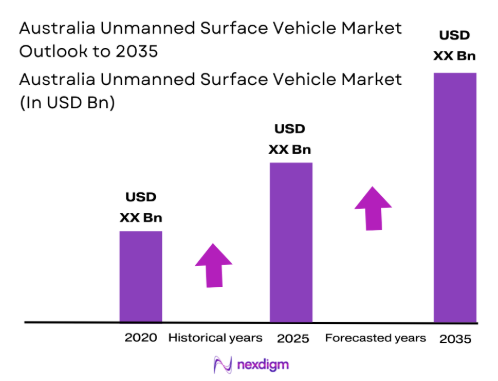
The Australia Unmanned Surface Vehicle market current size stands at around USD ~ million, supported by increasing defense procurement activity and expanding offshore operational requirements. Deployment volumes increased steadily across coastal surveillance, hydrographic mapping, and autonomous patrol functions, with fleet utilization rates rising during the last two operational cycles. Technology adoption accelerated through platform upgrades, enhanced autonomy software, and sensor integration. Government-backed trials and maritime modernization programs further contributed to operational acceptance, enabling consistent demand across defense and commercial maritime operators.
Operational concentration remains highest along eastern and western coastlines, supported by naval infrastructure, port density, and offshore energy assets. Sydney, Perth, and Brisbane act as deployment and testing hubs due to access to naval bases, research centers, and industrial shipyards. Policy frameworks encouraging autonomous maritime systems and coastal security investments strengthen ecosystem maturity. Growing collaboration between defense agencies, technology providers, and port authorities continues to reinforce long-term deployment stability across regional waters.
Market Segmentation
By Fleet Type
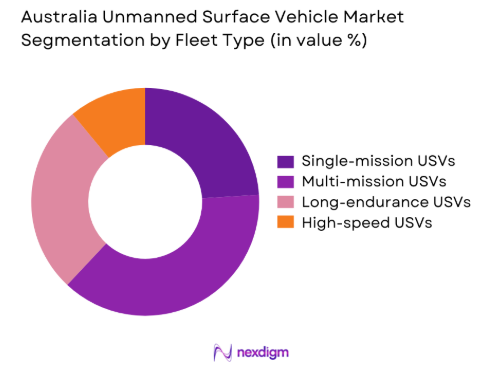
The fleet structure is dominated by multi-mission and long-endurance unmanned surface vehicles designed for extended surveillance and maritime monitoring. Defense agencies favor modular platforms capable of integrating multiple payloads, while commercial operators prioritize endurance and fuel efficiency. Single-mission units remain relevant for environmental monitoring and hydrographic surveys. Fleet composition is increasingly influenced by mission flexibility, autonomous endurance, and interoperability with naval command systems. Continuous upgrades in hull design and propulsion efficiency further shape procurement preferences across fleet categories.
By Application
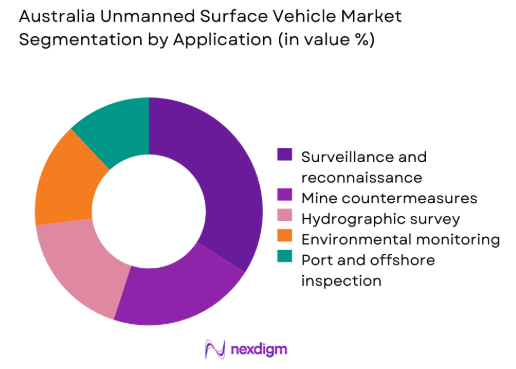
Surveillance and reconnaissance dominate application demand due to persistent maritime security requirements and extended coastline monitoring needs. Mine countermeasure operations and hydrographic surveying follow, driven by naval modernization and offshore infrastructure development. Environmental monitoring applications continue expanding with increased focus on marine ecosystem protection. Commercial inspection and port security applications are gaining relevance as automation reduces operational risks and improves efficiency. Application diversification is supported by improved sensor fusion and real-time communication systems.
Competitive Landscape
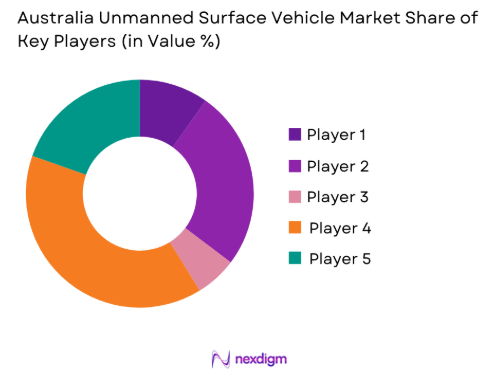
The competitive landscape reflects a mix of defense-focused manufacturers and specialized autonomous system developers. Market participation is shaped by platform reliability, integration capability, regulatory compliance, and service support depth. Strategic partnerships with naval agencies and technology integrators strengthen competitive positioning. Product differentiation increasingly depends on autonomy software maturity, endurance capability, and modular payload compatibility.
| Company Name | Establishment Year | Headquarters | Formulation Depth | Distribution Reach | Regulatory Readiness | Service Capability | Channel Strength | Pricing Flexibility |
| Austal | 1988 | Australia | ~ | ~ | ~ | ~ | ~ | ~ |
| L3Harris Technologies | 1895 | USA | ~ | ~ | ~ | ~ | ~ | ~ |
| BAE Systems | 1999 | UK | ~ | ~ | ~ | ~ | ~ | ~ |
| Thales Group | 1893 | France | ~ | ~ | ~ | ~ | ~ | ~ |
| Kongsberg Maritime | 1814 | Norway | ~ | ~ | ~ | ~ | ~ | ~ |
Australia Unmanned Surface Vehicle Market Analysis
Growth Drivers
Rising maritime surveillance requirements
Maritime security requirements expanded due to increased coastal monitoring needs and heightened awareness of unauthorized maritime activity. Naval forces prioritized unmanned systems to extend patrol coverage without increasing crew exposure. Autonomous surface vehicles enabled persistent operations across extended maritime zones. Enhanced sensor payloads improved detection accuracy under variable environmental conditions. Fleet operators increasingly relied on unmanned platforms for endurance missions. Deployment frequency increased steadily during recent operational cycles. Integration with command systems improved situational awareness across maritime domains. Budget allocations favored scalable autonomous assets over manned vessels. Operational efficiency gains supported continued adoption momentum. Strategic defense planning reinforced sustained surveillance investments.
Increasing naval modernization initiatives
Naval modernization programs emphasized fleet digitization and autonomous capability development across surface platforms. Unmanned systems were integrated to complement traditional naval assets. Modernization efforts focused on enhancing situational awareness and response speed. Autonomous platforms reduced operational strain on crewed vessels. Interoperability with legacy command systems remained a priority. Technology refresh cycles accelerated adoption of advanced navigation algorithms. Fleet planners emphasized modularity and upgradeability. Investment alignment supported long-term platform sustainability. Operational doctrines increasingly incorporated unmanned missions. Modernization roadmaps continued reinforcing demand consistency.
Challenges
High system integration and deployment costs
Integration complexity remains a challenge due to diverse mission requirements and platform configurations. System customization often requires specialized engineering resources. Deployment readiness depends on compatibility with existing naval infrastructure. Testing and certification cycles increase project timelines. Maintenance logistics add operational burden for fleet operators. Interoperability challenges persist across communication protocols. Training requirements increase operational overhead. Infrastructure readiness varies across deployment locations. Budget constraints limit rapid scaling potential. Cost management remains a persistent operational concern.
Complex regulatory and certification requirements
Regulatory frameworks governing autonomous maritime operations continue evolving. Certification processes require extensive validation and compliance documentation. Cross-jurisdictional operations introduce additional regulatory complexity. Safety standards mandate rigorous testing protocols. Approval timelines affect deployment schedules. Policy alignment between civil and defense authorities remains inconsistent. Data security compliance introduces operational constraints. Environmental regulations impact deployment planning. Regulatory uncertainty slows commercialization efforts. Compliance costs influence procurement decisions.
Opportunities
Expansion of autonomous port operations
Port authorities increasingly adopt unmanned platforms for monitoring and inspection tasks. Automation reduces operational risks in congested harbor environments. Demand for continuous surveillance supports deployment growth. Integration with port management systems enhances efficiency. Autonomous inspection reduces downtime and labor dependency. Ports benefit from real-time data acquisition. Expansion aligns with smart port initiatives. Operational scalability improves asset utilization. Technology maturity supports broader adoption. Long-term infrastructure modernization creates sustained opportunity.
Increased defense procurement programs
Defense agencies continue expanding unmanned system acquisition programs. Strategic emphasis on maritime domain awareness supports sustained demand. Procurement frameworks increasingly include autonomous surface platforms. Capability gaps addressed through rapid technology deployment. Collaborative development programs accelerate innovation cycles. Domestic manufacturing participation strengthens supply chains. Program funding stability enhances market confidence. Operational trials validate system effectiveness. Multi-year procurement plans support vendor planning. Defense modernization remains a key growth catalyst.
Future Outlook
The Australia unmanned surface vehicle market is expected to experience sustained expansion driven by defense modernization, port automation, and autonomous technology maturity. Continued regulatory alignment and infrastructure investment will support broader adoption. Advancements in artificial intelligence and sensor integration will enhance operational capability. Cross-sector collaboration will further strengthen ecosystem resilience through the forecast period.
Major Players
- Austal
- L3Harris Technologies
- BAE Systems
- Thales Group
- Kongsberg Maritime
- Saab Group
- Elbit Systems
- Rheinmetall Defence
- Northrop Grumman
- QinetiQ
- Teledyne Marine
- Atlas Elektronik
- Fugro
- Ocean Infinity
- Lockheed Martin
Key Target Audience
- Australian Department of Defence
- Royal Australian Navy
- Australian Maritime Safety Authority
- Port authorities and harbor operators
- Offshore energy operators
- Maritime security agencies
- Investments and venture capital firms
- State and federal regulatory bodies
Research Methodology
Step 1: Identification of Key Variables
Key operational, technological, and regulatory variables were identified through analysis of maritime programs and deployment models. Emphasis was placed on platform capabilities, mission types, and adoption drivers.
Step 2: Market Analysis and Construction
Market structure was developed using segmentation analysis, deployment trends, and technology maturity evaluation across operational use cases.
Step 3: Hypothesis Validation and Expert Consultation
Findings were validated through expert consultations with maritime specialists, defense planners, and autonomous system engineers to ensure practical alignment.
Step 4: Research Synthesis and Final Output
Validated insights were synthesized into a cohesive framework, ensuring consistency, accuracy, and relevance for strategic decision-making.

- Executive Summary
- Research Methodology (Market Definitions and Scope Alignment, Platform and Mission Taxonomy Development, Bottom-Up Fleet and Deployment Estimation, Revenue Attribution by Program and Procurement Cycle, Primary Interviews with Naval and Autonomous Systems Experts, Data Triangulation Across Defense, Commercial, and R&D Sources, Assumption Validation Based on Maritime Regulatory Frameworks)

- Definition and Scope
- Market evolution
- Usage and mission deployment landscape
- Ecosystem structure
- Supply chain and system integration flow
- Regulatory and maritime compliance environment

- Growth Drivers
Rising maritime surveillance requirements
Increasing naval modernization initiatives
Growing offshore energy exploration activities
Advancements in autonomous navigation technologies
Demand for cost-efficient unmanned operations - Challenges
High system integration and deployment costs
Complex regulatory and certification requirements
Limited interoperability standards
Cybersecurity and data integrity concerns
Harsh maritime operating conditions - Opportunities
Expansion of autonomous port operations
Increased defense procurement programs
Commercial adoption for offshore inspection
Advancements in AI-enabled navigation
Export potential to Asia-Pacific naval markets - Trends
Shift toward multi-mission platforms
Integration of AI-based navigation systems
Increased endurance and hybrid propulsion adoption
Growing use of swarm-based operations
Rising collaboration between defense and private industry - Government Regulations
SWOT Analysis
Stakeholder and Ecosystem Analysis
Porter’s Five Forces Analysis
Competition Intensity and Ecosystem Mapping

- By Value, 2020–2025
- By Volume, 2020–2025
- By Installed Base, 2020–2025
- By Average Selling Price, 2020–2025

- By Fleet Type (in Value %)
Single-mission USVs
Multi-mission USVs
Long-endurance USVs
High-speed interceptor USVs - By Application (in Value %)
Intelligence, surveillance, and reconnaissance
Mine countermeasures
Maritime security and patrol
Hydrographic survey
Environmental monitoring - By Technology Architecture (in Value %)
Remote-operated
Semi-autonomous
Fully autonomous - By End-Use Industry (in Value %)
Defense and naval forces
Offshore energy
Port and harbor authorities
Marine research organizations
Commercial maritime operators - By Connectivity Type (in Value %)
Line-of-sight communication
Satellite communication
Hybrid connectivity systems - By Region (in Value %)
New South Wales
Victoria
Western Australia
Queensland
Rest of Australia

- Market structure and competitive positioning
- Market share snapshot of major players
- Cross Comparison Parameters (Technology maturity, Fleet scalability, Mission versatility, Autonomy level, Integration capability, Regulatory compliance, Cost competitiveness, After-sales support)
- SWOT Analysis of Key Players
- Pricing and Commercial Model Benchmarking
- Porter’s Five Forces
- Detailed Profiles of Major Companies
Austal Limited
L3Harris Technologies
BAE Systems
Thales Group
Kongsberg Maritime
Elbit Systems
Saab Group
Rheinmetall Defence
Northrop Grumman
Ocean Infinity
QinetiQ
Teledyne Marine
Atlas Elektronik
Fugro
Lockheed Martin

- Demand and utilization drivers
- Procurement and tender dynamics
- Buying criteria and vendor selection
- Budget allocation and financing preferences
- Implementation barriers and risk factors
- Post-purchase service expectations

- By Value, 2026–2035
- By Volume, 2026–2035
- By Installed Base, 2026–2035
- By Average Selling Price, 2026–2035


 Request a Sample
 Ask for Customization
 Get a Quote
 Enquire Now