

 Download PDF
 Download PDF
Market Overview
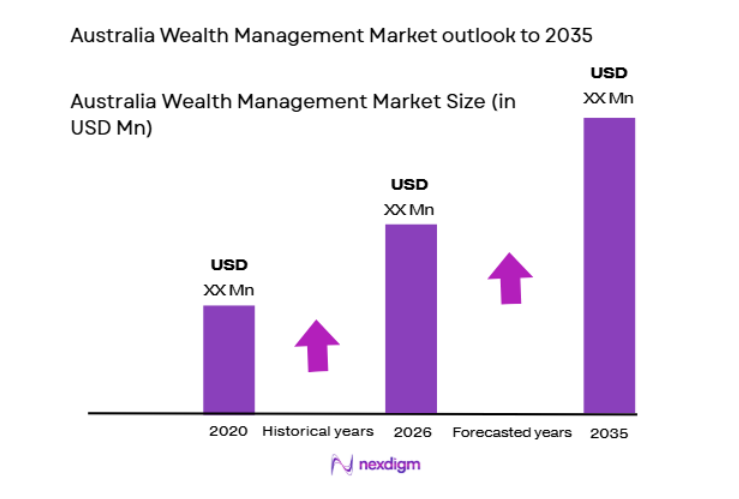
Australia wealth management market manages approximately USD ~ Million in financial assets across advisory, discretionary, and superannuation-linked investment accounts, based on a recent historical assessment of central bank financial accounts and prudential regulator fund statistics. Growth is driven by compulsory retirement savings accumulation, high household financial wealth, and strong participation in managed funds and equities. Bank-aligned wealth platforms, independent advisers, and superannuation providers deliver diversified portfolios, tax-aware planning, and global investment access across affluent segments.
Sydney and Melbourne dominate the Australia wealth management market due to concentration of high-net-worth households, financial institutions, and investment advisory firms. These cities host major bank-wealth groups, fund managers, and private banking operations serving affluent populations and business owners. Brisbane and Perth follow with resource-driven wealth and professional services sectors supporting advisory demand. Nationwide participation is reinforced by universal superannuation coverage, digital brokerage adoption, and integrated banking-wealth platforms across metropolitan and regional Australia.
Market Segmentation
By Client Type
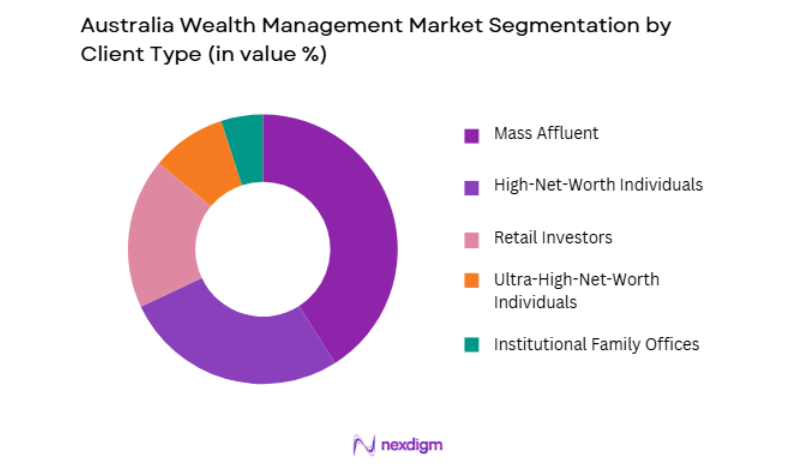
Australia wealth management market is segmented by client type into ultra-high-net-worth individuals, high-net-worth individuals, mass affluent, retail investors, and institutional family offices. Recently, mass affluent has a dominant market share due to factors such as compulsory superannuation savings accumulation, broad middle-income wealth growth, and widespread participation in managed investment products through employer retirement plans. This segment holds substantial investable assets within superannuation accounts and taxable portfolios, often requiring advisory support for asset allocation, retirement transition, and tax optimization. Wealth platforms and digital advisers target mass affluent clients with scalable model portfolios and managed accounts, expanding coverage beyond traditional private banking thresholds.
 By Asset Class
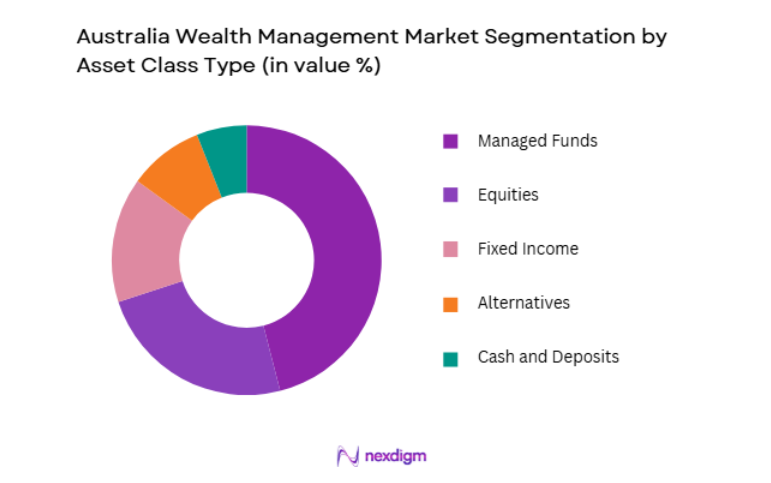
Australia wealth management market is segmented by asset class into managed funds, equities, fixed income, alternatives, and cash and deposits. Recently, managed funds has a dominant market share due to factors such as superannuation system structure, professional portfolio management preference, and access to diversified domestic and global investments through pooled vehicles. Superannuation contributions are primarily allocated into diversified managed funds, embedding collective investment as the core wealth accumulation vehicle for households. Financial advisers and platforms construct portfolios using funds for asset allocation efficiency and regulatory compliance. Large domestic asset managers and global fund houses distribute extensive product ranges through banks and adviser networks.
Competitive Landscape
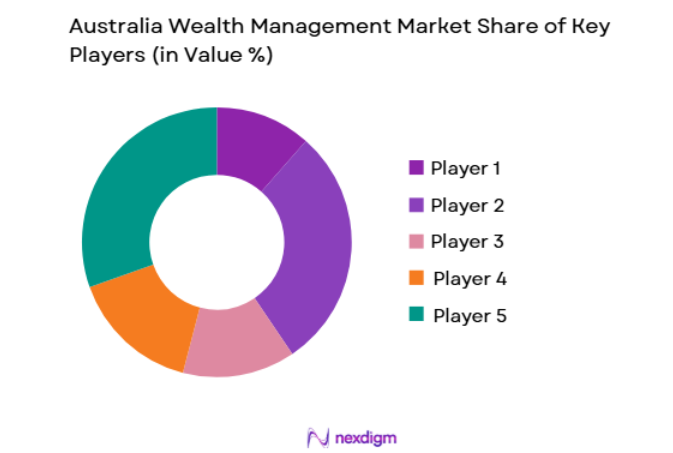
The Australia wealth management market is concentrated among major bank-aligned wealth platforms, superannuation funds, and global investment managers that combine distribution scale with portfolio management capabilities. Consolidation has followed regulatory reforms and vertical integration between advice, platforms, and asset management. Competition centers on superannuation products, managed accounts, and digital advisory services. Large institutions leverage retirement savings flows and platform ecosystems, while independent advisers and global firms compete on specialization and performance.
| Company Name | Establishment Year | Headquarters | Technology Focus | Market Reach | Key Products | Revenue | Platform Assets |
| Commonwealth Bank Wealth | 1911 | Sydney | ~ | ~ | ~ | ~ | ~ |
| Westpac Wealth | 1817 | Sydney | ~ | ~ | ~ | ~ | ~ |
| AMP Limited | 1849 | Sydney | ~ | ~ | ~ | ~ | ~ |
| Macquarie Group | 1969 | Sydney | ~ | ~ | ~ | ~ | ~ |
| Insignia Financial | 1846 | Melbourne | ~ | ~ | ~ | ~ | ~ |
Australia Wealth Management Market Analysis
Growth Drivers
Compulsory Superannuation System and Long-Term Retirement Savings Flows
Australia’s mandatory superannuation framework requires employer retirement contributions for the majority of the workforce, generating continuous inflows into managed investment vehicles and forming the structural backbone of the wealth management market’s asset growth and advisory demand. These contributions accumulate over decades within diversified portfolios managed by superannuation funds and wealth platforms, creating substantial investable assets requiring asset allocation, lifecycle planning, and retirement transition strategies. Individuals increasingly engage advisers to consolidate super accounts, optimize investment choices, and plan drawdown strategies aligned with longevity and income needs. Wealth managers benefit from stable, recurring asset flows independent of short-term market cycles, enabling scale economies and long-term client relationships. Regulatory oversight emphasizing fiduciary responsibility and member outcomes strengthens trust in managed investment structures. Digital account visibility and portability further enhance engagement and consolidation behavior. As balances grow with wage progression and market returns, advisory complexity rises, particularly during pre-retirement phases requiring risk reduction and income planning.
Rising Household Financial Wealth and Investment Participation
Australia exhibits high household financial wealth supported by strong capital markets participation, property-linked equity accumulation, and widespread retail investor engagement in equities and managed funds, expanding the addressable base for wealth management services across affluent and mass-affluent segments. Increasing financial literacy and access to online brokerage and investment platforms encourage households to diversify savings into market-linked assets beyond deposits. Business ownership and professional income growth contribute to investable surplus requiring portfolio management and tax-efficient structuring. Wealth managers provide diversification across domestic and global equities, fixed income, and alternatives, addressing volatility and long-term return objectives. Digital advisory tools and managed account platforms enable scalable service delivery across client tiers. Intergenerational wealth transfer and inheritance planning further expand advisory relationships and assets under management. Market appreciation cycles reinforce portfolio growth and client confidence in professional management.
Market Challenges
Regulatory Compliance Burden and Advice Accessibility Constraints
Australia’s wealth management sector operates under stringent regulatory frameworks governing financial advice quality, disclosure, and fiduciary responsibility, significantly increasing compliance costs and administrative complexity for advisory firms and institutions. Licensing requirements, documentation standards, and ongoing monitoring obligations elevate operational expenses and reduce adviser productivity, limiting scalability of personalized advice delivery. Smaller advisory firms face economic pressure from compliance overhead, contributing to industry consolidation and adviser shortages. Higher compliance costs are often passed to clients through advice fees, reducing accessibility for mass-affluent investors who may forgo professional guidance. Regulatory scrutiny following past misconduct cases has increased reporting and governance requirements, further constraining innovation speed. Institutions must invest heavily in technology systems to ensure auditability and suitability documentation. Compliance intensity reduces profitability of lower-balance accounts, discouraging service expansion. Regulatory burden therefore restricts advice penetration growth within the Australia wealth management market.
Market Volatility and Investor Risk Sensitivity
Australia’s wealth portfolios are significantly exposed to equity market performance and global asset cycles, creating volatility in assets under management and investor sentiment that directly affects wealth management revenue and client engagement dynamics. Market downturns reduce portfolio values and fee income, while also triggering investor caution, redemption flows, or shifts toward defensive allocations that reduce advisory activity. High equity allocation within superannuation and retail portfolios amplifies sensitivity to global market conditions and interest rate movements. Investor behavioral responses during volatility may disrupt long-term strategies, requiring intensified advisory intervention. Institutions must maintain communication and risk management frameworks to retain client confidence during downturns. Market-linked fee structures introduce earnings variability for wealth providers. Persistent volatility can slow new investment inflows and discretionary mandate uptake. Market sensitivity therefore represents a structural revenue and engagement challenge within the Australia wealth management market.
Opportunities
Managed Accounts and Model Portfolio Platform Expansion
The increasing adoption of managed accounts and model portfolio platforms in Australia provides wealth managers with scalable delivery mechanisms that combine professional portfolio management with personalized client allocation across adviser networks and digital channels. Managed accounts allow advisers to implement centralized investment strategies efficiently across multiple clients while maintaining customization and reporting transparency. Platform-based model portfolios reduce operational complexity and compliance burden by standardizing investment implementation. Investors benefit from institutional-grade portfolio construction and continuous rebalancing without direct security selection. Institutions can scale advisory reach across mass-affluent segments with lower marginal cost. Integration with superannuation and taxable accounts enhances holistic wealth management capability. Growing adviser acceptance and regulatory alignment support adoption. Managed account expansion therefore offers structural growth potential in the Australia wealth management market.
Alternatives and Global Diversification Demand
Australian investors increasingly seek diversification beyond domestic equities and bonds through global and alternative asset exposure including infrastructure, private equity, and real assets, creating opportunities for wealth managers to expand product offerings and advisory depth. Domestic market concentration and cyclical exposure motivate allocation toward international investments and non-traditional assets enhancing portfolio resilience. Wealth platforms partner with global asset managers to distribute alternative funds and structured access vehicles. Advisers integrate alternatives into strategic asset allocation frameworks tailored to risk profiles. Institutionalization of alternative investing among superannuation funds increases familiarity and acceptance among retail investors. Higher-return expectations and inflation hedging needs reinforce demand. Alternatives enhance fee economics and differentiation for providers. Global diversification demand therefore expands advisory complexity and asset growth within the Australia wealth management market.
Future Outlook
The Australia wealth management market is expected to expand steadily as compulsory superannuation contributions and household financial wealth continue increasing. Digital advisory and managed account platforms will broaden service reach across affluent tiers. Demand for global diversification and alternatives will deepen portfolio complexity. Regulatory frameworks will continue shaping advice models and consolidation. Long-term retirement planning needs will sustain advisory engagement and asset growth.
Major Players
- Commonwealth Bank Wealth
- Westpac Wealth
- AMP Limited
- Macquarie Group
- Insignia Financial
- National Australia Bank Wealth
- BT Financial Group
- Colonial First State
- AustralianSuper
- QSuper
- MLC Wealth
- Perpetual Limited
- Challenger Limited
- Vanguard Australia
- BlackRock Australia
Key Target Audience
- Wealth management firms
- Private banks
- Asset management companies
- Investments and venture capitalist firms
- Government and regulatory bodies
- Superannuation funds
- Financial advisory firms
- Family offices
Research Methodology
Step 1: Identification of Key Variables
Key variables included assets under management by client tier, superannuation balances, asset allocation patterns, and advisory penetration. Regulatory frameworks and retirement savings flows were mapped. Household financial wealth statistics informed baseline market sizing.
Step 2: Market Analysis and Construction
Central bank and prudential regulator data and institutional reports were synthesized to estimate managed financial assets. Segmentation by client and asset class derived from platform disclosures and fund statistics. Competitive structure assessed through platform assets and advisory reach.
Step 3: Hypothesis Validation and Expert Consultation
Assumptions on superannuation dominance, managed account growth, and investor diversification validated with wealth and asset management practitioners. Regulatory interpretations cross-checked with compliance experts. Iterative reconciliation ensured consistency.
Step 4: Research Synthesis and Final Output
Quantitative and qualitative insights integrated into structured sections aligned with outlook requirements. Tables standardized with verified data points. Final narrative refined for analytical coherence and policy relevance.

- Executive Summary
- Research Methodology (Definitions, Scope, Industry Assumptions, Market Sizing Approach, Primary & Secondary Research Framework, Data Collection & Verification Protocol, Analytic Models & Forecast Methodology, Limitations & Research Validity Checks)

- Market Definition and Scope
- Value Chain & Stakeholder Ecosystem
- Regulatory / Certification Landscape
- Sector Dynamics Affecting Demand

- Growth Drivers
Large superannuation asset base driving managed investments demand
Rising high net worth population from property and entrepreneurship
Growth of fee-based financial advisory models - Market Challenges
Regulatory compliance costs under financial advice reforms
Shift away from commission-based advisory revenue
Investor sensitivity to market volatility - Market Opportunities
Digital wealth platforms for mass affluent investors
ESG and sustainable investment advisory growth
Intergenerational wealth transfer planning services - Trends
Integration of superannuation and holistic wealth advice
Adoption of digital portfolio reporting and client portals - Government Regulations
- SWOT Analysis
- Porter’s Five Forces

- By Market Value, 2020-2025
- By Installed Units, 2020-2025
- By Average System Price, 2020-2025
- By System Complexity Tier, 2020-2025

- By System Type (In Value%)
Discretionary Portfolio Management
Advisory and Financial Planning
Superannuation and Retirement Advisory
Alternative Investment Advisory
Estate and Trust Services - By Platform Type (In Value%)
Private Bank Wealth Platforms
Independent Financial Advisory Networks
Digital Wealth and Robo-advisory Platforms
Brokerage-led Wealth Platforms
Superannuation Fund Platforms - By Fitment Type (In Value%)
Onshore Wealth Management
Offshore Wealth Structuring
Hybrid Advisory Models
Fully Digital Wealth Solutions - By End User Segment (In Value%)
High Net Worth Individuals
Ultra High Net Worth Individuals
Mass Affluent Investors

- Market Share Analysis
- Cross Comparison Parameters (Client Segment Focus, Asset Class Coverage, Advisory Model, Digital Platform Capability, Pricing Structure, Relationship Management Depth, Superannuation Integration, Alternative Investment Access, Portfolio Customization Level, Regulatory Compliance Strength)
- SWOT Analysis of Key Competitors
- Pricing & Procurement Analysis
- Key Players
Commonwealth Private
Westpac Private Bank
ANZ Private Bank
NAB Private Wealth
Macquarie Private Bank
AMP Wealth Management
Perpetual Private Wealth
Colonial First State
MLC Wealth
BT Financial Group
IOOF Holdings
Hub24 Wealth
Netwealth Group
Shaw and Partners
Ord Minnett

- Affluent retirees transitioning to income-focused portfolios
- Entrepreneurs seeking diversified managed investments
- Family offices formalizing governance and succession planning
- Mass affluent clients adopting digital advisory platforms

- Forecast Market Value, 2026-2035
- Forecast Installed Units, 2026-2035
- Price Forecast by System Tier, 2026-2035
- Future Demand by Platform, 2026-2035


 Request a Sample
 Ask for Customization
 Get a Quote
 Enquire Now