

 Download PDF
Market Overview
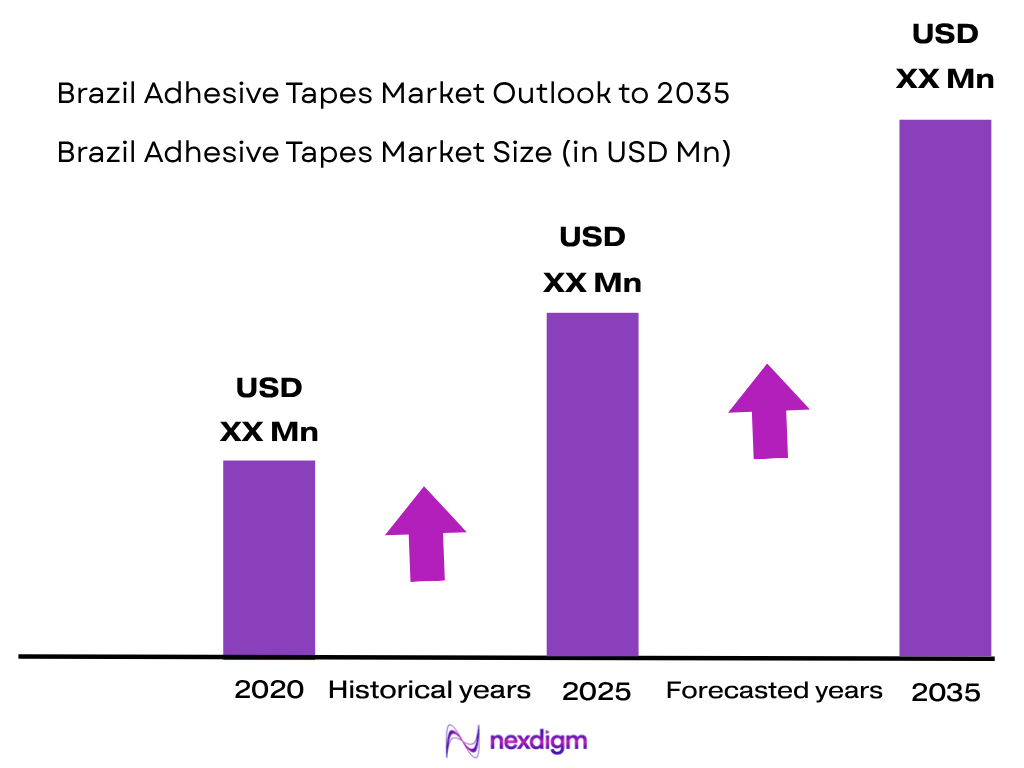
The Brazil Adhesive Tapes Market is valued at ~USD XX million in 2025, compared with ~USD XX million in 2024, supported by demand from packaging, logistics, automotive, construction, electrical and electronics, furniture, healthcare, and industrial manufacturing applications. Brazil’s large manufacturing base and expanding domestic consumption provide a broad demand platform for pressure-sensitive tapes. IBGE reported continued industrial activity across several tape-intensive manufacturing categories, while Brazil’s extensive retail and logistics infrastructure sustains recurring requirements for carton sealing, bundling, mounting, masking, splicing and surface protection tapes.
São Paulo represents the most important demand and manufacturing center for the Brazil Adhesive Tapes Market because it combines the country’s largest concentration of industrial companies, automotive operations, packaging converters, electronics businesses, construction activity and distribution infrastructure. Other important demand centers include Campinas, Curitiba, Joinville, Belo Horizonte, Rio de Janeiro, Porto Alegre and Manaus, where automotive, machinery, consumer goods, electronics, food processing and industrial production generate application-specific tape demand. The concentration of converters and industrial buyers enables shorter supply chains and technical-sales coverage.
Market Segmentation
By Adhesive Technology
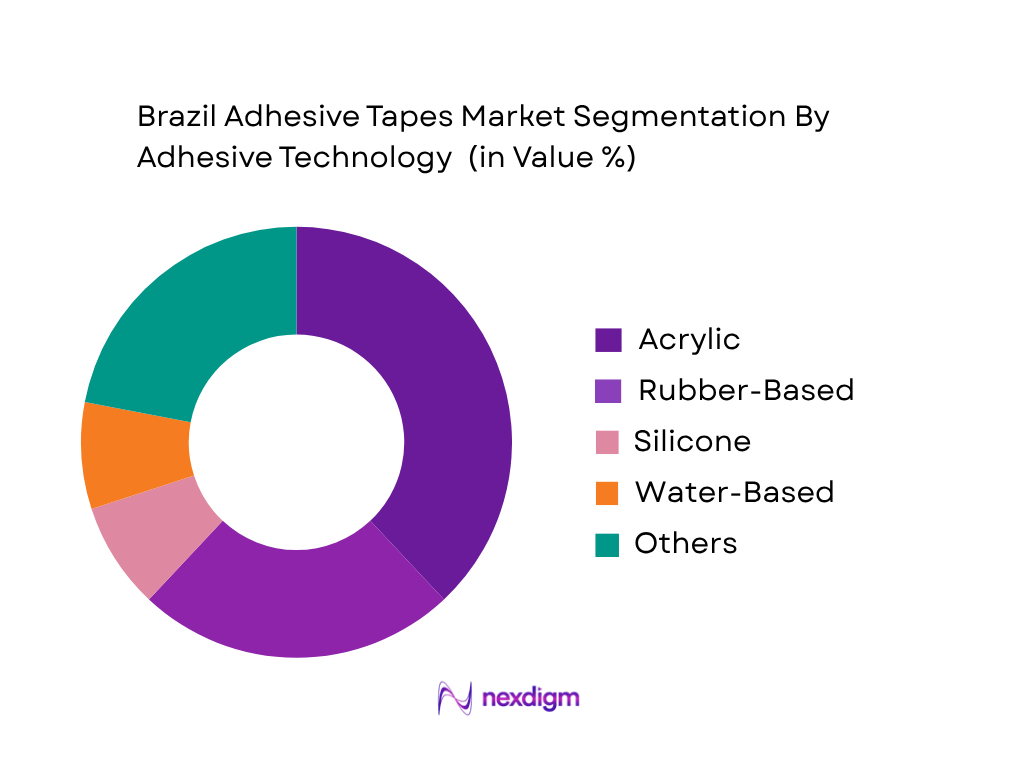
The Brazil Adhesive Tapes Market is segmented by adhesive technology into acrylic, rubber-based, silicone, water-based, solvent-based, hot-melt, and reactive/specialty adhesive systems. Acrylic adhesive tapes are expected to represent the dominant technology, supported by their broad compatibility with packaging, automotive, construction, electronics and industrial applications. Acrylic systems offer a combination of adhesion, aging resistance, UV stability and temperature performance that allows manufacturers to address both general-purpose and higher-performance applications. Their suitability for permanent bonding is particularly relevant as Brazilian manufacturers increasingly use tapes as alternatives to mechanical fastening, welding and liquid adhesives. Rubber-based technologies remain important in packaging and general industrial applications because of their high initial tack, while silicone technologies serve demanding temperature and specialty applications. Water-based and hot-melt systems benefit from manufacturing-process efficiency and environmental considerations. Solvent-based systems retain relevance where high adhesion and specialized performance are required. The growing use of double-sided, foam and transfer tapes further supports acrylic chemistry because these formats can provide controlled bonding thickness, high shear performance and clean application across multiple substrates.
By End-Use Industry
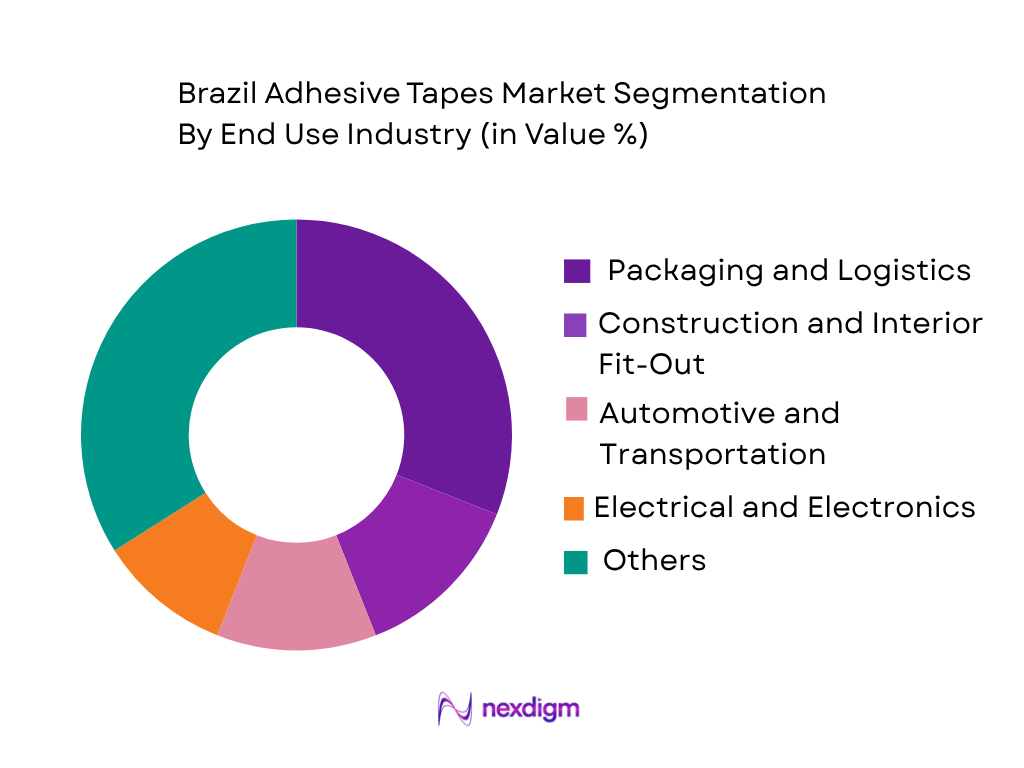
The Brazil Adhesive Tapes Market is segmented by end-use industry into packaging and logistics, construction and interior fit-out, automotive and transportation, electrical and electronics, HVAC and MEP, healthcare and pharmaceuticals, industrial manufacturing, aerospace and defense, furniture and interiors, food and beverage, and marine and specialty applications. Packaging and logistics are expected to remain the leading end-use segment because adhesive tapes are consumed repeatedly across carton sealing, bundling, palletizing, labeling, splicing and parcel fulfilment operations. Brazil’s extensive consumer-goods manufacturing base creates recurring packaging requirements, while modern distribution and e-commerce fulfilment increase the need for reliable carton-sealing and protective tapes. Automotive manufacturing is another significant application because tapes are increasingly used for trim attachment, wire management, emblem mounting, component bonding and noise-control applications. Construction demand supports masking, mounting, insulation and surface-protection tapes. Electronics and electrical applications favor higher-performance tapes requiring controlled thickness, dielectric properties and thermal resistance. Industrial manufacturing uses tapes for assembly, splicing, protection and process applications. Premium growth is expected to come from EV components, electronics, renewable energy, HVAC systems and specialty industrial assembly, where performance requirements are more demanding than conventional packaging applications.
Competitive Landscape
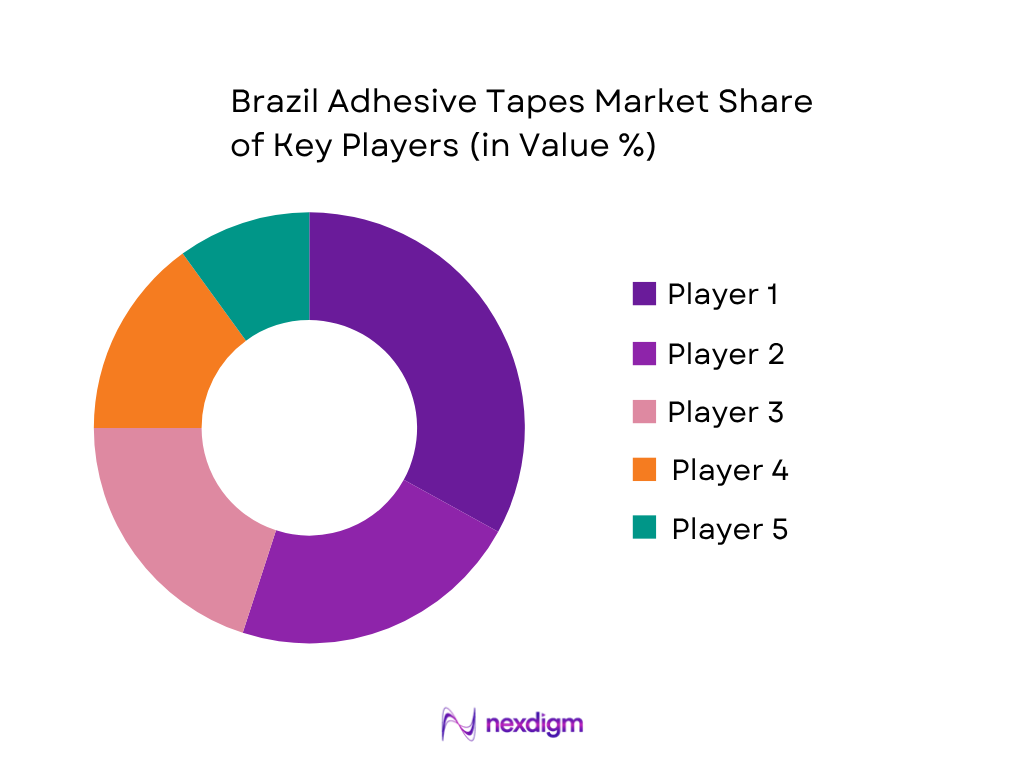
The Brazil Adhesive Tapes Market is characterized by the presence of multinational adhesive-material companies, global specialty-tape manufacturers, packaging-tape suppliers and domestic converters. Companies such as 3M, tesa, Avery Dennison, Nitto Denko and Saint-Gobain compete through broad product portfolios, technical support, application engineering and relationships with major industrial customers. Brazilian specialists and converters complement multinational suppliers by serving regional packaging, construction, industrial and customized-tape requirements. Competition increasingly centers on adhesive performance, local availability, customization, OEM qualification, technical service and the ability to supply specialty tapes rather than solely on commodity tape pricing.
| Company | Established | Headquarters | Key Tape Portfolio | Key End-Use Strength | Brazil Presence | Manufacturing / Converting Capability | Financial Data |
| 3M | 1902 | St. Paul, USA | ~ | ~ | ~ | ~ | ~ |
| tesa SE | 1941 | Norderstedt, Germany | ~ | ~ | ~ | ~ | ~ |
| Avery Dennison | 1935 | Mentor, USA | ~ | ~ | ~ | ~ | ~ |
| Nitto Denko | 1918 | Osaka, Japan | ~ | ~ | ~ | ~ | ~ |
| Saint-Gobain | 1665 | Paris, France | ~ | ~ | ~ | ~ | ~ |
Brazil Adhesive Tapes Market Analysis
Growth Drivers
Packaging and E-Commerce Fulfilment
Packaging and logistics remain a core demand engine for the Brazil Adhesive Tapes Market because pressure-sensitive tapes are consumed continuously in carton sealing, bundling, palletizing, splicing, labeling, parcel protection and automated fulfilment. Brazil’s industrial production increased 3.1% in 2024, according to IBGE, with particularly relevant gains in cellulose, paper and paper products of 2.8%, food products of 1.5%, furniture of 9.5%, and rubber and plastic products of 5.1%. These manufacturing activities directly increase the number of packaged goods requiring tape-based secondary packaging and unitization. IBGE also recorded R$11.7 trillion in Brazilian GDP in 2024, while household consumption expenditure reached approximately R$7.5 trillion, indicating a large underlying flow of consumer goods through retail and distribution networks. Internet penetration reached 84% of the population in 2024, according to the World Bank, supporting the digital-commerce ecosystem that generates parcel-level packaging requirements. For adhesive tape suppliers, the opportunity extends beyond conventional BOPP carton-sealing products toward reinforced tapes, printed tapes, tamper-evident solutions, sustainable paper tapes and automated-application formats. The continued development of fulfillment centers and distribution operations also increases requirements for consistent unwind performance, adhesion to recycled corrugated board, high-speed application and reliable holding strength. Consequently, packaging growth provides Brazil’s adhesive-tape industry with a recurring-volume base while e-commerce and automated logistics create an avenue for higher-performance tape solutions.
Automotive Production, Industrial Manufacturing and Construction Activity
Brazil’s industrial expansion provides a broad application base for adhesive tapes across automotive assembly, machinery manufacturing, electrical equipment, furniture, construction materials and industrial component production. IBGE reported that Brazilian industrial output expanded 3.1% in 2024, while vehicle manufacturing increased 12.5%, computer equipment and electronic and optical products increased 14.7%, electrical machinery and apparatus increased 12.2%, machinery and equipment increased 2.8%, and furniture increased 9.5%. These figures are particularly relevant because each industry consumes specialized tape formats for mounting, wire management, masking, insulation, component fixation, surface protection, splicing and lightweight assembly. Construction provides another substantial demand pool: IBGE’s Annual Survey of Construction Industry reported that the sector generated R$522.5 billion in developments, works and services in 2024 and employed approximately 2.5 million people. Brazil’s gross fixed capital formation also reached roughly R$2.0 trillion in 2024, while the investment rate was 17.0% of GDP, according to IBGE. Such investment supports machinery, factories, buildings, infrastructure and equipment installations where mounting, masking, insulation and sealing tapes are used. The combination of manufacturing expansion and construction investment is therefore shifting demand from simple packaging tapes toward double-sided, foam, electrical, HVAC, masking and high-shear industrial products. Tape manufacturers capable of supplying application-specific products, technical support and customized converting can benefit from this expanding industrial consumption base.
Market Challenges
Imported Master-Roll Dependency, Polymer Feedstock Exposure and Adhesive Chemistry Dependency
Brazil’s adhesive-tape supply chain remains exposed to international sourcing for specialized films, polymers, adhesive chemicals, release liners and master rolls, creating a structural challenge for manufacturers and converters that rely on imported inputs. Brazil’s official Comex Stat system, maintained by the Ministry of Development, Industry, Foreign Trade and Services, records import and export flows at detailed NCM-product levels and provides the basis for monitoring dependence on foreign industrial materials. The broader industrial trade environment illustrates the importance of this exposure: IBGE reported that Brazilian imports of goods and services increased 16.0% in the fourth quarter of 2024, with electrical machinery and apparatus, chemicals, machinery and equipment and metal products among the categories contributing to import growth. The IMF’s Brazil assessment reported merchandise imports of approximately USD267.4 billion in its 2024 projection framework, demonstrating the scale of Brazil’s external industrial-input exposure. At the same time, the World Bank recorded foreign direct investment inflows equivalent to 3.4% of GDP in 2024, indicating continued integration with global capital and supply chains. For adhesive tapes, imported acrylic monomers, synthetic rubber components, silicone chemistry, specialty films and release materials can therefore create procurement vulnerabilities when international logistics, foreign exchange or supplier availability changes. The challenge is particularly significant for electronics, automotive and high-performance industrial tapes because qualification requirements restrict rapid substitution between adhesive chemistries. Local converters may be able to convert imported jumbo rolls domestically, but this does not fully eliminate upstream exposure. The strategic implication is a need for dual sourcing, local inventory buffers, supplier qualification and gradual development of domestic specialty-material capabilities.
Exchange-Rate Exposure, Technical Qualification Requirements and Commodity-Tape Competition
Currency volatility creates an additional challenge for the Brazil Adhesive Tapes Market because imported adhesive raw materials, films, specialty master rolls and finished tapes are generally exposed to international currencies. The IMF’s Brazil country assessment noted that the Brazilian real had depreciated approximately 4.5% against the US dollar from December 2023 to May 2024, illustrating how exchange-rate movements can affect imported industrial inputs. Brazil’s inflation environment also remained relevant, with the IMF reporting headline inflation of 3.9% year-on-year in May 2024. These macroeconomic conditions can complicate procurement planning for tape manufacturers while customers simultaneously demand predictable supply and performance. Technical qualification creates another barrier, particularly in automotive, electronics, aerospace, electrical and industrial applications. A tape used for vehicle trim, battery components, wire harnessing or electronic assembly must satisfy specific requirements for peel strength, shear performance, temperature resistance, aging, chemical resistance and substrate compatibility. Replacing a qualified tape with a lower-cost alternative can require application testing and customer approval, slowing switching and increasing development requirements. At the commodity end of the market, however, purchasing decisions remain strongly price-sensitive, especially for conventional carton-sealing, masking and general-purpose tapes. This creates a two-speed competitive structure: specialty applications reward technical differentiation, whereas commodity products face intense price pressure. The challenge for suppliers is therefore to avoid competing solely on price while maintaining sufficient scale and conversion efficiency to remain competitive in high-volume applications.
Market Opportunities
EV Manufacturing, Electronics Assembly and Semiconductor-Related Components
The expansion of Brazil’s advanced manufacturing ecosystem creates an opportunity for adhesive-tape suppliers to move toward higher-value bonding, insulation, masking and component-assembly applications. IBGE reported that production of computer equipment, electronic and optical products increased 14.7% in 2024, while electrical machinery and apparatus increased 12.2% and motor vehicles, trailers and bodies increased 12.5%. These industries require considerably more specialized tape performance than conventional packaging applications, including controlled thickness, high dielectric strength, thermal stability, low outgassing, clean removal, dimensional stability and resistance to automotive fluids. Brazil’s wider industrial base also expanded 3.1% in 2024, demonstrating a favorable environment for industrial tape adoption. The opportunity is particularly relevant to EV-related manufacturing because battery packs, thermal-management systems, charging equipment, wire harnesses and lightweight vehicle components can use double-sided, foam, insulating, conductive and protective tapes. Semiconductor and electronics applications similarly create demand for precision masking, die-cut components, wafer-processing support, component protection and high-temperature bonding. Although Brazil’s semiconductor ecosystem is smaller than those of major Asian manufacturing hubs, its electronics production infrastructure and government focus on technological development provide a pathway for specialized adhesive solutions. The addressable opportunity is therefore not limited to finished tape rolls; precision converting, die-cut adhesive components and application-engineered assemblies can provide higher-value offerings. Suppliers that establish local technical support and qualification capabilities can position themselves closer to OEMs and Tier-1 manufacturers, improving their ability to capture advanced applications as Brazil’s electronics, automotive and electrical manufacturing base develops.
Sustainable Packaging, Low-VOC Adhesives, Precision Converting and Renewable Energy
Sustainability and industrial automation create several adjacent opportunities for Brazil’s adhesive-tape suppliers, particularly in recyclable packaging, low-VOC chemistry, specialty converting and renewable-energy applications. Brazil’s electricity system provides a strong foundation for renewable-energy-related tape demand: EPE reported that solar photovoltaic generation reached 70.7 TWh in 2024, while installed solar capacity reached 48,468 MW. Wind generation reached 107.7 TWh, with installed wind capacity of 29,550 MW. The Ministry of Mines and Energy also reported that Brazil added 10,853.35 MW of electricity-generation capacity during 2024 through 301 new plants, providing a significant pipeline of equipment and infrastructure installations requiring electrical insulation, bundling, component mounting, protection and sealing solutions. At the packaging level, Brazil’s industrial production of pulp, paper and paper products increased 2.8% in 2024, according to IBGE, creating an important substrate ecosystem for paper-based and recyclable packaging solutions. Sustainable tape development can therefore focus on paper backings, solvent-reduced adhesives, water-based systems and constructions designed to improve compatibility with recycling processes. Precision converting represents another opportunity because customers increasingly require narrow-width rolls, laminated structures, die-cut parts and customized adhesive geometries rather than standard rolls. Industrial automation can increase demand for tapes that operate reliably on high-speed application equipment and deliver consistent unwind and adhesion characteristics. These opportunities allow suppliers to move beyond commodity carton-sealing products into application-engineered solutions serving renewable energy, automated packaging, electronics, construction and industrial assembly.
Future Outlook
The Brazil Adhesive Tapes Market is expected to expand through increasing industrial automation, packaging consumption, infrastructure development and adoption of lightweight bonding technologies. Demand is likely to shift gradually toward double-sided, foam, acrylic, specialty and application-engineered tapes. Automotive electrification, electronics manufacturing, renewable-energy installations and HVAC development are expected to create additional requirements for technically differentiated products. Sustainability considerations will also encourage water-based, hot-melt, low-VOC and recyclable tape solutions, while domestic converting can improve supply responsiveness and customization.
Growth is expected to be particularly relevant in EV and battery assembly, electronics, industrial automation, solar applications, sustainable packaging, HVAC insulation and high-performance construction bonding. Suppliers able to combine local inventory with application engineering and customized converting are positioned to capture higher-value industrial applications.
Major Players
- 3M Company
- tesa SE
- Avery Dennison Corporation
- Nitto Denko Corporation
- Saint-Gobain
- LINTEC Corporation
- Lohmann GmbH & Co. KG
- Intertape Polymer Group
- Berry Global
- Nichiban Co., Ltd.
- GERGONNE
- Sicad Group / Eurocel
- ADERE
- Adelbras
- FIT-PEL
Key Target Audience
- Adhesive Tape Manufacturers and Converters
- Packaging and Flexible-Packaging Manufacturers
- Automotive OEMs and Tier-1/Tier-2 Component Manufacturers
- Electronics, Electrical and Precision-Assembly Manufacturers
- Construction Materials, HVAC and MEP Suppliers
- Investments and Venture Capitalist Firms
- Government and Regulatory Bodies (ANVISA, IBAMA, INMETRO, Ministério do Desenvolvimento, Indústria, Comércio e Serviços)
- Industrial Procurement, Supply-Chain and Strategic Sourcing Departments
Research Methodology
Step 1: Identification of Key Variables
The initial stage develops an ecosystem map covering adhesive-tape manufacturers, master-roll suppliers, adhesive formulators, film and backing suppliers, converters, distributors and major end users. Variables include tape consumption, adhesive technology, backing material, conversion activity, imports, exports, industrial production and end-use demand.
Step 2: Market Analysis and Construction
Historical market information is compiled through production, trade, industrial-output and end-use indicators. The assessment separates domestic production, imported finished tapes, imported master rolls and locally converted products to avoid double counting and establishes demand estimates across packaging, automotive, construction, electronics and industrial applications.
Step 3: Hypothesis Validation and Expert Consultation
Market hypotheses are validated through discussions with adhesive manufacturers, converters, distributors, procurement professionals and industrial users. Interviews focus on technology adoption, product qualification, sourcing patterns, application requirements, imported-material dependence and shifts from conventional fastening toward pressure-sensitive bonding.
Step 4: Research Synthesis and Final Output
The final analysis triangulates bottom-up consumption estimates with supply-side information, trade data and industrial indicators. Company-level information is reviewed against product portfolios, manufacturing capabilities, application coverage and financial disclosures to produce a consolidated view of market structure, competitive positioning and future opportunities.

- Executive Summary
- Research Methodology (Market Definition and Scope, Adhesive Tape Taxonomy, HS-Code Mapping, Top-Down Market Sizing, Bottom-Up Demand Reconstruction, Domestic Production Assessment, Import–Export Reconciliation, Consumption Build-Up, Demand-Side Analysis, Supply-Side Analysis, Primary Industry Interviews, Manufacturer Validation, Distributor Mapping, Data Triangulation, Forecasting Framework, Scenario Analysis, Sensitivity Analysis, Research Limitations)

- Definition and Scope
- Evolution of the Brazilian Adhesive Tapes Industry
- Adhesive Tape Industry Structure and Ecosystem
- Brazil Adhesive Tape Value Chain
- Domestic Manufacturing Landscape
- Adhesive Tape Production and Conversion Infrastructure
- Brazil Adhesive Tape Import–Export Landscape

- Growth Drivers (Packaging and E-Commerce Fulfilment, Automotive Production, Industrial Manufacturing, Construction Activity, Consumer Goods Production, Logistics Expansion, Electronics Assembly, HVAC Installation)
- Market Challenges (Imported Master-Roll Dependency, Polymer Feedstock Exposure, Adhesive Chemistry Dependency, Exchange-Rate Exposure, Production Costs, Technical Qualification Requirements, Commodity-Tape Competition, Supply-Chain Volatility)
- Market Opportunities (EV Manufacturing, Electronics Assembly, Semiconductor Components, Sustainable Packaging, High-Performance Acrylic Foam, Low-VOC Adhesives, Precision Converting, Renewable Energy, Industrial Automation)
- Adhesive Technology Trends (Acrylic Chemistry, Silicone Systems, Hot-Melt Adhesives, Water-Based Systems, Low-VOC Formulation, High-Temperature Performance, Functional Adhesives)
- Regulatory Framework (ANVISA, IBAMA, CONAMA, ABNT Standards, Chemical Safety, Product Labelling, Workplace Safety, Environmental Compliance)
- SWOT Analysis
- Porter’s Five Forces Analysis
- PESTLE Analysis

- By Market Value (2026-2035)
- By Tape Consumption Volume (2026-2035)
- By Average Selling Price (2026-2035)
- By Domestic Production Volume (2026-2035)
- By Import Volume (2026-2035)
- By Export Volume (2026-2035)
- By Domestic Consumption (2026-2035)
- By Industrial Tape Consumption (2026-2035)

- By Adhesive Technology ( in value % )
Acrylic Adhesive Tapes
Rubber-Based Adhesive Tapes
Silicone Adhesive Tapes
Water-Based Adhesive Tapes
Solvent-Based Adhesive Tapes
Hot-Melt Adhesive Tapes
Reactive and Specialty Adhesive Tapes - By Backing Material ( in value % )
BOPP Tapes
PVC Tapes
PET Tapes
PE Tapes
Paper-Based Tapes
Nonwoven Tapes
Foam Tapes
Polyimide Tapes
Aluminum Foil Tapes
Fabric and Specialty Film Tapes - By Tape Construction (in value %)
Single-Sided Tapes
Double-Sided Tapes
Transfer Tapes
Foam Tapes
Filament-Reinforced Tapes
Masking Tapes
Protective Tapes
Electrical Insulation Tapes
Functional Specialty Tapes - By Product Format ( in value % )
Jumbo Rolls
Slit Rolls
Narrow-Width Industrial Rolls
Adhesive Sheets
Laminated Tape Structures
Die-Cut Adhesive Components
Customized Converted Tape Products - By End-Use Industry ( in value % )
Packaging and Logistics
Construction and Interior Fit-Out
Automotive and Transportation
Electrical and Electronics
HVAC and MEP
Healthcare and Pharmaceuticals
Industrial Manufacturing
Aerospace and Defense
Furniture and Interiors
Food and Beverage
Marine and Specialty Applications - By Application ( in value % )
Carton Sealing and Case Closing
Permanent Mounting and Bonding
Splicing and Web Joining
Masking and Surface Protection
Electrical Insulation and Wire Management
Component Assembly
Lamination and Composite Bonding
Labelling and Graphic Applications
Packaging Reinforcement
HVAC Insulation and Sealing

- Market Share of Major Players (By Value, Volume, Adhesive Technology, Backing Material, Tape Construction, End-Use Industry, Application, Distribution Channel)
- Cross Comparison Parameters (Adhesive Technology Breadth, Tape Construction Portfolio, Automotive OEM Qualification Capability, Electronics-Grade Product Capability, Brazilian Manufacturing Footprint, Precision Converting Capability, Distribution Network Reach, R&D and Product Innovation Capability)
- Pricing and Product Positioning (Commodity Packaging Tapes, General Industrial Tapes, Premium Industrial Tapes, Automotive Tapes, Electronics Tapes, Specialty Functional Tapes)
- SWOT Analysis of Major Players
- Detailed Profiles of Major Companies
3M Company
tesa SE
Avery Dennison Corporation
Nitto Denko Corporation
LINTEC Corporation
Saint-Gobain
Lohmann GmbH & Co. KG
Intertape Polymer Group
Berry Global
Nichiban Co., Ltd.
GERGONNE
Sicad Group / Eurocel
ADERE
Adelbras
FIT-PEL

- Packaging and Logistics End-User Assessment
- Automotive and Transportation End-User Assessment
- Electrical, Electronics and Technology End-User Assessment
- Construction and Infrastructure End-User Assessment
- Industrial Manufacturing End-User Assessment
- Healthcare and Pharmaceutical End-User Assessment
- Food and Beverage End-User Assessment

- By Market Value (2026-2035)
- By Tape Consumption Volume (2026-2035)
- By Average Selling Price (2026-2035)
- By Domestic Production Volume (2026-2035)
- By Import Volume (2026-2035)
- By Export Volume (2026-2035)
- By Domestic Consumption (2026-2035)


 Request a Sample
 Ask for Customization
 Get a Quote
 Enquire Now