
 Download PDF
 Download PDF
Market Overview
Brazil agricultural equipment market reached approximately USD ~ billion based on a recent historical assessment, supported by strong mechanization demand in soybean, corn, and sugarcane cultivation regions. The market is driven by expanding large-scale agribusiness operations, increased adoption of precision farming technologies, and favorable rural credit programs that enable equipment acquisition. High-capacity tractors and harvesters dominate sales due to Brazil’s extensive farm sizes and export-oriented agricultural production systems, which require advanced machinery to enhance productivity and operational efficiency.
São Paulo, Mato Grosso, and Paraná dominate the Brazil agricultural equipment market due to concentration of large commercial farms, agro-industrial processing clusters, and established dealer networks. These regions benefit from advanced logistics corridors and strong agribusiness investment, enabling higher mechanization intensity compared with other states. Brazil leads Latin America in agricultural machinery demand because of vast arable land, large-scale commodity exports, and government-supported financing programs that stimulate farm equipment purchases across commercial agriculture zones.
Market Segmentation
By Product Type:
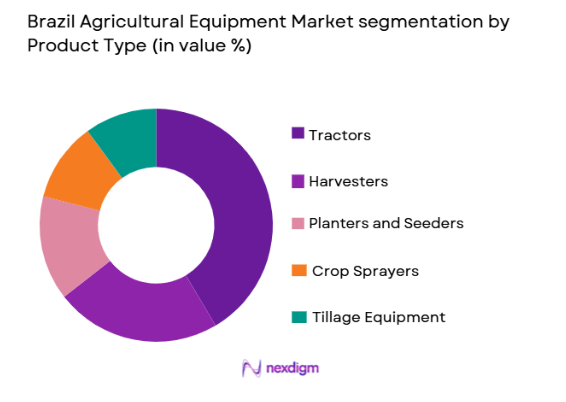
Brazil Agricultural Equipment market is segmented by product type into tractors, harvesters, planters and seeders, crop sprayers, and tillage equipment. Recently, tractors has a dominant market share due to factors such as demand patterns, brand presence, infrastructure availability, or consumer preference. Large-scale soybean and corn farms require high-horsepower tractors for plowing, planting, and hauling operations across extensive fields, making them essential multipurpose machines. Strong domestic manufacturing presence and dealer support networks also reinforce tractor dominance, while government-backed rural credit programs prioritize tractor financing. Additionally, increasing adoption of precision guidance systems integrated into tractors enhances productivity and fuel efficiency, further driving demand among commercial agribusiness operators across Brazil’s mechanized farming regions.
By Application:
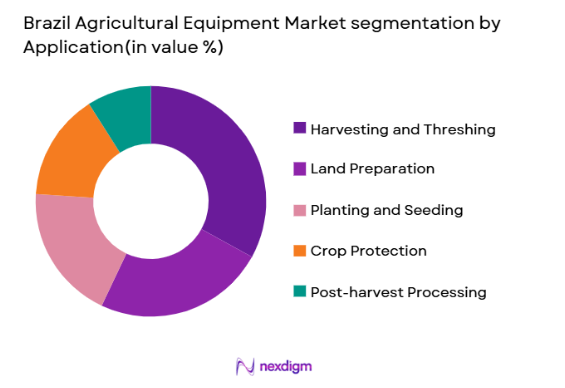
Brazil Agricultural Equipment market is segmented by application into land preparation, planting and seeding, crop protection, harvesting and threshing, and post-harvest processing. Recently, harvesting and threshing has a dominant market share due to factors such as demand patterns, brand presence, infrastructure availability, or consumer preference. Brazil’s export-oriented crops such as soybean, sugarcane, and corn require large-scale mechanized harvesting to manage vast cultivated areas within short seasonal windows. Combine harvesters and sugarcane harvesters are critical to maintain yield quality and reduce labor dependency, especially amid rural workforce shortages. High capital investment in harvesting equipment by agribusiness plantations and cooperatives reinforces this segment’s dominance, supported by technological advancements in automated harvesting systems improving operational efficiency and throughput.
Competitive Landscape
Brazil agricultural equipment market is moderately consolidated, with global manufacturers and domestic specialists competing through localized production, dealer networks, and precision technology integration. Multinational firms dominate high-horsepower and advanced machinery segments, while Brazilian companies focus on implements and niche equipment adapted to local crops. Strategic partnerships with dealers and financing institutions strengthen market reach, and product differentiation increasingly relies on digital agriculture solutions and automation capabilities tailored to large-scale farming operations.
| Company Name | Establishment Year | Headquarters | Technology Focus | Market Reach | Key Products | Revenue | Local Manufacturing Presence |
| John Deere | 1837 | USA | ~ | ~ | ~ | ~ | ~ |
| CNH Industrial | 2013 | UK | ~ | ~ | ~ | ~ | ~ |
| AGCO Corporation | 1990 | USA | ~ | ~ | ~ | ~ | ~ |
| Kubota Corporation | 1890 | Japan | ~ | ~ | ~ | ~ | ~ |
| Mahindra & Mahindra | 1945 | India | ~ | ~ | ~ | ~ | ~ |
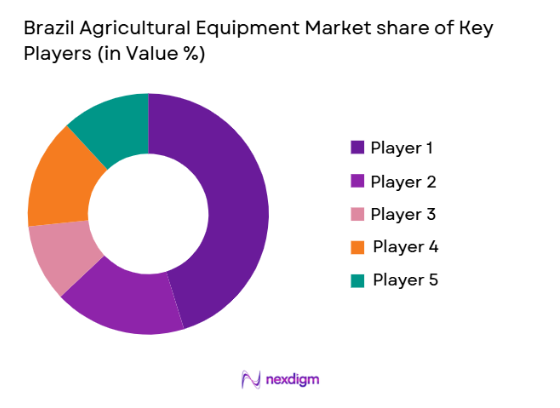
Brazil Agricultural Equipment Market Analysis
Growth Drivers
Expansion of Large-Scale Mechanized Agribusiness Operations:
Brazil’s agricultural structure is characterized by extensive commercial farms producing export commodities such as soybean, corn, and sugarcane, creating sustained demand for high-capacity machinery. These farms require advanced tractors, harvesters, and precision implements to manage thousands of hectares efficiently and maintain competitiveness in global commodity markets. Continuous expansion of cultivated land in frontier agricultural regions further reinforces equipment adoption as new areas are developed for mechanized farming. Agribusiness corporations increasingly invest in fleet modernization to improve yield, reduce operating costs, and optimize resource utilization through automation and digital monitoring technologies. Mechanization also compensates for labor scarcity in rural areas, ensuring timely planting and harvesting across large production cycles. Integration of precision agriculture features into machinery enhances operational efficiency and supports data-driven farm management, encouraging replacement of older equipment. Export-oriented production systems emphasize productivity and consistency, further driving demand for technologically advanced agricultural equipment. Government-supported credit programs for farm mechanization lower financing barriers for large producers, accelerating equipment acquisition. As Brazil strengthens its position as a leading global food supplier, mechanized agribusiness expansion remains a core structural driver of agricultural equipment demand.
Adoption of Precision Agriculture and Smart Farming Technologies: Brazilian
agriculture is rapidly incorporating digital technologies such as GPS guidance, telematics, and variable-rate application systems into farm machinery to enhance productivity. Precision agriculture enables optimized input usage, reduced environmental impact, and improved crop yields across large mechanized farms. Equipment integrated with sensors and connectivity allows real-time monitoring of field conditions and machinery performance, improving operational planning and maintenance efficiency. Farmers increasingly recognize the economic benefits of data-driven cultivation practices, encouraging investment in technologically advanced equipment platforms. Multinational manufacturers actively localize smart machinery solutions for Brazilian crop patterns and terrain conditions, supporting adoption. Government initiatives promoting sustainable agriculture and efficient resource use also favor precision technology deployment. The availability of retrofit kits allows existing machinery fleets to upgrade to precision capabilities, expanding market penetration. Digital integration across farm operations creates long-term productivity gains, strengthening return on investment for equipment purchases. As agribusiness operations scale further, precision technologies become essential for competitiveness, reinforcing sustained demand for technologically advanced agricultural machinery across Brazil.
Market Challenges
High Capital Cost and Financing Constraints for Advanced Machinery:
Agricultural equipment in Brazil, particularly high-horsepower tractors and harvesters with precision technology integration, involves substantial upfront investment, limiting accessibility for many farmers. Although large agribusinesses can finance machinery purchases through credit programs, mid-size and smaller producers often face financial constraints. Interest rate volatility and macroeconomic uncertainty can reduce farmer confidence in long-term capital investments, delaying equipment replacement cycles. Imported components and currency fluctuations also increase machinery prices, further elevating acquisition costs. Financing schemes may prioritize certain equipment categories, creating uneven access across segments and regions. Maintenance and operational costs associated with advanced machinery add to total ownership expenses, influencing purchase decisions. Rural credit availability varies by region, leading to disparities in mechanization levels across Brazil’s agricultural landscape. Limited collateral among smaller farmers restricts their eligibility for equipment financing programs. Consequently, high capital intensity remains a structural barrier to broader mechanization adoption in the Brazilian agricultural equipment market.
Infrastructure and Service Limitations in Remote Agricultural Regions:
Brazil’s major agricultural expansion zones are often located in remote frontier regions with limited transport infrastructure and technical service networks, affecting machinery utilization and maintenance. Poor road connectivity increases logistics costs for equipment delivery and spare parts distribution, delaying operational readiness. Dealers and service centers are concentrated in established agricultural states, leaving newer farming areas underserved in technical support. Downtime caused by delayed repairs can significantly impact farm productivity during critical planting and harvesting periods. Farmers operating in remote zones may hesitate to invest in complex machinery due to uncertainty regarding maintenance availability. Transporting large equipment for servicing adds operational costs and logistical complexity, especially in regions lacking heavy-equipment facilities. Infrastructure constraints also limit demonstration and training opportunities for advanced technologies, slowing adoption rates. Seasonal weather conditions and terrain challenges further complicate equipment movement and servicing access. These structural limitations hinder efficient machinery deployment and create regional disparities in agricultural mechanization across Brazil.
Opportunities
Expansion of Sustainable and Low-Emission Agricultural Machinery Solutions:
Increasing environmental awareness and regulatory emphasis on sustainable farming create opportunities for low-emission and energy-efficient agricultural equipment in Brazil. Manufacturers are developing electric, hybrid, and fuel-efficient machinery platforms that reduce greenhouse gas emissions and operating costs for farmers. Sustainable equipment aligns with global agribusiness supply chain requirements emphasizing environmental compliance and responsible production. Adoption of low-emission machinery also supports Brazil’s climate commitments and agricultural sustainability initiatives. Government incentives and financing programs promoting clean technologies can accelerate adoption across commercial farms. Precision agriculture integration with sustainable machinery enhances resource efficiency and reduces input waste. Large export-oriented agribusinesses increasingly prioritize environmental certification, driving demand for environmentally advanced equipment. Localization of sustainable machinery production can reduce costs and improve accessibility in Brazil. As sustainability becomes central to agricultural competitiveness, environmentally optimized equipment solutions present significant growth potential within the Brazilian agricultural machinery market.
Development of Equipment Rental and Shared Mechanization Platforms:
Brazil’s diverse farm structure, including many mid-size and smallholder producers, creates demand for alternative machinery access models such as rental and shared equipment platforms. Equipment-as-a-service models enable farmers to utilize advanced machinery without large capital investment, expanding mechanization access. Cooperative ownership and rental services allow cost-effective utilization of high-value equipment such as harvesters and sprayers during peak seasons. Digital platforms facilitating equipment sharing improve utilization efficiency and scheduling transparency across farming communities. Manufacturers and dealers can diversify revenue streams by offering rental fleets and service contracts. Government and cooperative programs supporting shared mechanization enhance rural productivity and technology adoption. Rental models also accelerate exposure to advanced machinery technologies among smaller producers, stimulating future purchase demand. Seasonal agricultural cycles align well with shared equipment utilization across regions. As mechanization demand grows beyond large agribusinesses, rental and shared platforms represent a scalable opportunity to expand agricultural equipment adoption across Brazil’s broader farming base.
Future Outlook
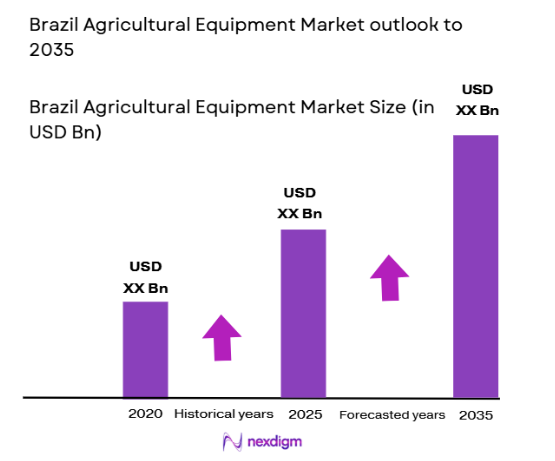
Brazil agricultural equipment market is expected to expand steadily over the next five years, supported by continued mechanization of large-scale farming and rising adoption of precision technologies. Technological advancements in automation, telematics, and sustainable machinery will reshape equipment portfolios and productivity standards. Government financing programs and sustainability initiatives will encourage modernization of farm machinery fleets. Growing export-oriented agriculture and expansion into new cultivation regions will further stimulate demand for advanced agricultural equipment across Brazil.
Major Players
- John Deere
- CNH Industrial
- AGCO Corporation
- Kubota Corporation
- Mahindra & Mahindra
- Valtra
- New Holland Agriculture
- Massey Ferguson
- Stara
- Jacto
- Tatu Marchesan
- Baldan Implementos Agrícolas
- Agrale
- Kuhn Group
- Case IH
Key Target Audience
- Agricultural equipment manufacturers
- Agribusiness corporations
- Farm equipment distributors
- Agricultural cooperatives
- Precision agriculture technology providers
- Equipment leasing and financing companies
- Investments and venture capitalist firms
- Government and regulatory bodies
Research Methodology
Step 1: Identification of Key Variables
Comprehensive identification of machinery categories, crop types, mechanization levels, and regional agricultural patterns influencing equipment demand across Brazil’s farming ecosystem.
Step 2: Market Analysis and Construction
Integration of production statistics, equipment sales data, trade flows, and mechanization trends to construct market sizing and segmentation frameworks for Brazil agricultural equipment.
Step 3: Hypothesis Validation and Expert Consultation
Validation through consultations with industry participants including manufacturers, dealers, agronomists, and agribusiness operators to ensure accuracy of demand drivers and technology trends.
Step 4: Research Synthesis and Final Output
Synthesis of quantitative and qualitative insights into structured market analysis covering segmentation, competitive dynamics, growth factors, and future outlook for Brazil agricultural equipment market.

- Executive Summary
- Research Methodology (Definitions, Scope, Industry Assumptions, Market Sizing Approach, Primary & Secondary Research Framework, Data Collection & Verification Protocol, Analytic Models & Forecast Methodology, Limitations & Research Validity Checks)

- Market Definition and Scope
- Value Chain & Stakeholder Ecosystem
- Regulatory / Certification Landscape
- Sector Dynamics Affecting Demand
- Strategic Initiatives & Infrastructure Growth

- Growth Drivers
Expansion of mechanized farming across large soybean and corn regions
Rising adoption of precision agriculture technologies in commercial farms
Government-supported rural credit and equipment financing schemes
Labor shortages accelerating demand for automated machinery
Growth in export-oriented agribusiness requiring productivity gains - Market Challenges
High upfront capital cost of advanced agricultural machinery
Volatility in commodity prices affecting farmer investment capacity
Limited technical service infrastructure in remote farming zones
Dependence on imported components and currency fluctuations
Fragmented smallholder market with low mechanization affordability - Market Opportunities
Electrification and low-emission machinery for sustainable farming
Expansion of precision agriculture services and retrofit solutions
Growth of rental and shared machinery platforms in rural areas - Trends
Integration of telematics and fleet management in farm equipment
Shift toward autonomous and semi-autonomous field operations
Increased demand for high-horsepower tractors in large farms
Adoption of variable rate and smart spraying technologies
Localization of equipment manufacturing within Brazil - Government Regulations & Defense Policy
National agricultural mechanization and rural credit policies
Emissions and environmental compliance standards for machinery
Local manufacturing incentives and import tariff structures - SWOT Analysis
- Stakeholder and Ecosystem Analysis
- Porter’s Five Forces Analysis
- Competition Intensity and Ecosystem Mapping

- By Market Value, 2020-2025
- By Installed Units, 2020-2025
- By Average System Price, 2020-2025
- By System Complexity Tier, 2020-2025

- By System Type (In Value%)
Tractors
Harvesters
Planters and Seeders
Crop Sprayers
Tillage Equipment - By Platform Type (In Value%)
Wheeled Equipment
Tracked Equipment
Autonomous Platforms
Mounted Implements
Self-Propelled Machinery - By Fitment Type (In Value%)
OEM Factory-Fitted Systems
Aftermarket Retrofit Kits
PTO-Driven Attachments
Hydraulic-Integrated Implements
ISOBUS-Compatible Systems - By EndUser Segment (In Value%)
Large Commercial Farms
Mid-Size Farms
Smallholder Farmers
Agricultural Cooperatives
Agro-Industrial Plantations - By Procurement Channel (In Value%)
Authorized Dealer Networks
Direct OEM Sales
Leasing and Equipment Financing
Government Subsidy Programs
Online Agricultural Marketplaces - By Material / Technology (in Value %)
Precision Agriculture GPS Guidance
Telematics and IoT Monitoring
Electric and Hybrid Drivetrains
Advanced Hydraulic Systems
High-Strength Steel and Composites

- Market structure and competitive positioning
- Market share snapshot of major players
- CrossComparison Parameters (Product Portfolio Breadth, Horsepower Range Coverage, Precision Technology Integration, Local Manufacturing Presence, Dealer Network Strength, Aftermarket Service Capability, Pricing Tier Positioning, Financing Solutions Availability, Export Capability, Brand Penetration in Brazil)
- SWOT Analysis of Key Players
- Pricing & Procurement Analysis
- Key Players
John Deere
CNH Industrial
AGCO Corporation
Kubota Corporation
Mahindra & Mahindra
Valtra
New Holland Agriculture
Massey Ferguson
Stara
Jacto
Tatu Marchesan
Baldan Implementos Agrícolas
Agrale
Kuhn Group
Case IH

- Large agribusiness farms driving demand for high-capacity machinery
- Cooperatives enabling shared equipment access for mid-size farmers
- Smallholders adopting low-cost and retrofit mechanization solutions
- Plantation agriculture requiring specialized harvesting systems

- Forecast Market Value, 2026-2035
- Forecast Installed Units, 2026-2035
- Price Forecast by System Tier, 2026-2035
- Future Demand by Platform, 2026-2035


 Request a Sample
 Ask for Customization
 Get a Quote
 Enquire Now